Hindu woman raped and pressured to convert to Islam; stripped naked, dragged by her hair, tied to a pole and brutally assaulted in a Muslim-majority village
 Siddharthnagar, Uttar Pradesh, India
 28 October, 2025
Case Summary
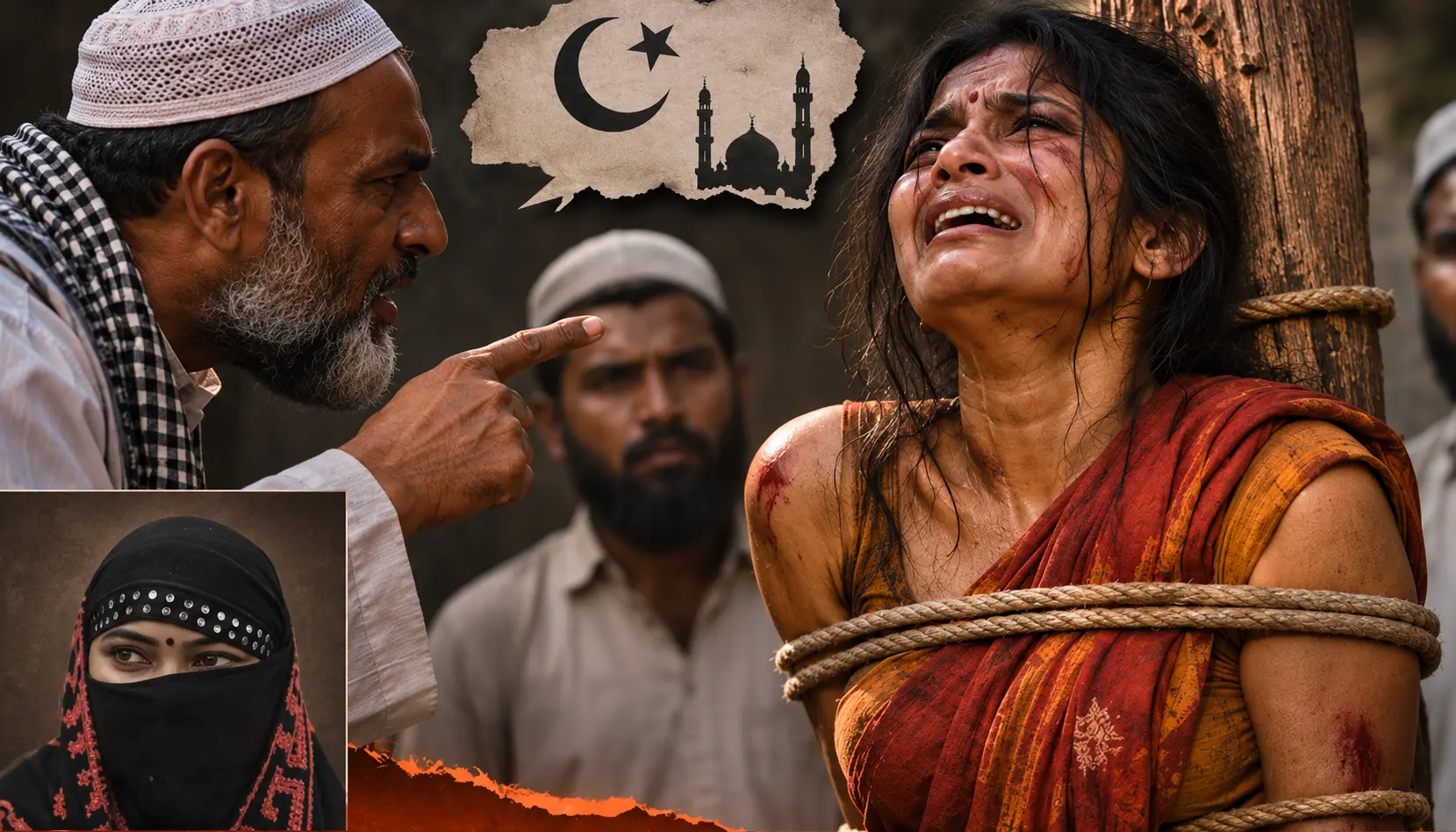
In the Muslim-majority Banhaiti village, in Siddharthnagar, Uttar Pradesh, a 28-year-old Hindu woman was gang-raped and pressured to convert to Islam by Muslim sarpanch Ahmed Hussain and his associates. The victim was also subjected to a brutal physical assault. She was stripped naked, dragged by her hair, tied to an electricity pole, and brutally assaulted for nearly three hours. The victim revealed that the Muslim-majority composition of the village had contributed to an atmosphere of intimidation for its Hindu residents. She stated that there had been multiple instances of Muslims mobilising and assaulting Hindus and creating an environment of fear in the village. According to media reports, Banhaiti village had a population of approximately 1,500 people, including around 150 Muslim households and only 15–20 Hindu families. The accused, Ahmed Hussain (50), was the village head (sarpanch) and operated a hospital from his residence, situated along the roadside on the outskirts of the village. The hospital's signboard carried the name of a doctor, Sudhakar Pandey. However, Ahmed also practised medicine there. The victim stated that Ahmed did not possess a medical degree and that the hospital was not registered. Ahmed lived in the village with his wife, Badrunnisha, four sons, Abdul Gani, Abdul Shami, Mohammad Salim and Mohammad Kaleem, and daughter Amina Khatun. He had also provided a separate house to a divorced woman, Rizwana Khatun, who lived there with her son Aslam. The 28-year-old Hindu victim lived in the village with her four children. She had married in 2019 and had a six-year-old son, while her husband had three children from his previous marriage, aged 13, 10 and 8. Her husband worked in Mumbai. In 2025, the woman developed blood pressure-related problems and began experiencing dizziness. She approached Ahmed's hospital to obtain medicines. According to the victim, Ahmed told her to return home and assured her that he would bring the medicines himself. He subsequently visited her house, administered a sedative injection and raped her. She further stated that Ahmed's sons also raped her repeatedly whenever they visited under the pretext of providing medical treatment. The woman initially did not realise that she had been sexually assaulted. However, one day, she developed severe stomach pain and underwent an ultrasound examination, which revealed that she was pregnant. Since her husband was away working in Mumbai and no outsider visited their house, she confronted Ahmed about the pregnancy. According to her complaint, Ahmed acknowledged that the unborn child was his and pressured her to convert to Islam, promising to accept the child if she embraced his religion. When she refused, the accused forcibly took her to a settlement and arranged for her abortion. The victim also stated that the accused had recorded obscene photographs and videos of her and repeatedly exploited her by threatening to circulate them. When the sexual exploitation and harassment became unbearable, she called her husband home. On 20 October 2026, she submitted a written complaint addressed to the Superintendent of Police (SP) by registered post. However, she stated that when the complaint was forwarded to the local police station for investigation, the police informed Ahmed Hussain about it instead of taking action against him. On 27 October 2026, at around 7 am, while the Hindu woman was preparing her children for school, Ahmed Hussain arrived at her house along with his sons Abdul Gani and Abdul Shami and others, including Aslam, Rizwana Khatun, Badrunnisha and approximately 20–25 associates. The accused forcibly entered her house, citing a personal grudge, and attacked her. The victim attempted to escape and sought refuge inside a neighbour's house. However, the attackers began breaking down the door. Frightened by the mob, the neighbour asked the Hindu woman to leave. The accused then dragged her out by her hair, stripped her naked, tied her to an electricity pole and brutally assaulted her with sticks, kicks and punches. The assault continued for nearly three hours, during which she was subjected to sexual violence and public humiliation. Despite other Hindu women from the village attempting to intervene, the attackers threatened them with violence. The victim stated that nobody came forward to rescue her because the villagers were afraid of the accused. Her husband subsequently called the police emergency number 100, following which police personnel arrived and freed her from the pole. The woman sustained severe injuries, with her entire body turning black due to the beatings. She stated that she was unable to walk because of the pain. The victim's complaint further stated that during the assault on 27 October 2026, the accused again pressured her to convert to Islam and threatened to kill her if she refused. Following the assault, the woman approached Khesraha police station seeking action against the perpetrators. However, she stated that the station house officer tore up and discarded her original written complaint in front of her. She further stated that the police recorded details without her consent and registered a case only under minor assault-related provisions instead of taking appropriate action against the accused. Despite the severity of her injuries, no medico-legal examination (MLC) was conducted, forcing the Hindu woman to preserve photographs and videos of her injuries as evidence. She also stated that the police had recorded a video showing her tied to the pole. On 28 October 2026, the victim visited the offices of the District Magistrate (DM) and Superintendent of Police to seek intervention but could not meet anyone. She further stated that Ahmed Hussain and his associates continued threatening her and her family, warning that she would not be allowed to enter the village and that she would have to follow their rules if she wanted to live there. She stated that the accused were influential, travelled in four vehicles and continued intimidating her family. Fearing for their safety, the woman, her husband and their relatives were forced to stay outside the village. On 2 November 2026, she approached the Superintendent of Police's office again to seek justice and raise concerns about police inaction. There, Ahmed Hussain mobilised a Muslim mob and openly threatened to kill her in front of the media. Meanwhile, police arrested Aslam, one of the accused, on the same day. However, he was subsequently produced before the Sub-Divisional Magistrate (SDM) court and granted bail. The woman also brought up a previous rape and murder case involving her husband's first wife, who was raped and murdered in 2018. She stated that Aslam and his brother-in-law Razzaq had been convicted and sentenced to life imprisonment in that case. She further stated that a complaint had also been made against Ahmed Hussain in connection with the murder, but the police did not register a case against him. The victim also stated that Ahmed had sexually assaulted several other girls in the village, but they remained silent out of fear. Senior Superintendent of Police (SSP) Dr Abhishek Mahajan subsequently assigned the investigation into the incident to Dumariyaganj Circle Officer Brijesh Verma, stating that further action would be taken based on the investigation report. Chief Medical Officer (CMO) Dr Sanjay Dohre also stated that action would be taken if the hospital operated by Ahmed Hussain was found to be functioning without registration. With no effective assistance forthcoming from the local police or district authorities, the woman travelled to Lucknow on 6 November 2026, approximately ten days after the assault, and approached the Uttar Pradesh State Commission for Women. She met the Commission's Vice-President, Aparna Yadav, and narrated her entire ordeal, seeking justice for the brutality inflicted upon her and her family. The woman submitted complaints to the Women's Commission and the Superintendent of Police, demanding the registration of a First Information Report (FIR) against all the perpetrators, an impartial investigation and immediate police protection for herself and her family. Aparna Yadav described the incident as a deeply disturbing and horrific crime. She expressed regret that the woman's complaint had not received attention at the local level and assured her that the Women's Commission would intervene. She stated that instructions were being issued to the District Magistrate and the Senior Superintendent of Police (SSP), and that summons would be issued to the concerned officials. She further stated that the police would be entrusted with ensuring the safety of the victim and her family. Yadav assured the woman that the Commission would extend its full support in securing justice.
Why it is Hate Crime ?
This case is being added to the tracker under the first primary category: Predatory Proselytisation. The subcategory selected is: Harassment, threats, coercion for conversion. Harassment covers a wide range of behaviours of an offensive nature. It is commonly understood as behaviour that demeans, humiliates, and intimidates a person, including threats and coercion. Harassment and threats, in this case, find their root on discriminatory grounds which has the effect of nullifying a person’s rights or infringing upon his freedom to exercise his right specifically owing to the victim’s religious identity. Verbal and physical threats and psychological or physical harassment are often used against Hindu victims because they choose to practice their professed religion. Religious harassment also includes forced and involuntary conversions by harassment, threats or coercion. Coercion includes intimidatory tactics like force-feeding a Hindu victim beef to convert to another religion, forceful circumcision etc. In several cases documented, non-Hindu perpetrators or those who harbour specific animosity towards Hinduism, harass victims simply based on their religious identity. Such cases often also include harassment to ensure the Hindu victim abandons his/her professed religion and adopts the religion of the perpetrator. Such cases where Hindu victims are harassed to convert to the perpetrator’s religion are rooted in animosity towards the victim’s religious identity and are therefore documented as religiously motivated hate crimes. The second primary category selected is: Attack not resulting in death. The subcategory selected is: Attacked for opposing radicals or trying to save victim. In several cases, Hindus are attacked for opposing religiously motivated crimes being committed against a fellow Hindu or simply for voicing an opinion opposing radical elements, who either have in the past or continue to persecute Hindus. In such cases, the initial attack against the victim, against which the Hindu was trying to defend the victim, would also need to be classified as a religiously motivated hate crime. Since the initial crime itself was religiously motivated and the subsequent crime of attempting to save the victim or speaking against the radical elements ends up inviting a violent attack, it would also be classified as a religiously motivated hate crime under this category. The other subcategory selected is: Attacked for refusal to convert. When there is pressure, threat or coercion employed upon the Hindu victim to convert to a different religion, in several cases, the victim refuses to succumb to the pressure/threats. Once the victim refuses, the perpetrator proceeds to attack/assault the victim owing to his/her refusal to convert. In such cases, the pressure/threat/intimidation/coercion/violence itself is driven by animosity towards the victim’s Hindu faith. The violence then is another hate crime driven by the victim’s refusal to abandon his professed faith, Hinduism, and convert to the religion of a non-Hindu perpetrator. Since the victim’s faith is at the heart of the pressure to convert and the ensuing violence towards the victim, such cases are considered religiously motivated hate crimes. The other subcategory selected is: Attacked for crossing "Muslim area". One of the reasons that Hindus get attacked unprovoked specifically by Islamists is for crossing ‘Muslim areas’. Essentially, Muslim mobs often attack Hindus crossing or present in certain areas which have a majority Muslim population. It has often been cited as one of the reasons to blame Hindus for attacks against themselves, signalling that Hindus displaying religious symbols, taking our religious processions or crossing any area which is dominated by Muslim residents is a provocation in and of itself. These areas are mostly ghettoized areas where mobs mobilize quickly to attack Hindus for a variety of reasons like playing music during a religious procession, crossing a mosque, wearing a tilak or any other religious symbol in a Muslim-dominated area, praying at a local temple in that area etc. There have been cases where the few local Hindus of that area have been attacked on their way to the Temple for prayers as well, simply because the area is considered a Muslim-dominated area. Several times, it is entirely possible that the immediate trigger for the violence against Hindus was non-religious in nature, however, the violence became religiously motivated in nature because the area was Muslim dominated and the residents on the whole harboured animosity towards Hindus, evidenced from the actions of the mob, the slogans, and the nature of the attack. Such crimes are motivated by the religious identity of the victims and are therefore classified as hate crimes under this category. This incident constituted a clear example of a religiously driven hate crime, as a Hindu woman was subjected to sexual exploitation and coercive pressure to convert to Islam by Ahmed Hussain and his associates. The initial sexual violence was rooted in religious hostility, as the victim was drugged and raped before being subjected to pressure to convert to Islam. The sequence of events is significant: the sexual assault was followed by attempts to exploit her vulnerability and compel her to abandon Hinduism. The use of rape as a means of violating her bodily autonomy, undermining her sense of security and making her more vulnerable to subsequent religious coercion demonstrated a deliberate disregard for her Hindu identity. The sexual violence was therefore not merely an act of sexual exploitation but, in the context of the subsequent conversion demands, formed part of a broader pattern of religiously coercive abuse. It amounted to religiously motivated rape, with sexual violence being used to subjugate a Hindu woman and facilitate attempts to force her into another faith. Furthermore, the demand that the victim abandon Hinduism and embrace Islam, particularly after she had been sexually exploited, demonstrated a fundamental disregard for her religious identity and her right to retain her faith. Forcing an individual to renounce their religion is not an act of ordinary religious persuasion; it is an attempt to deny that person the freedom to determine and practise their own faith. By seeking to compel a Hindu woman to abandon her religious identity through sexual exploitation, coercion and manipulation, the perpetrators demonstrated deep-seated animosity towards Hinduism and the Hindu community. The use of the pregnancy resulting from the sexual assault as leverage to secure her conversion further exposed the coercive nature of this conduct. It demonstrated an attempt to exploit her vulnerable circumstances to force her into religious submission, rather than respecting her freedom of conscience. The subsequent assault on 27 October 2026 further exposed the religious hostility involved. Although the perpetrators used a personal grudge as the pretext for the attack, the circumstances could not be separated from the earlier sexual exploitation and conversion pressure. The victim was again pressured to convert to Islam while being subjected to extreme physical violence, sexual violence and public humiliation. Reiterating the demand that she abandon her Hindu faith while subjecting her to such brutality demonstrated that her refusal to convert was central to the hostility directed against her. The perpetrators' conduct reflected not only a rejection of her right to remain Hindu but also an attempt to punish and intimidate her for asserting that right. The use of violence to enforce religious conversion further demonstrated their contempt for her religious identity and their animosity towards the Hindu faith she practised. The retaliatory nature of the attack further highlighted this hostility. The victim was assaulted shortly after submitting a complaint against Ahmed Hussain concerning his sexual exploitation and attempts to pressure her into conversion. The attack demonstrated an attempt to punish and silence her for resisting the perpetrator, refusing to abandon her faith and seeking legal recourse. Subsequent death threats, including the threat made by Ahmed after mobilising a Muslim mob outside the Superintendent of Police's office, further demonstrated an attempt to intimidate her and deter her from pursuing justice. Threats against other Hindu women who attempted to intervene, as well as warnings that the victim would not be allowed to return to her village unless she followed the perpetrators' rules, showed that the intimidation extended beyond the immediate assault. The victim also stated that Ahmed Hussain had sexually exploited several other girls in the village, who remained silent out of fear. She further referred to the 2018 rape and murder of her husband's first wife, in which Ahmed's associate Aslam and his brother-in-law Razzaq were convicted and sentenced to life imprisonment. These details highlighted the wider background of serious criminal conduct, sexual exploitation and violence involving individuals connected to the accused. Although these previous crimes did not independently establish religious motivation, they provided context regarding the pattern of exploitation and intimidation surrounding the perpetrators. The victim's account of repeated attacks on Hindus in the Muslim-majority village also highlighted the wider communal atmosphere in which the incident took place. She stated that Muslims had repeatedly mobilised in groups and assaulted Hindu residents, creating an atmosphere of fear among the minority Hindu population. The threats to prevent her from returning to her own home unless she complied with the perpetrators' demands further demonstrated attempts to assert communal dominance over the locality. It is crucial to note that Muslims treat areas surrounding mosques and dargahs, or localities where their community forms a majority, as exclusively Muslim spaces, referring to them as ‘Muslim areas’. This reveals a disturbing sense of Islamic supremacy, wherein Muslims believe they have the right to dominate Hindus and dictate how they should live and move through ‘their area’. Such an attitude reflects an attempt to assert religious dominance over public spaces and dictate who can reside in or move freely through them. The intimidation and violence directed at the victim and other Hindu residents therefore went beyond an individual dispute and pointed to a wider pattern of exclusion, intolerance and religious animosity towards the Hindu community. It demonstrated an attempt to impose communal control over their residence, movement and everyday lives, providing a broader context of religious hostility in which the incident took place. Overall, the repeated attempts to force the victim to abandon Hinduism, the violence used against her for resisting those demands and the subsequent intimidation demonstrated deep-seated hostility towards her Hindu religious identity. The perpetrators' conduct reflected a complete disregard for her freedom of conscience and her right to practise her faith without coercion. The incident therefore met the parameters of a religiously driven hate crime and was added to the hate crime database of the Hinduphobia Tracker. Disclaimer: The Hinduphobia Tracker records incident dates based on when the victim's ordeal began, rather than when the incident was reported in the media. In this case, media reports did not specify the exact date on which the victim's ordeal began, but stated that she first approached the perpetrator in 2025 after experiencing blood pressure-related health issues. The earliest media report concerning the incident appeared on 29 October 2026. Therefore, 29 October 2025 has been selected as the indicative incident date for documentation purposes only. The perpetrator count includes eight individually identified perpetrators, Ahmed Hussain, his four sons, Aslam, Rizwana Khatun and Badrunnisha, along with approximately 25 other associates who participated in the assault on 27 October 2026. Therefore, a total of 33 perpetrators have been selected for documentation purposes.
Victim Details
Total Victim
1
Deceased
0
Gender
- Male 0
- Female 1
- Third Gender 0
- Unknown 0
Caste
- SC/ST 0
- OBC 0
- General 0
- Unknown 1
Age Group
- Minor 0
- Adult 1
- Senior Citizen 0
- Unknown 0


Case Status
Complaint filed


Perpetrators Details
Perpetrators
Muslim Extremists
Perpetrators Range
From 10 to 100
Perpetrators Gender
both
 Sources



