Tribal Hindu villagers targeted through inducements for religious conversion by Christian missionaries in Khagrachhari, Bangladesh”
 Khagrachari District, Bangladesh
 30 September, 2013
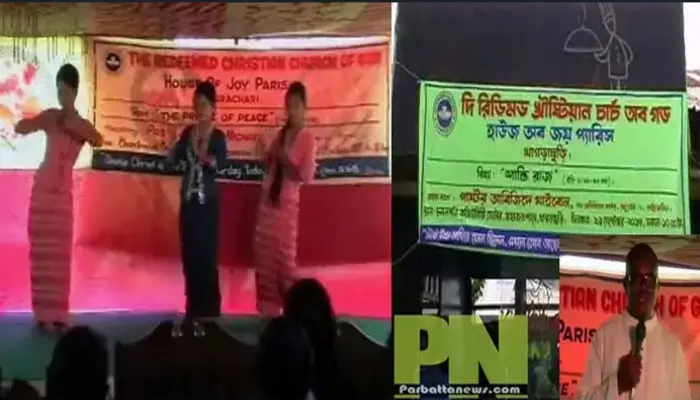
Case Summary
In Khagrachhari, Bangladesh, tribal Hindu villagers were targeted and offered inducements for religious conversion by Christian missionaries. According to reports, a group of 10 foreign nationals and two Bangladeshi nationals associated with a Christian missionary organisation, The Redeemed Christian Church of God, arrived in Khagrachhari district, Bangladesh, under the guise of tourists. They organised a religious gathering aimed at converting tribal Hindu villagers to Christianity at the Chandanpati Community Centre in Khagrachhari town. The religious gathering, which also featured dance and music, came under scrutiny after information emerged that Christian preaching and conversion activities were being conducted under the cover of cultural programmes. It was revealed that Christian missionaries had been entering remote tribal settlements in Khagrachhari and using various inducements to persuade economically disadvantaged indigenous people to embrace Christianity. They specifically targeted poor and vulnerable Marma and Tripura communities in these conversion efforts. When intelligence officials attempted to enter the community centre to verify the organisation's legitimacy and inspect the foreigners' documents, they were initially obstructed, leading to tension at the venue. Members of the Marma Student Forum also arrived at the location. The organisers subsequently left the premises when officials sought the necessary documentation. The group included Nigerian national Abizide Michael, identified as an assistant provincial pastor from Benue State, along with other nationals from Nigeria, Liberia and Cameroon, as well as two Bangladeshi citizens. Police stated that the group had checked into the Khagrachhari Tourism Motel on Saturday evening as tourists but had failed to provide accurate information about their identities and purpose of visit in the motel register. They left the motel in haste on Sunday afternoon. The group's activities were linked to a missionary organisation that had recently begun operating from a rented house in Pankhaiyapara, Khagrachhari, under the name The Redeemed Christian Church of God. Its local organiser, Prince Biswas, had reportedly established the organisation and organised the gathering with the participation of the foreign nationals. The Khagrachhari Sadar Police escorted the foreign nationals to the district's boundary and directed them to leave the area amid concerns that their activities could disrupt communal harmony. District police officials stated that the foreigners had entered Khagrachhari on tourist visas without obtaining the necessary authorisation for missionary activities. The Deputy Commissioner also confirmed that although the foreigners had applied to visit the district as tourists, they had arrived before their applications could be verified. The incident prompted objections from members of the Marma community, while the president of the Khagrachhari Reporters' Unity raised concerns about efforts to convert economically disadvantaged indigenous communities through inducements. Kiran Roja, founding president of Gospel for Asia in Khagrachhari, also acknowledged that some missionaries had been converting poor indigenous residents to Christianity and referred to the organisation involved in the gathering as fraudulent.
Why it is Hate Crime ?
This case has been added to the tracker under the primary category of - Predatory proselytisation. Within it, the sub-category selected here is - Conversion/ attempts to convert by inducement. Predatory Proselytisation is not just limited to threat, harassment, force and violence, but it also has contours of stealth. In several cases, the Hindu victim is exploited to convert, with non-Hindus taking advantage of their poverty. In such cases, the Hindu victim who is suffering financially is offered monetary benefits, including lucrative offers for jobs, health treatment, education, etc, to induce the victim into changing his/her religion. In such cases, the religious identity of the victim and the aim to disenfranchise him from his faith form the heart of the crime. Also, taking advantage of and exploiting an individual’s economic vulnerabilities is widely acknowledged as exploitation, forms of which are often penalised by law. Such cases therefore are considered religiously motivated hate crimes since the victim’s religious identity forms the very heart of the crime itself. The incident constituted a case of targeted religious proselytisation directed at economically vulnerable indigenous communities in Khagrachhari. The activities went beyond the ordinary practice of a religious organisation or the voluntary dissemination of Christian beliefs. The missionaries entered remote tribal settlements under the pretext of tourism and used various inducements to persuade poor residents to abandon their existing religious beliefs and embrace Christianity. Offering incentives or making false promises, especially when directed at vulnerable individuals in need, shows that these incentives are not acts of kindness or charity. Instead, they are calculated moves to exploit vulnerable Hindus because of their religion. By providing inducements or promising healing in exchange for conversion, the accused were effectively blackmailing those who might have been desperate for assistance or hope. Such instances are seen in many cases where members of Christian missionary groups target socially and economically vulnerable Hindus to further their agenda of religious conversions. This form of coercion strips people of their agency and dignity and results in coerced conversions. These are not random or isolated incidents, but rather cases deeply rooted in religious animosity towards Hindu victims. The circumstances surrounding the gathering at Chandanpati Community Centre further strengthened the religious dimension of the case. The Christian missionaries had entered the district under the guise of tourism while engaging in organised proselytisation. Their concealment of the actual purpose of their visit demonstrated an attempt to circumvent the scrutiny ordinarily applicable to missionary activities. This was significant because it indicated that the conversion effort was not being pursued through transparent religious engagement, but through a concealed and organised operation targeting economically vulnerable indigenous communities. The Christian faith, by its very theological foundations, places a strong emphasis on proselytisation. In pursuit of conversion objectives, Christian evangelists often employ unethical means, ranging from psychological pressure and misinformation to inducements such as money or jobs. In such cases, Christian missionary groups often target and brainwash socially and economically vulnerable Hindus to further their agenda of religious conversions. This form of coercion strips Hindus of their agency and dignity and enforces forced conversions. These are not random or isolated incidents, but rather premeditated efforts to undermine the Hindu faith, persuade Hindus to discard their own faith, and convert to Christianity. Such acts were deeply rooted in religious animosity towards Hindu victims, and thus, this case was added to the tracker. Disclaimer: The number of perpetrators has been recorded as 12, comprising 10 foreign nationals and two Bangladeshi nationals associated with The Redeemed Christian Church of God. Disclaimer: The Hinduphobia Tracker records incidents based on when an event occurred or when the victim's ordeal began. It is important to clarify that none of the media sources covering this case has specified the exact date when the conversion activities began. Therefore, for documentation purposes, we have recorded the date based on when the incident was reported in the media, 1 October 2013.


Case Status
Unknown


Perpetrators Details
Perpetrators
Christian Extremists
Perpetrators Range
From 5 to 10
Perpetrators Gender
unknown
 Sources



