Hindu doctors targeted by Muslim seniors at medical university in Lucknow; denied leave for Hindu festivals, subjected to discriminatory treatment and excessive workloads
 Lucknow, Uttar Pradesh, India
 24 October, 2026
Case Summary
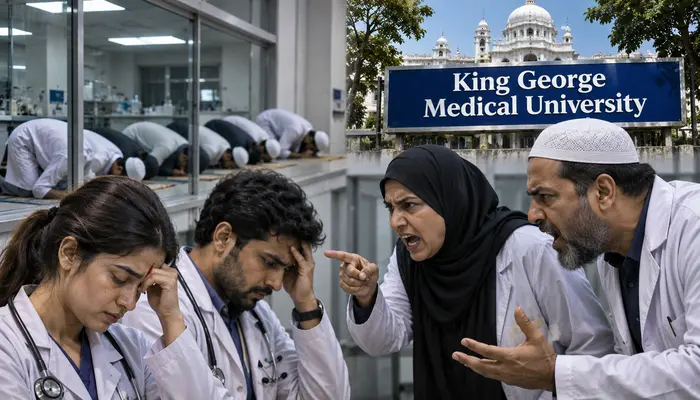
Another incident of religiously motivated targeting of Hindu doctors emerged from King George’s Medical University (KGMU) in Lucknow, Uttar Pradesh. In this case, multiple Hindu doctors were subjected to religious discrimination and harassment by Muslim senior faculty members and other Muslim personnel in positions of authority. They were denied leave for Hindu religious festivals and important family obligations, made to perform additional duties and burdened with excessive workloads, while Muslim doctors were granted greater flexibility to attend Namaz, weddings and other personal engagements without being subjected to similar work responsibilities. The Muslim perpetrators involved in these activities were operating a conversion racket in the university that targeted Hindu medical students, doctors and other university personnel. This wider pattern of discrimination came to light following an earlier case of religiously motivated harassment and sexual exploitation of a Hindu woman at KGMU, which had previously been documented by the Hinduphobia Tracker. The victim, Dr Devatri Mitra, a Hindu resident doctor at the university, was targeted by Rameezuddin Nayak (Rameez Malik). In December 2025, he lured her into a relationship under the pretext of marriage and sexually exploited her before pressuring her to convert to Islam as a condition of marrying him. When she refused to abandon her faith, he ended the relationship and subjected her to sustained harassment and intimidation, driving her to attempt suicide on 17 December 2025. Following this, Dr Devatri exposed his involvement in a wider conversion racket targeting Hindu women, students and employees within the university. A First Information Report (FIR) was registered at Chowk Police Station on 23 December 2025, prompting the Uttar Pradesh government to order an investigation by the Special Task Force (STF). The STF submitted its report on 25 October 2026, exposing a wider pattern of religious discrimination, harassment and suppression of complaints involving Hindu doctors and other employees at the university. According to the STF inquiry report, Hindu resident doctors in the Pathology Department at KGMU faced religious discrimination in the allocation of duties and approval of leave. One such victim was Harshit Jain, a Hindu resident doctor from the 2023 batch. The report stated that a Muslim resident doctor named Dr Sabina was granted leave without a replacement despite being posted in the Trauma Laboratory. However, when Harshit Jain was appointed in her place, he was subjected to harassment. When he sought leave to celebrate Chhath Puja and attend his grandfather’s last rites, Additional Professor Dr Sumaiya Qaiyum, who was responsible for approving residents’ leave, harassed him and made a derogatory remark questioning whether he would personally light his grandfather’s funeral pyre. In contrast, Muslim resident doctors were readily granted permission to attend Namaz, weddings and other personal engagements without being burdened with additional duties. The STF report also revealed that Dr Wahid Ali, in charge of the Biochemistry Laboratory, discriminated against Hindu resident doctors, making Harshit Jain perform double duties and giving him negative professional feedback. At the same time, he provided Muslim students with separate seating and prayer facilities inside the High-Performance Liquid Chromatography (HPLC) Laboratory, where they gathered to offer Namaz and hold meetings. The inquiry further noted that Dr Wahid Ali also supported Rameezuddin against Dr Devatri Mitra. Apart from this, the STF inquiry also highlighted the involvement of Dr Sumaiya Qaiyum and the Head of the Pathology Department, Professor Suresh Babu, in suppressing complaints raised by Hindu female doctors. Dr Sumaiya dismissed Dr Devatri Mitra’s complaint against Rameezuddin as a minor incident, advised other resident doctors not to blow the matter out of proportion and threatened those who supported Devatri. Professor Suresh Babu, meanwhile, declared Rameezuddin innocent, characterised Devatri as a psychopath, attempted to discredit her and pressured her family to reach a compromise. The STF inquiry described a wider pattern of collusion among faculty members to shield accused personnel and harass Hindu junior doctors and nursing staff who raised complaints. Notably, the Uttar Pradesh Special Task Force (STF) report submitted on 25 October 2026 exposed a widespread and organised religious conversion network operating within King George's Medical University (KGMU), Lucknow, and extending to other medical institutions, including Sarojini Naidu Medical College (SNMC), Agra, and Etah Medical College. Dr Rameezuddin Nayak (Rameez Malik) was identified as one of the key figures in this network, which connected Muslim medical students, resident doctors and university personnel across institutions. Operating through interconnected groups, including one known as 'Islamic Medicos', the network systematically targeted Hindu women doctors, students and employees through relationships, sexual exploitation, blackmail and pressure to convert to Islam. The investigation also exposed the involvement of several medical personnel and university staff members who facilitated these activities, protected those involved and enabled the network to operate across departments and institutions. The STF report further documented systematic religious discrimination against Hindu doctors, students and employees within KGMU. Hindu residents faced discriminatory treatment, harassment, adverse professional assessments and unequal treatment on account of their religious identity, while Muslim students and employees received preferential treatment. The report also exposed how influential faculty members and university personnel shielded those involved, discouraged complaints and created an institutional environment in which Hindu women who resisted religious coercion or sought action faced intimidation and professional repercussions. The investigation additionally brought to light the systematic propagation of hardline Islamic ideology and religious radicalisation among Muslim medical students. It specifically highlighted the promotion of the ideology of Islamic extremist preacher Zakir Naik, who was banned in India and whose organisation, the Islamic Research Foundation (IRF), was declared an unlawful association under the Unlawful Activities (Prevention) Act (UAPA). The report documented organised religious gatherings, the use of university facilities for religious activities and visits by Islamic preachers from outside Lucknow. These activities demonstrated that the network extended beyond individual conversion attempts and involved organised efforts to promote hardline religious ideology within medical institutions. Significantly, the STF report also established Rameezuddin's association with Dr Shaheen Saeed, who was apprehended in connection with the 2025 Delhi Red Fort blast case. He had met her at a medical conference and was influenced by her radical Islamic ideology. During interrogation, he acknowledged his association with her. Electronic devices recovered from him contained contacts of several Hindu women he had approached and pressured to embrace Islam, along with photographs of around 50 women. The report further exposed the financial incentives attached to the conversion operation: ₹15 lakh was offered for converting Hindu medical professionals and doctors, while ₹5 lakh was offered for converting other Hindu individuals. Taken together, the findings exposed an organised network involving the targeting of Hindu women across medical institutions, religious discrimination, ideological radicalisation, institutional support and financial incentives for religious conversion.
Why it is Hate Crime ?
This case is being added to the tracker under the first primary category: Attack not resulting in death. The subcategory selected is: Attacked for Hindu identity. In several cases, Hindus are attacked merely for their Hindu identity without any perceived provocation. A classic example of this category of religiously motivated hate crime is a murder in 2016. 7 ISIS terrorists were convicted for shooting a school principal in Kanpur because they got ‘triggered’ seeing the Kalava on his wrist and tilak that he had put. In this, the Hindu victim had offered no provocation except for his Hindu religious identity. The motivation for the murder was purely religious, driven by religious supremacy. Such cases where Hindus are targeted merely for their religious identity would be documented as a hate crime under this category. The second primary category selected is: Restriction/ban on Hindu practices. The subcategory selected is: Restriction on expression of Hindu identity. An example of the state-affected prejudicial and targeted orders against the Hindu community would be a government denying the right of a Hindu or a group of Hindus to hold a religious procession owing to the animosity of non-Hindu groups. Denial of the religious right of the Hindus to assuage the non-Hindu group which harbours animosity to a point where it could lead to violence against Hindus is not only a failure of law and order but is a prejudicial order against Hindus, denying them their fundamental rights to express their religious identity. An example of a hate crime against Hindus by a non-Hindu would be a non-Hindu institution forcing its Hindu employees to abandon religious symbols that a Hindu would wear as an expression of faith owing to inherent prejudice against the faith professed by the victim or a non-Hindu group of people restricting a Hindu group from constructing a place of worship simply because the demography of the area in which the temple is being built is dominated by non-Hindus. Such actions are driven by religious animosity and/or prejudice against Hindus and their faith and would therefore be categorized as a hate crime. This case constituted a clear example of a religiously driven hate crime, as Hindu doctors and other university personnel were systematically targeted on account of their religious identity and subjected to discriminatory treatment, harassment and restrictions on their religious freedom. The selective denial of leave for Hindu religious festivals, discriminatory allocation of duties, additional workloads and harassment by Muslim senior faculty members, contrasted with the preferential treatment extended to Muslim doctors, demonstrated a pattern of hostility towards Hindu employees and their faith. The wider conversion network operating within the university further established that the targeting extended beyond individual workplace disputes and formed part of a broader pattern of religiously motivated activities directed against Hindus. The selective discrimination against Hindu doctors, while Muslim doctors enjoyed greater flexibility and freedom to attend their religious and personal engagements, demonstrated that the victims were targeted specifically for being Hindu. An educational and medical institution is expected to uphold impartiality, equality and religious freedom, ensuring that no individual is disadvantaged because of their faith. However, the discriminatory practices documented in the Special Task Force (STF) inquiry exposed an institutional environment in which Hindu doctors were denied the same consideration and privileges afforded to their Muslim colleagues. This differential treatment was not merely an administrative disparity; it demonstrated hostility towards Hindu religious identity and the unequal treatment of individuals based on their faith. The conduct of Dr Sumaiya Qaiyum, Dr Wahid Ali and other Muslim senior personnel reflected an attitude of contempt towards Hindu employees and their religious obligations. By using their positions of authority to discriminate against Hindu doctors, burden them with additional responsibilities and subject them to harassment, these individuals demonstrated religious animosity towards Hinduism and those who practised it. Such treatment also reinforced an environment in which Hindu employees were made to feel that their religious identity was unwelcome and that their religious obligations were less deserving of institutional respect than those of their Muslim colleagues. The denial of leave for Hindu religious festivals and important family obligations constituted a direct restriction on the victims' ability to practise and express their Hindu identity. Festivals such as Chhath Puja hold profound religious and cultural significance for Hindus. Dedicated to the worship of Surya Dev, the festival involves ritual offerings, prayers, fasting and family participation. It is an annual religious occasion during which devotees return to their homes, reunite with their families and observe their traditions. Preventing Hindu doctors from taking leave for such occasions effectively obstructed their participation in important religious observances and restricted their freedom to practise their faith. Similarly, Hindu funeral rites and other family ceremonies carry religious significance and cannot simply be treated as ordinary personal engagements. The case of Harshit Jain, who faced harassment when he sought leave to celebrate Chhath Puja and attend his grandfather's last rites, demonstrated how Hindu employees were prevented from fulfilling their religious and familial responsibilities. Meanwhile, Muslim doctors were permitted to attend Namaz, weddings and other engagements. This unequal treatment exposed a deliberate pattern of restricting Hindu religious expression while accommodating the religious practices of Muslim personnel. Denying Hindu doctors the opportunity to observe their festivals and fulfil their religious obligations amounted to an infringement of their religious freedom and demonstrated hostility towards the expression of Hindu identity within the institution. The derogatory remark made by Dr Sumaiya Qaiyum when Harshit Jain sought leave to attend his grandfather's funeral further demonstrated the contempt with which Hindu religious obligations were treated. She questioned whether he intended to personally light his grandfather's funeral pyre, thereby mocking an important Hindu religious responsibility. In Hinduism, Antyeshti, or the final rites, holds profound spiritual and religious significance. These rites involve the cremation of the deceased, prayers and prescribed rituals intended to facilitate the departed soul's onward journey. The lighting of the funeral pyre by a close family member, traditionally the eldest son or another designated relative, forms an important part of these observances. For Harshit, attending his grandfather's funeral was therefore not simply a matter of family obligation but also an opportunity to fulfil an important religious responsibility. By mocking his request through a derogatory remark about the funeral pyre, Dr Sumaiya denigrated a fundamental Hindu religious practice and displayed open disregard for the religious sentiments of a Hindu employee. This was particularly significant given her authority over the approval of residents' leave. Rather than respecting his religious obligations and personal loss, she used her position to subject him to humiliation. The incident demonstrated hostility towards Hindu religious customs and exposed the contempt with which the religious practices of Hindu doctors were treated by those exercising authority over them. The operation of an organised conversion network within KGMU demonstrated that the targeting of Hindus was premeditated rather than a series of isolated incidents. Hindu women, medical students, doctors and other university personnel were targeted for conversion to Islam, while Hindu employees also faced discriminatory treatment and harassment within the institution. Considered together, these activities exposed a wider pattern of targeting individuals on the basis of their Hindu religious identity. The exploitation of institutional authority, professional relationships and personal vulnerabilities to pursue conversion attempts further demonstrated the organised nature of the operation. The discriminatory treatment of Hindu personnel, occurring alongside these conversion activities, reflected an institutional environment in which Hindu identity and religious practices were subjected to hostility and unequal treatment. This combination of organised conversion efforts and workplace discrimination demonstrated religious hostility towards Hinduism and an attempt to undermine the religious identity and autonomy of Hindus within the university. The ideological associations uncovered during the investigation further exposed the anti-Hindu orientation of the network. The Special Task Force report referred to the propagation of the ideology of Islamic extremist preacher Zakir Naik, whose organisation, the Islamic Research Foundation (IRF), was declared an unlawful association by the Government of India under the Unlawful Activities (Prevention) Act, 1967, on grounds that included promoting religious hatred, encouraging forcible conversions to Islam and making derogatory statements against Hindus and Hindu deities. The investigation also brought to light the conversion racket's association with Dr Shaheen Saeed, who was one of the perpetrators of the November 2025 Red Fort bombing in Delhi. These ideological associations, when considered alongside the organised efforts to target Hindu doctors and coerce their conversion, demonstrated that the activities extended beyond individual acts of discrimination and exploitation and were accompanied by a broader ideological hostility towards Hinduism. The network's attempts to target Hindus, viewed in this context, exposed a premeditated effort to undermine Hindu religious identity and autonomy through coercion, establishing the wider religious motivation behind the offences. Overall, since this incident met several parameters of a hate crime, it was added to the hate crime database of the Hinduphobia Tracker. Disclaimer: Although multiple Hindu doctors were targeted in this case, the available information did not specify the total number of victims and identified only Harshit Jain by name. Accordingly, the victim count has been recorded as one for documentation purposes only. This figure represents a conservative estimate and does not indicate that only one Hindu doctor was affected. The Hinduphobia Tracker records incident dates based on when a crime occurs or when the victim's ordeal begins, rather than when it is reported by the media. However, in this case, media reports did not specify the exact date on which the victims' ordeal began. The only available date was that of the Uttar Pradesh Special Task Force (STF) report, published on 25 October 2026. Therefore, this date has been selected as the indicative incident date for documentation purposes only.
Victim Details
Total Victim
1
Deceased
0
Gender
- Male 1
- Female 0
- Third Gender 0
- Unknown 0
Caste
- SC/ST 0
- OBC 0
- General 0
- Unknown 1
Age Group
- Minor 0
- Adult 1
- Senior Citizen 0
- Unknown 0


Case Status
Case sub-judice


Perpetrators Details
Perpetrators
Muslim Extremists
Perpetrators Range
From 2 To 5
Perpetrators Gender
both
 Sources



