Hindu woman forcibly converted to Islam and married by Muslim man at medical university in Lucknow; accused linked to organised conversion racket
 Lucknow, Uttar Pradesh, India
 24 October, 2026
Case Summary
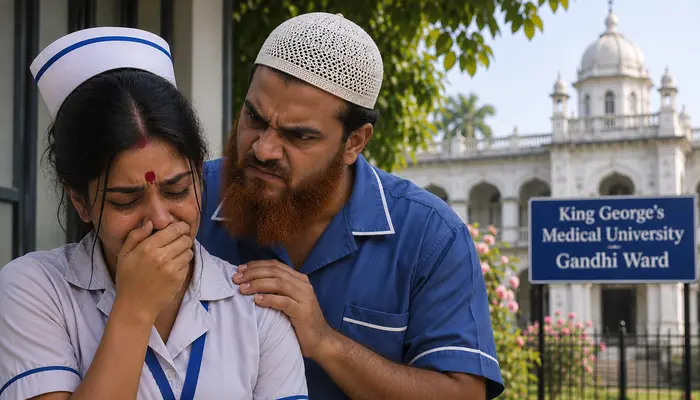
Another incident of religiously motivated targeting of a Hindu woman came to light at King George’s Medical University (KGMU) in Lucknow, Uttar Pradesh. In this incident, a Hindu nurse named Jyoti Singh was targeted by a Muslim nursing staff member named Nafees. The accused trapped her in a relationship, forcibly converted her to Islam and subsequently performed Nikah (Islamic marriage) with her. Nafees was also part of a wider Islamic conversion network operating within the university, which targeted Hindu medical students, doctors and other personnel for religious conversion. Notably, this incident came to light following an earlier case of forced religious conversion and sexual exploitation of a Hindu woman at KGMU, Lucknow, which had previously been documented by the Hinduphobia Tracker. The victim, Dr Devatri Mitra, a Hindu resident doctor at the university, was targeted by Rameezuddin Nayak (Rameez Malik). In December 2025, he lured her into a relationship under the pretext of marriage and sexually exploited her before pressuring her to convert to Islam as a condition of marrying him. When she refused to abandon her faith, he ended the relationship and subjected her to sustained harassment and intimidation, driving her to attempt suicide on 17 December 2025. Following this, Dr Devatri exposed his involvement in a wider conversion racket targeting Hindu women, students and employees within the university. A First Information Report (FIR) was registered at Chowk Police Station on 23 December 2025, prompting the Uttar Pradesh government to order an investigation by the Special Task Force (STF). The STF submitted its report on 25 October 2026, exposing a wider conversion network involving several Muslim doctors and senior faculty members and bringing the ordeal of the Hindu female nurse in the present case to light. According to the STF inquiry report, Nafees, a member of the nursing staff at KGMU, targeted Jyoti Singh, a Hindu woman employed as a nurse in the university's Gandhi Ward. He trapped her in a relationship and subjected her to mental and sexual exploitation. Subsequently, he forcibly converted her to Islam and performed Nikah with her. At the time of writing this report, no information regarding Nafees's arrest, the registration of a separate FIR against him, or any specific departmental action taken against him was publicly available. Notably, the Uttar Pradesh Special Task Force (STF) report submitted on 25 October 2026 exposed a widespread and organised religious conversion network operating within King George's Medical University (KGMU), Lucknow, and extending to other medical institutions, including Sarojini Naidu Medical College (SNMC), Agra, and Etah Medical College. Dr Rameezuddin Nayak (Rameez Malik) was identified as one of the key figures in this network, which connected Muslim medical students, resident doctors and university personnel across institutions. Operating through interconnected groups, including one known as 'Islamic Medicos', the network systematically targeted Hindu women doctors, students and employees through relationships, sexual exploitation, blackmail and pressure to convert to Islam. The investigation also exposed the involvement of several medical personnel and university staff members who facilitated these activities, protected those involved and enabled the network to operate across departments and institutions. The STF report further documented systematic religious discrimination against Hindu doctors, students and employees within KGMU. Hindu residents faced discriminatory treatment, harassment, adverse professional assessments and unequal treatment on account of their religious identity, while Muslim students and employees received preferential treatment. The report also exposed how influential faculty members and university personnel shielded those involved, discouraged complaints and created an institutional environment in which Hindu women who resisted religious coercion or sought action faced intimidation and professional repercussions. The investigation additionally brought to light the systematic propagation of hardline Islamic ideology and religious radicalisation among Muslim medical students. It specifically highlighted the promotion of the ideology of Islamic extremist preacher Zakir Naik, who was banned in India and whose organisation, the Islamic Research Foundation (IRF), was declared an unlawful association under the Unlawful Activities (Prevention) Act (UAPA). The report documented organised religious gatherings, the use of university facilities for religious activities and visits by Islamic preachers from outside Lucknow. These activities demonstrated that the network extended beyond individual conversion attempts and involved organised efforts to promote hardline religious ideology within medical institutions. Significantly, the STF report also established Rameezuddin's association with Dr Shaheen Saeed, who was apprehended in connection with the 2025 Delhi Red Fort blast case. He had met her at a medical conference and was influenced by her radical Islamic ideology. During interrogation, he acknowledged his association with her. Electronic devices recovered from him contained contacts of several Hindu women he had approached and pressured to embrace Islam, along with photographs of around 50 women. The report further exposed the financial incentives attached to the conversion operation: ₹15 lakh was offered for converting Hindu medical professionals and doctors, while ₹5 lakh was offered for converting other Hindu individuals. Taken together, the findings exposed an organised network involving the targeting of Hindu women across medical institutions, religious discrimination, ideological radicalisation, institutional support and financial incentives for religious conversion.
Why it is Hate Crime ?
This case is being added to the tracker under the primary category: Crimes against women in relationships and other sexual crimes. The subcategory selected is: Brainwashed and/or Groomed. The tertiary categories are: Rape and sexual assault/harassment, Pattern of targeting Hindus. In our database, we have not added incidents where women have converted to another religion of their free will and no allegations of forced/involuntary conversion have been made. However, there are certain cases of conversion where the consent itself is a result of the brainwashing or grooming of a minor by the non-Hindu perpetrator trying to victimise a woman for her Hindu religious identity. The phenomenon of grooming points to non-Hindu perpetrators identifying their Hindu victims’ vulnerabilities and exploiting them over months and sometimes years, to extract the supposed ‘consent’ in order to convert their religion. In most cases of grooming, the victims are minors or the grooming started when the victim was a minor. In other cases of grooming, the non-Hindu perpetrator brainwashes and grooms a minor victim to extract their trust and then proceeds to rape them repeatedly with the intent of converting them to their faith. It is pertinent to understand here that when the victim is a minor, the ‘consent’ to convert or enter into a romantic relationship with an adult itself is redundant – addressed by POCSO. While every case of conversion of a minor and incidents of establishing a physical relationship with a minor by an adult is a crime, for the purpose of this database, a case would be considered a hate crime only if there is a distinct religious angle to the grooming. For example, in the UK, if a Hindu minor is targeted by Pakistani grooming gangs, it would be considered a hate crime because the victims are specifically targeted owing to their non-Muslim religious identity with the perpetrators being Muslim. In other cases, if a Hindu minor is brainwashed into entering a physical relationship with the non-Hindu adult perpetrator and the family alleges grooming/brainwashing of the minor to convert her religion, it would form a part of this database. If the victim is a Hindu adult, the case would form a part of this database only if the victim herself says that she was brainwashed/groomed to convert her religion. However, if the victim is deceased (murdered or otherwise), the case would form a part of this database if her family/friends provided testimony that the victim was brainwashed/groomed to convert her religion. Since these crimes have a distinct religious angle where the victim is being targeted owing to her Hindu religious identity, these cases are considered a hate crime. The other subcategory selected is: Forced conversion before marriage. The tertiary category selected is: Forced to do nikah. In such cases, a non-Hindu man is in a relationship with a Hindu woman when the pressure to convert her religion begins to manifest. In such cases, typically, two patterns emerge. First, when the relationship is consensual, and the religious identity of the perpetrator is known to the Hindu woman in the relationship, however, at some point during the relationship, the non-Hindu man starts to force the victim to convert her religion and give up her Hindu religious identity. The second is when the woman gets into a marriage with the man pretending to share her faith. Later, when the truth is revealed, the man starts pressuring the woman to convert her religion and give up her religious identity. In both the situations, the methods used to force the victim to convert her religion often revolve around force-feeding beef, forcing her to wear hijab, forcing her to read the Kalma or even pressurizing the victim to do ‘Nikah’, which is marriage under Islamic law, with a prerequisite being conversion to Islam. Cases where a Hindu woman consensually converts to Islam in a relationship will be left out of the hate crime database, even though it could be argued in several cases that the conversion was a result of religious brainwashing. This case is a clear example of a religiously driven hate crime, as a Hindu nurse named Jyoti Singh was lured into a relationship, sexually exploited, and forcibly converted to Islam by a Muslim man named Nafees. The incident involved predatory relationship tactics and coercive religious conversion, targeting a Hindu woman on account of her faith. The fact that Jyoti was lured into a relationship in which sexual exploitation was accompanied by her forced conversion to Islam and subsequent Nikah demonstrates the religious dimension of the targeting. The relationship involved coercion rather than mutual affection or trust, with the victim being made to abandon her Hindu faith. Such conduct demonstrates deep-seated religious hatred towards the victim and her Hindu identity. Furthermore, the forced conversion of Jyoti to Islam and the solemnisation of Nikah demonstrated a disregard for her religious autonomy and freedom of conscience. Religious conversion can be considered voluntary only when an individual embraces a faith out of personal conviction and free will, without coercion, manipulation or pressure. In this case, Jyoti was forcibly made to abandon Hinduism after being lured into a relationship and subjected to exploitation. Such coercion violated her fundamental right to freedom of religion and exposed the perpetrator's disregard for her right to retain and practise her Hindu faith. The conduct reflected deep-seated religious animosity towards Hinduism and the Hindu community, treating the victim's religious identity as something to be abandoned rather than respected. The Nikah, in this context, was not merely a marital arrangement but also formalised the relationship following her forced religious conversion, making the marriage an extension of the coercion directed at her. The sexual and mental exploitation that Jyoti was subjected to further demonstrated the severity of the targeting. Her exploitation and psychological manipulation occurred alongside her forced conversion, placing her in a vulnerable position and subjecting her to coercion in matters of personal and religious choice. In this context, the sexual exploitation cannot be viewed in isolation from the accompanying attempts to make her abandon her Hindu faith. It formed part of a pattern of predatory conduct in which her vulnerability was compounded by religious coercion. The use of a relationship to exploit a Hindu woman while forcibly converting her demonstrates that sexual exploitation and psychological manipulation were being used to exert control over her and make her more susceptible to the perpetrator's demands. This further underscores the religious dimension of the targeting and the hostility directed at her Hindu identity. Furthermore, the perpetrator's association with an organised conversion network demonstrated that the targeting of Hindu women was not an isolated occurrence but part of a wider, coordinated effort. The network, which involved other Muslim doctors and professionals, engaged with Hindu female resident doctors and promoted hardline Islamic ideology among them. Its activities pointed to a premeditated pattern of targeting Hindu women and pressuring them to abandon their faith and embrace Islam through relationships, sexual exploitation, manipulation and intimidation. This organised approach exposed a wider conversion agenda in which Hindu women were targeted on account of their religious identity, with no regard for their freedom to retain their faith. The systematic use of coercion to undermine Hindu religious identity reflected deep-seated hostility towards Hinduism and demonstrated how Islamic radicalism manifests through organised efforts to influence and compel religious conversion. The Hindu victim, Jyoti, was therefore not an isolated target but part of a wider nexus seeking to violate the religious autonomy of Hindu women, making this a clear instance of organised, religiously motivated hostility towards Hindus. The ideological associations uncovered during the investigation further exposed the anti-Hindu orientation of the network. The Special Task Force report referred to the propagation of the ideology of Islamic extremist preacher Zakir Naik, whose organisation, the Islamic Research Foundation (IRF), was declared an unlawful association by the Government of India under the Unlawful Activities (Prevention) Act, 1967, on grounds that included promoting religious hatred, encouraging forcible conversions to Islam and making derogatory statements against Hindus and Hindu deities. The investigation also brought to light the conversion racket's association with Dr Shaheen Saeed, who was one of the perpetrators of the November 2025 Red Fort bombing in Delhi. These ideological influences and associations, considered alongside the network’s organised efforts to target Hindu women and coerce their conversion, revealed a deeply hostile attitude towards Hinduism and demonstrated that the perpetrators’ conduct was rooted in more than personal exploitation: it was accompanied by an ideological drive to undermine Hindu religious identity and impose Islam through coercion, making this an example of a religiously driven offence. Overall, since this incident met several parameters of a hate crime, it was added to the hate crime database of the Hinduphobia Tracker. Disclaimer: The Hinduphobia Tracker records incident dates based on when a crime occurs or when the victim's ordeal begins, rather than when it is reported by the media. However, in this case, media reports did not specify the exact date on which the victim's ordeal began. The only available date was that of the Uttar Pradesh Special Task Force (STF) report, published on 25 October 2026. Therefore, this date has been selected as the indicative incident date for documentation purposes only.
Victim Details
Total Victim
1
Deceased
0
Gender
- Male 0
- Female 1
- Third Gender 0
- Unknown 0
Caste
- SC/ST 0
- OBC 0
- General 0
- Unknown 1
Age Group
- Minor 0
- Adult 1
- Senior Citizen 0
- Unknown 0


Case Status
Case sub-judice


Perpetrators Details
Perpetrators
Muslim Extremists
Perpetrators Range
One Person
Perpetrators Gender
male
 Sources



