Hindus and their faith in the crosshairs: Islamist group in Bangladesh demand ban on ISKCON activities and closure of Nilachal Temple
 Chandpur District, Bangladesh
 1 November, 2026
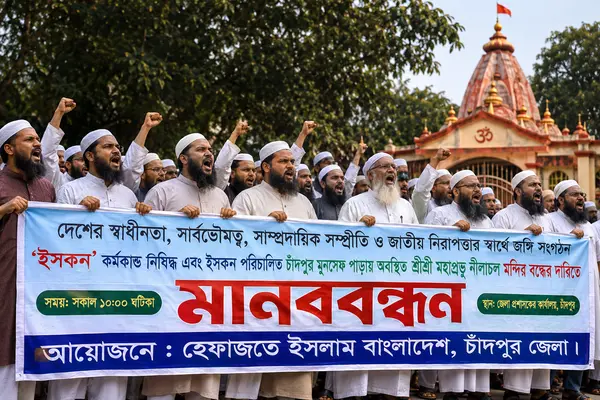
Case Summary
In another instance of Hindu religious institutions being targeted in Bangladesh, Hefazat-e-Islam Bangladesh's Chandpur district unit has demanded a ban on the activities of the International Society for Krishna Consciousness (ISKCON) and the closure of Shri Shri Mahaprabhu Nilachal Temple in Chandpur. On 2 November 2026, members of the Islamist organisation Hefazat-e-Islam Bangladesh, Chandpur District Branch, along with religious clerics and other participants, staged a human chain outside the Chandpur Deputy Commissioner's office to demand a ban on ISKCON activities and the closure of Nilachal Temple. The demonstration was held at around 10 am, following which the organisation's representatives submitted a memorandum to Deputy Commissioner Ahmed Ziaur Rahman. In its memorandum, Hefazat-e-Islam accused ISKCON of engaging in activities that it described as provocative and opposed to Bangladesh's national interests. The organisation claimed that these activities threatened communal harmony, peace and stability in the country. Its representatives also demanded an investigation into ISKCON's activities and called upon the administration to examine the operations, location, authorisation and legal status of Shri Shri Mahaprabhu Nilachal Temple, situated in Munsifpara, Chandpur town. During the demonstration, speakers described ISKCON as an extremist organisation and questioned its activities in Bangladesh. They also referred to the arrest of ISKCON leader Chinmoy Krishna Das in 2024 and the subsequent killing of lawyer Saiful Islam Alif outside the Chattogram court premises, using the incident to reinforce their demand for action against the organisation. While the group presented its demands in the name of national security, sovereignty and communal harmony, it specifically called for the closure of a Hindu temple. The demand went beyond seeking an investigation into an organisation's activities. It sought administrative action against a place of Hindu worship, raising serious questions about the religious freedom of Hindus in the country. The memorandum was submitted to the Deputy Commissioner, urging the administration to investigate and take necessary action under the law. The demand to ban ISKCON in Chandpur is not an isolated development. Islamist groups in Bangladesh have repeatedly attempted to portray the Hindu religious and spiritual organisation as an extremist outfit, using this narrative to mobilise opposition against it and demand state action. On 24 October 2025, after Friday prayers, hardline Islamist groups, including Hefazat-e-Islam and Intifada Bangladesh, organised large-scale protests in Dhaka and Chattogram, targeting ISKCON with accusations that it was an extremist Hindutva organisation. Intifada Bangladesh staged a demonstration outside Dhaka's Baitul Mukarram Mosque and presented six demands to the government, the foremost being a ban on ISKCON and an investigation into its activities. The campaign also received support from Jasimuddin Rahmani, chief of Ansarullah Bangla Team (ABT), an Al-Qaeda-affiliated terrorist organisation. Rahmani, who had been released from prison by the interim government led by Muhammad Yunus, described ISKCON as an "extremist Jewish organisation" and declared that banning it was the need of the hour. Intifada member Ahmad Rafique also accused the government of protecting attackers following the abduction and brutal assault of an imam who had spoken against ISKCON. In Chattogram, Hefazat-e-Islam organised a separate rally demanding that ISKCON be declared a terrorist organisation. These demands were directed at a Hindu spiritual organisation active in Bangladesh since the 1970s. Through its Food for Life programme, ISKCON has provided food to people during the 1971 Liberation War and subsequent floods. It also runs schools, orphanages, care homes for the elderly, and free medical camps, extending its services to people regardless of religious identity. The attempt to portray such an organisation as a threat to national security, while demanding its prohibition, exposes the hostility behind the campaign. The hostility towards ISKCON is part of a wider pattern of attacks on Hindu religious identity and institutions in Bangladesh. This pattern has intensified since the fall of Sheikh Hasina's Awami League government on 5 August 2024, when political instability created an environment in which Islamist groups and mobs intensified attacks against the Hindu minority. Hindu homes have been attacked and set on fire, women have faced abduction and intimidation, and temples and religious structures have been vandalised and destroyed. Reports have also documented Muslim students forcing around 60 Hindu teachers, professors and government officials to resign. Exiled Bangladeshi activist Asad Noor has further spoken about attempts to coerce members of the Hindu minority into joining Jamaat-e-Islami. Hindu religious celebrations and places of worship have also repeatedly come under attack. On 6 September, a procession carrying an idol of Lord Ganesha was attacked in Chattogram. Ahead of Durga Puja, incidents of idol vandalism were reported in Mymensingh, Pabna, Rajshahi, Kishoreganj and Dhaka. On 29 November, a Muslim mob attacked three temples in Patharghata, Chattogram, following Friday prayers. The crackdown has extended to Hindu voices as well, with Hindu journalist Munni Saha arrested in Dhaka on 30 November. Earlier, on 22 May 2025, a Muslim mob carried out arson attacks targeting Hindu homes in Dahar Mashihati village in Abhaynagar upazila of Jessore district. Seen against this backdrop, the demand to ban ISKCON and close Shri Shri Mahaprabhu Nilachal Temple is part of a wider campaign in which Hindu organisations, religious institutions, places of worship and members of the Hindu community are being targeted. The demand to shut down a Hindu temple, alongside calls to prohibit a Hindu spiritual organisation, strikes directly at the religious freedom of Bangladesh's Hindu minority.
Why it is Hate Crime ?
The primary category selected in this case is: Hate Speech against Hindus. The subcategory selected is: Anti-Hindu slurs, mocking faith. Anti-Hindu slurs and the deliberate mocking of the Hindu faith owing to religious animosity involve the usage of derogatory terms, stereotypes, or offensive references to religious practices, symbols, or figures. One of the common anti-Hindu slurs used against Hindus is “cow-worshipper” and “cow piss drinker”. The intention of using this term is to demean and mock Hindus as a group and their religious beliefs since Hindus consider the cow holy. Additionally, some symbols and the slurs attached to them have a historical context that exacerbates the insult, hate, stereotyping, dehumanisation and oppression against Hindus. Cow worship has been used for centuries to denigrate Hindus, insult their faith and oppress Hindus specifically as a religious group. There has been overwhelming documentation about how cow slaughter has been used to persecute Hindus with cow meat being thrown in temples and places of worship. There has also been overwhelming documentation of cow meat (beef) being force-fed to Hindus to either forcefully convert them to Islam or denigrate their faith. Apart from cow worship, the Swastika – which holds deep religious significance for the Hindus – has also been misinterpreted and distorted to use as a slur against Hindus. Similarly, the worship of the Shivling has been used by supremacist ideologies and religions to denigrate Hindus owing to religious animosity. Such slurs and denigration stem out of inherent animosity and hate towards Hindus and their faith, therefore, it is categorised as hate speech targeted at Hindus specifically owing to their religious identity. The other subcategory is: Mocking/denigrating Hindu leaders. Hate speech is defined as any speech, gesture, conduct, writing, or display that is prejudicial against a specific individual and/or group of people and leads to, or may lead to, violence, prejudicial action, or hate against that individual and/or group. Religious leaders are often seen as representatives of the community, especially the community’s religious faith and beliefs. Mocking or denigrating a religious leader specifically owing to his religious identity and/or the religious rituals he observes can be considered hate speech because the motivating factor of the speech is animosity and/or dislike for what he represents – the religious beliefs and faith of the community. Mere insulting words against an individual do not constitute hate speech. Insulting words can be directed at an individual; however, the speech is not motivated by religious hate and/or animosity toward the religious leader's professed faith, but by animus toward the individual himself. For the speech to be considered hate speech, the speech itself or the motivating factor behind the speech has to be religious in nature. Such speech which denigrates Hindu religious leaders specifically owing to animosity towards the faith they profess and the community faith they represent will be treated as hate speech under this category. In this case, the false portrayal of ISKCON as an extremist Hindu organisation is a deliberate attempt to vilify a prominent Hindu religious institution and turn public sentiment against the Hindu community in Bangladesh. ISKCON is a globally recognised Hindu religious and spiritual organisation dedicated to the worship of Lord Krishna. Through devotional worship, religious education, cultural activities and humanitarian service, it plays an important role in sustaining Hindu religious life. It is not a militant or terrorist organisation. Labelling it an extremist outfit without substantiating such accusations serves to discredit its religious activities and portray the presence of an organised Hindu institution as a threat. This targeting assumes particular significance in Bangladesh, where Hindus constitute a religious minority and have faced repeated attacks on their homes, temples, religious practices and community leaders. Since the fall of Sheikh Hasina's government on 5 August 2024, the Hinduphobia Tracker has documented a sharp escalation in anti-Hindu incidents, including temple desecrations, targeted killings, sexual violence and arson attacks. In this environment, organisations such as ISKCON provide an important source of spiritual, cultural and social support to Hindus. Attempts to discredit and prohibit such an organisation therefore go beyond criticism of its activities. They strike at one of the institutional foundations through which the Hindu community maintains its religious identity and collective presence. The use of the label "Hindutva extremist group" is particularly significant. The campaign against ISKCON attempts to conflate Hindu religious identity and the preservation of Hindu culture with extremism. By branding a Hindu spiritual organisation as extremist and presenting its activities as a threat to national security, the campaign creates a pretext for demanding its prohibition. This rhetoric also helps normalise hostility towards Hindu organisations by presenting their religious and cultural activities as something that must be controlled or eliminated. The demand to declare ISKCON a terrorist organisation takes this vilification further by seeking to criminalise its religious presence. This is not the first time ISKCON has been targeted in Bangladesh. The Hinduphobia Tracker has documented several previous instances of hostility towards the organisation and those associated with it. In October 2025, a Muslim extremist circulated a viral video inciting violence against Hindu temples and idols, including those associated with ISKCON. In November 2024, Chinmoy Krishna Das Brahmachari, an ISKCON monk and spokesperson for Bangladesh's Sanatan Jagaran Manch, a prominent Hindu rights organisation, was arrested on sedition charges after speaking out against violence targeting religious minorities. In December 2024, around 70 Hindu lawyers faced lawsuits for their efforts to defend him. In February 2025, a petrol station in Madaripur district displayed a board carrying the offensive message "F*ck ISKCON". These incidents demonstrate that hostility towards ISKCON has repeatedly extended from verbal vilification to actions targeting its leaders, supporters and public presence. This case takes that hostility a step further. Hefazat-e-Islam Bangladesh did not limit its demands to an investigation into ISKCON. It called for the organisation to be banned and specifically demanded the closure of Shri Shri Mahaprabhu Nilachal Temple in Chandpur. This is a direct attack on a Hindu place of worship. A temple is not merely a physical structure. It is a sacred space where devotees worship, observe religious traditions and maintain their connection with their faith. Demanding its closure strikes at the religious freedom of the Hindus who worship there and seeks to deprive them of an institutional space for practising their religion. The demand to shut down the temple also exposes the campaign's wider implications against ISKCON. When a Hindu organisation is branded extremist and a Hindu temple is simultaneously targeted for closure, the hostility is directed not simply at an organisation's activities but at the religious identity and institutional presence of the Hindu community itself. Invoking national security, sovereignty, and communal harmony does not change the nature of these demands. Instead, such arguments are being used to justify restrictions on Hindu religious institutions and their activities. The fundamental motivation behind this campaign is hostility towards Hindu religious identity and the organised expression of Hindu faith in Bangladesh. By falsely portraying ISKCON as an extremist organisation, demanding its prohibition and calling for the closure of a Hindu temple, the Islamist group sought to delegitimise Hindu religious institutions, intimidate their followers and undermine the community's ability to preserve and practise its faith. In this context, attacks on ISKCON are not isolated attacks on one organisation. They form part of a wider pattern of hostility towards the Hindu community and its religious institutions. Such targeted vilification and demands for the suppression of Hindu religious expression constitute religiously motivated hate speech and persecution. This case has therefore been included in the Hinduphobia Tracker's Hate Crime Database.


Case Status
Unknown


Perpetrators Details
Perpetrators
Muslim Extremists
Perpetrators Range
From 10 to 100
Perpetrators Gender
male
 Sources



