Hindu man brutally humiliated by Muslim mob for dining with Muslim woman; subjected to anti-Hindu hate slogans, threats of slaughter and mass violence
 Rangpur Division, Bangladesh
 29 October, 2026
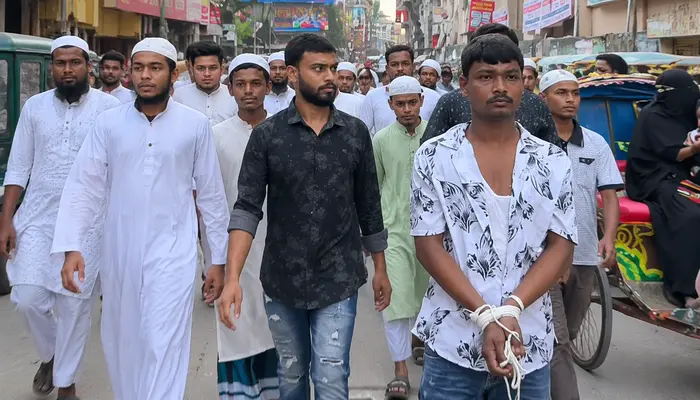
Case Summary
In Rangpur, Bangladesh, a Hindu man was subjected to religiously motivated humiliation and intimidation by a Muslim mob over his association with a Muslim woman. The victim's hands were tied with a rope and paraded through the streets, with the Muslim crowd calling him an ISKCON member and threatening him with execution. The incident came to public attention after a video circulated on social media. The footage showed a Hindu youth with his hands tied with a rope as several Muslim individuals escorted him through the streets. The crowd following him raised slogans as they paraded him from one location to another. A few of the slogans heard in the footage were, "ISKCON dhar jobai kor", meaning "catch ISKCON, slaughter them" and "Break down and demolish the establishments of Hindus!” According to reports, the Hindu youth had gone to a restaurant to dine with his Muslim female friend, which Muslims used as a pretext to target him. The mob labelled him an International Society for Krishna Consciousness (ISKCON) member, tied his hands and paraded him in the street. They also raised anti-ISKCON slogans, calling for its members to be captured and slaughtered, while openly urging their brethren to unite and launch attacks against the Hindu organisation and destroy it. Threats were also directed at the wider Hindu community, with references to the 1946 Noakhali communal violence and warnings of a similar wave of violence against Hindus. The Noakhali communal violence of October 1946 was a series of organised communal attacks against Hindu minorities in the Noakhali and adjoining Tippera districts of East Bengal (now Bangladesh), beginning on 10 October 1946, during the final years of British rule in India. Hindu villages and homes were attacked, looted and burnt, while thousands of Hindus faced killings, abductions, sexual violence and forced religious conversions. The violence triggered mass displacement, forcing large numbers of Hindu families to flee their homes and seek refuge elsewhere. The atrocities became one of the most significant episodes of communal violence in Bengal before the Partition of India in 1947. Meanwhile, the attack on the Hindu man occurred against the broader backdrop of the historical persecution faced by Hindus in Bangladesh. While the Hindu minority has endured discrimination, targeted violence, and religious hostility over decades, such persecution has intensified in distinct spurts during periods of political and social instability. The latest major escalation began after the ouster of Sheikh Hasina’s government in August 2024, continued after the death of Sharif Osman Bin Hadi in December 2025, and resurfaced in the immediate aftermath of the 13th National Parliamentary Election in 2026. Following the ouster of Sheikh Hasina, multiple incidents involving attacks on Hindu homes, temples and religious institutions were documented, alongside intimidation, arson and mob violence targeting Hindu localities. The Hinduphobia Tracker recorded 336 incidents involving the Hindu minority during this period, reflecting the scale of the escalation and the continuing vulnerability of Hindus in Bangladesh. A further spurt of violence followed the death of Sharif Osman Bin Hadi, a Muslim political activist and student leader known for his anti-Hindu and anti-India rhetoric, in December 2025. In the aftermath, Hindu communities were subjected to retaliatory violence, with Hindu homes and properties selectively attacked and several families forced to flee. Among the victims was Dipu Chandra Das, who was lynched and whose body was subsequently set ablaze by a Muslim mob over false blasphemy allegations. The Hinduphobia Tracker documented 51 incidents of anti-Hindu violence in the period following Hadi’s death alone, further illustrating how existing hostility towards the Hindu minority intensified during moments of communal mobilisation. During the same period, posters and written material calling for the extermination of Hindus were also displayed in public spaces. Such rhetoric, when viewed alongside incidents of arson, vandalism, assault and targeted intimidation, reflected an environment in which hostility towards Hindus was not merely episodic but repeatedly resurfaced in more intense forms during periods of unrest. The most recent escalation followed the 13th National Parliamentary Election in 2026. In the immediate aftermath of the election results, Hindu families in districts including Noakhali, Rangpur, Nilphamari, Sylhet, Thakurgaon and Dinajpur faced attacks involving arson, looting, assault and vandalism of Hindu homes and temples. In several instances, Hindu properties were selectively targeted, and families were threatened with displacement. The present incident therefore occurred within a much longer history of persecution of Hindus in Bangladesh, where hostility towards the community has persisted over time and intensified in repeated spurts. The latest cycle began after the ouster of Sheikh Hasina and continued through subsequent periods of political and communal upheaval, leaving the Hindu minority increasingly vulnerable to targeted violence, intimidation and religious hostility.
Why it is Hate Crime ?
The primary category selected in this case is: Men attacked for being associated with non-Hindu women. Within this, the subcategory selected is: Attacked/killed for being associated or suspicion of being associated with Muslim woman. There have been several cases documented of Hindu men/boys being attacked specifically by Muslim groups/mobs for merely being associated or suspicion of being associated or being seen with a Muslim woman in public. In most of such cases, the Hindu man is not in a relationship with the Muslim woman, however, the mob proceeds to threaten and/or assault the Hindu man for merely being associated with the Muslim woman in any capacity. The rise of such crimes stems from a particularly sinister campaign run by several Muslim ideologues and activists. The campaign claims that Hindu men are attempting to ‘lure’ Muslim women into relationships to ensure that Muslim women leave their faith and follow Hinduism. The propaganda has been spearheaded with the help of WhatsApp groups and the extensive use of social media, sans evidence of the same. In many cases, pamphlets were fabricated to lend credence to this campaign. The root of this campaign lies in the fact that several cases of sectarian crimes against Hindu women in relationships with Muslim men have been documented. In such cases, Hindu women have often been forced/pressured to convert to Islam, assaulted, threatened and even murdered owing specifically to their religious identity and their refusal to give up that religious identity to adopt Islam. To delegitimize the suffering of Hindu women when such sectarian crimes are committed against them, the theory of ‘Bhagwa Love Trap’ was floated by sections of the Muslim community. As this theory gained traction, Muslim mobs started targeting Hindu men who were seen with Muslim women. In several such cases, the Hindu man was assaulted merely for offering to drop a Muslim woman in his vehicle or being friends. The differentiating factor between such cases and legitimate cases of Hindu women being targeted while in a relationship with Muslim men is that there is no sectarian violence, and force/pressure to convert. The nature of sectarian violence against Hindu women is not about two adults in a consensual relationship, working together, studying together, or even marrying each other where religious considerations are declared. In this category of crimes, it is pertinent to remember that in none of the cases, there is an element of the Hindu man masking his identity or forced religious conversion. Such cases are driven by specific religious motivations and against the religious identity of the victim and are therefore qualified as hate crimes. The other primary category selected is: Hate speech against Hindus. Under this, the subcategory selected is: Violent threats. Violent threats, explicit, implicit or implied, is the most dangerous form of hate speech since it goes beyond discriminatory and prejudicial language to express the intent of causing harm to an individual or a group of people based on their religious identity and faith. There could be several different kinds of threats that are issued to Hindus based on religious animosity. An explicit threat would mean the direct threat of violence towards an individual Hindu, a group of Hindus or Hindus at large. Physical violence, death threats, threats of destruction of property belonging to Hindus and threats of genocide would mean explicit threats against Hindus for their religious identity. Implicit threats may not be a direct threat but implied through the use of symbols of actions – for example – in the Nupur Sharma case, other than explicit threats, there were also implicit threats when Islamists took to the streets to burn and beat her effigies. It implies that they want to do the same to Nupur Sharma – thereby is considered an implicit threat. Violent threats can be delivered in person, through letters, phone calls, graffiti, or increasingly through social media and other online platforms. It would be important to understand that a threat – explicit or implicit, online or offline – to an individual who happens to be a Hindu does not qualify as a religiously motivated threat. Such a threat, while vile and dangerous, could be owing to non-religious reasons and/or personal animosity. To qualify as a religiously motivated threat, it would need to exhibit an indication that the individual is being targeted for religious reasons and/or owing to his/her religious identity as a Hindu. This case is a clear example of a hate crime because the public humiliation and intimidation of the Hindu man were marked by explicit religious hostility directed at his Hindu identity. The perpetrators did not attack him over any personal dispute but used his association with a Muslim woman to target him for his religious identity, which was evident from the fact that he was labelled an ISKCON member, subjected to anti-Hindu slogans and threatened with death. Broader threats to slaughter ISKCON followers were also issued. The hostility was accompanied by targeted hate speech, making his Hindu identity and interfaith association the basis of the intimidation and demonstrating clear animosity towards Hindus and Hinduism. To begin with, the Hindu man was tied up, publicly humiliated and paraded through the streets simply for dining with his Muslim female friend. His personal association with a woman from another religious community was turned into a pretext for degrading and intimidating him in public. It is important to mention here that the Hindu man had not applied any sort of force, and the Muslim girl was with him of her own free will. Yet the Muslims used it as a pretext to attack and humiliate him. The humiliation and assault of the Hindu youth cannot be viewed as a mere dispute arising from his association with a Muslim woman. The circumstances of the incident, particularly the slogans raised by the mob and the threats directed at ISKCON and the wider Hindu community, make it clear that his Hindu religious identity was central to the hostility directed against him. Had his association with the Muslim woman been the sole issue, there would have been no reason to label him an ISKCON member, raise slogans calling for ISKCON members to be slaughtered, or openly call for the destruction of Hindu establishments. His association with the Muslim woman was used as a pretext to publicly humiliate and intimidate him, while the hostility was directed at the Hindu identity he represented. The manner in which the victim was treated makes the religious dimension of the incident particularly disturbing. His hands were tied, and he was paraded through the streets before a hostile Muslim crowd. This was not simply physical intimidation. It was a public spectacle intended to humiliate him, strip him of his dignity and send a warning to other Hindus. The slogans raised during the procession went far beyond the individual victim. Calls to capture and slaughter ISKCON members and demolish Hindu establishments turned the incident into an open expression of hostility towards the Hindu community and its religious institutions. The threats against ISKCON are especially significant in the wider context of Bangladesh, where the organisation and its members have faced increasing hostility, particularly after the ouster of Sheikh Hasina's government in August 2024. During the period of political upheaval that followed, ISKCON centres and Hindu religious institutions came under attack, while Hindu religious figures who spoke out against atrocities faced intimidation and legal action. One prominent example was Chinmoy Krishna Das, a Hindu monk and former ISKCON leader who became a prominent voice raising concerns about attacks on Hindus and demanding protection for the minority community. His arrest in November 2024 on charges of sedition, followed by the continued targeting of those associated with the movement for Hindu rights, further exposed the hostility faced by Hindu religious voices seeking to draw attention to the community's persecution. The slogans raised against ISKCON in the present incident therefore cannot be dismissed as random expressions of anger. They echoed a wider pattern of hostility towards an organisation that has become a visible symbol of Hindu religious identity in Bangladesh. Calling for its members to be captured and slaughtered, while simultaneously urging the destruction of Hindu establishments, amounted to a direct threat against the religious freedom and safety of Hindus. The reference to the 1946 Noakhali violence made these threats even more menacing. That episode remains one of the darkest chapters in the history of Hindus in Bengal, marked by killings, sexual violence, forced conversions, destruction of homes and mass displacement. Invoking that history in threats against the present-day Hindu community was a way of recalling past communal violence and instilling fear of its repetition. The incident must also be understood against the wider deterioration in the security of Hindus in Bangladesh following the ouster of Sheikh Hasina. The Hinduphobia Tracker documented 336 incidents involving the Hindu minority during the period following the political upheaval. Subsequent waves of violence following the death of Sharif Osman Bin Hadi in December 2025 and the 2026 parliamentary election further exposed the vulnerability of Hindu families, homes, temples and religious institutions. These incidents included assaults, arson, looting, vandalism and targeted intimidation. The attack in Rangpur took place against this backdrop of recurring hostility, in which threats against Hindu religious institutions and the public intimidation of Hindu individuals have repeatedly surfaced. The victim was not merely subjected to humiliation because he was seen dining with a Muslim woman. He was publicly branded as an ISKCON member, paraded with his hands tied, and subjected to slogans demanding the slaughter of ISKCON devotees and the destruction of Hindu establishments. The mob also invoked the memory of past massacres to threaten the wider Hindu community. These actions reveal that the hostility extended far beyond his personal association with the woman. His association with the Muslim woman served merely as a pretext to single him out and subject him to public humiliation. The hostility was fundamentally directed at his Hindu identity and the religious community he belonged to, as evident from the anti-ISKCON slogans and threats against Hindu establishments. Such acts of violence, rooted in religious intolerance and aimed at intimidating and harming individuals because of their faith, constitute religiously motivated hate crimes and warrant inclusion in the tracker. Disclaimer: The Hinduphobia Tracker records incidents based on when an event occurred or when the victim's ordeal began. None of the media sources covering this case has specified the exact date the incident occurred. Therefore, for documentation purposes, we have recorded the date based on when the incident was first reported in the media, 30 October 2026.
Victim Details
Total Victim
1
Deceased
0
Gender
- Male 1
- Female 0
- Third Gender 0
- Unknown 0
Caste
- SC/ST 0
- OBC 0
- General 0
- Unknown 1
Age Group
- Minor 0
- Adult 0
- Senior Citizen 0
- Unknown 1


Case Status
Unknown


Perpetrators Details
Perpetrators
Muslim Extremists
Perpetrators Range
From 10 to 100
Perpetrators Gender
male
 Sources



