Hindu temple sanctity defiled: Sacred Shivling smeared with meat by Muslim man in Aligarh, Uttar Pradesh
 Aligarh, Uttar Pradesh, India
 29 October, 2026
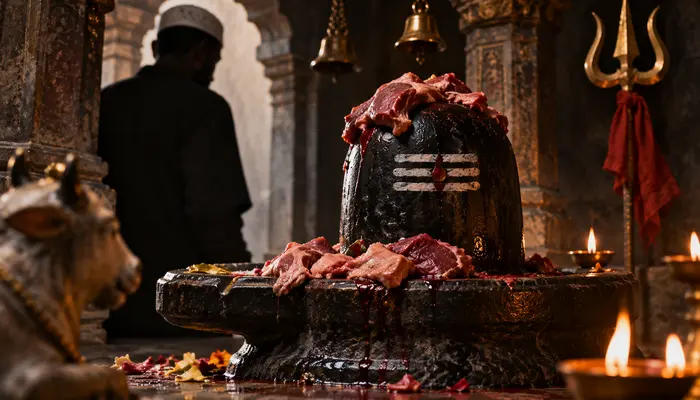
Case Summary
In Aligarh, Uttar Pradesh, the ancient Siddhpeeth Khereshwar Mahadev Temple was defiled by a Muslim man when pieces of meat were smeared on the sacred Shivling, along with a beverage and other food items. The incident involved two separate acts of desecration, on 31 October 2026 and 3 November 2026, when the accused, Anwaruddin, brought pieces of meat and other articles into the temple and smeared them on the sacred Shivling. When confronted by the temple priest, Prahlad Giri, during the second incident, Anwaruddin threatened to kill him. On the evening of 31 October 2026, temple staff found pieces of meat near the Shivling while cleaning the premises. Following the discovery, the temple management examined the closed-circuit television (CCTV) footage installed across the premises, which showed an individual smearing pieces of meat on the Shivling. The temple committee and its volunteers subsequently launched a search for the individual, who had fled the premises. The temple authorities also performed a purification ceremony (Shuddhikaran) and tightened security arrangements, keeping a close watch on the premises to identify and apprehend the person responsible. The CCTV footage was preserved and subsequently handed over to the police as evidence. On Tuesday, 3 November 2026, at approximately 10:00 am, the same individual returned to the temple. At the time, the temple priest, Prahlad Giri, had completed his prayers and was standing near the premises. The individual approached the Shivling again, carrying a bottle containing a beverage, chole-bhature, samosas and other food items, including meat. Temple personnel recognised him from earlier CCTV footage. When Prahlad Giri attempted to stop him, the individual threatened to kill him. Hearing the commotion, temple committee members Radhe, Manoj Kumar, Gaurav and Bhupendra Singh, along with other devotees, rushed to the spot and apprehended him. The angry devotees beat up the accused before handing him over to the police. The accused was identified as 47–48-year-old Anwaruddin, a suspended government primary school teacher posted at Ganeshpur Primary School in the Peshawa police station area. He resided in the Dhaurra locality of Aligarh, behind the Badi Masjid in Dhurra Mafi. He had been suspended from service for failing to attend his teaching duties regularly. During questioning by devotees and temple representatives, he gave a series of unusual explanations for his actions. He initially stated that he had come from America and that United States President Donald Trump had sent him to carry out the act. He subsequently invoked the name of Russian President Vladimir Putin. In another explanation, he stated that Lord Bholenath had called him and that a supernatural power had instructed him in a dream to offer meat at the temple to fulfil his wishes. He also referred to religious practices at Kamakhya Temple and Baidyanath Dham, where meat offerings were associated with certain religious traditions. He also said he had been visiting Khereshwar Temple for the past 10–15 years. People present at the scene recorded videos of the questioning, which were later circulated on social media. The incident sparked widespread anger among devotees and temple management. Gehraaj Singh, president of the Shri Khereshwar and Dauji Maharaj Committee; Devendra Singh Chauhan, its treasurer; and Rishiraj Sharma, also known as Kaka, its general secretary, demanded a thorough investigation. They suspected that the accused had acted at somebody else's instigation as part of a conspiracy to disturb communal harmony and called for an investigation into the possible involvement of other individuals. Swami Purnanandpuri also expressed his displeasure over the incident. Pandit Dayanand Bharti, the temple's protector, provided details of the discovery of the meat pieces, the examination of the CCTV footage and the subsequent apprehension of the accused. After taking Anwaruddin into custody, the police transported him to Lodha Police Station. Members of Karni Sena, accompanied by the temple priest and other Hindu activists, subsequently gathered outside the police station and demanded strict action against the accused. The delegation included Thakur Gyanendra Singh Chauhan, senior national vice-president of Karni Sena; Sumit, its district president; Sanjay Singh, its state general secretary; Rahul Chauhan, a district-level office-bearer of Yuva Shakti; Rahul Chaudhary; and Hindu activist Sachin Raghav. The demonstrators demanded that the police take the accused out of the lock-up and hand him over to them. A heated exchange ensued between the protesters and police personnel over the demand. Superintendent of Police (City) Aditya Bansal and Indian Police Service officer Srishti Jain, Circle Officer of Gabhana, arrived at the police station and assured the demonstrators that they would take appropriate legal action and register a First Information Report. Following the assurances, the protesters dispersed. Lodha Police registered a First Information Report (FIR) against Anwaruddin under Sections 298, 302, 196(2) and 351(2) of the Bharatiya Nyaya Sanhita (BNS), 2023, and arrested him. The police subsequently launched an investigation into the circumstances and motive behind the incident. The investigation focused on examining the CCTV footage provided by the temple committee, tracing the source of the meat, scrutinising the accused's mobile phone records, call detail records (CDRs) and social media contacts, and determining whether any other individuals had instructed or assisted him. The police also examined the possibility of a wider conspiracy and sought to assess the accused's mental condition. Superintendent of Police (City) Aditya Bansal said the accused told investigators he had been visiting the temple for about 15 years and had brought meat there after a dream in which he was instructed to do so to fulfil his wishes. He confirmed that the FIR had been registered and that investigators were examining the accused's contacts to determine whether anyone else was involved. Following his arrest, Anwaruddin was to be produced before the court and sent to judicial custody.
Why it is Hate Crime ?
In this case, the primary category selected is: Attack on Hindu religious representations. The subcategory selected is: Desecration of Hindu religious symbols. Icons and symbols or a religious representation of a spiritual ideal are widely revered in Hinduism. Iconography is of vital significance in the Hindu milieu. It helps connect people’s spiritual beliefs with the real world. Iconography within the Hindu faith takes several shapes and forms. Murtis are of most significance to Hindus, to which daily rituals, prayers and offerings are done. Besides the murtis, there are several other symbols which have deep significance in the Hindu faith – the Om and Swastika for example. Since these Hindu religious symbols hold paramount importance in Hinduism, any desecration of symbols, icons, murtis, religious representations and manifestations, is driven by animosity towards the faith itself which manifests itself through these murtis, icons and symbols. Therefore, any desecration of these Hindu religious symbols and representations is considered religiously motivated hate crimes under this category. The other subcategory selected is: Defiling religious customs. Sanatan Dharma is not a religion of one book, which is to say that while it has religious scriptures that form the central tenets of the faith, there are several traditions followed through thousands of years, mostly passed from generation to generation orally. There are several such customs and traditions that are followed by various Hindus and Hindu sects. Defiling of these traditions and customs is a breach of an individual or group’s religious practices. Such practices can range from dietary restrictions like not eating non-vegetarian food for a certain period of the year, not eating non-vegetarian food at all, not eating beef since the cow is considered holy in Hinduism, the sanctity of religious customs followed in the house (like many ISCKON devotees), etc. Any malicious action leading to the breach of such traditions or defilement of these traditions owing to animosity towards the faith or for the sake of activism stems not only from the lack of faith in the religion itself but also from disregard for the faith of the devotees who follow the customs/traditions and implicit bias against the faith and the tradition itself. Since these specific traditions are central to the faith of the devotees of that specific sect of Hindus, any non-compliance with these traditional rules would be considered a religiously motivated hate crime. The other subcategory selected is: Attack on Temples. In Hinduism, a temple is the abode of the Deity. The Deity in the Temple is consecrated, thereby, making it a real, breathing entity. Hindus believe that not just the Deity but the temple premises itself are sacred to Hindus since Hindus hold the faith that the entire Temple space is an amalgamation of the divine energy of the deity. Given the central significance of Temples in Hindu Dharma, any attack against a Hindu Temple or its peripheral premises is an attack on the faith itself and is born out of animosity towards the faith, of which, the Temple is a central tenet. Any manner of attack against a Temple and/or its premises would therefore be considered a religiously motivated hate crime. This case constituted a clear example of a religiously motivated hate crime because the Muslim perpetrator repeatedly defiled the sanctity of a Hindu temple by smearing pieces of meat directly on the sacred Shivling on two separate occasions. By specifically targeting a Hindu place of worship and one of Hinduism's most revered religious symbols, the act amounted to a deliberate desecration of Hindu temples and religious symbols, causing deep injury to Hindu religious sentiments. In Hinduism, a temple is not merely a physical structure but the abode of the consecrated deity, where devotees worship in an atmosphere of ritual purity and sanctity. Likewise, the Shivalinga is one of the most sacred and widely revered manifestations of Lord Shiva and serves as the focal point of worship for millions of Hindus. Hindu temples observe strict standards of ritual purity, and substances such as meat, alcohol, intoxicants, and activities such as smoking are regarded as incompatible with the sanctity of the temple premises. The purity of both the temple and the Shivalinga forms an essential aspect of Hindu religious practice, making any deliberate contamination of these sacred spaces a direct affront to Hindu faith. The deliberate act of placing meat on the sacred Shivling at a Hindu temple on two separate occasions demonstrated a conscious desecration of sacred Hindu religious symbols. The perpetrator did not merely discard meat in a public place but specifically targeted a consecrated Hindu temple and the Shivalinga as the location where the act would be carried out. The execution of the offence therefore depended upon violating the sanctity of a Hindu place of worship and one of Hinduism's most sacred religious representations. This transformed the act from ordinary criminal conduct into one intrinsically directed against Hindu religious symbols and their sacred character. The incident also constituted a deliberate defilement of Hindu religious customs. Preserving ritual purity is fundamental to Hindu temple worship, and devotees must maintain the sanctity of temple premises by ensuring that ritually impure substances are not brought into these sacred spaces. By bringing meat into the temple and placing it directly on the Shivalinga, despite these well-established religious customs, the perpetrator violated practices that are central to Hindu worship. The conduct therefore not only desecrated a sacred religious symbol but also disrupted the religious customs and devotional practices that Hindus observe while worshipping at their temples. The fact that this was repeatedly done on two separate occasions proved that the act was deliberate. The first incident was not isolated, as the perpetrator returned to the same temple and attempted to repeat the conduct even after the discovery of the meat, the purification of the premises, and the strengthening of security arrangements. The repeated targeting of the sacred Shivling was particularly significant as it further reinforced the religious motive. Placing meat on such a sacred representation directly violated the sanctity that Hindu devotees associated with the deity, the temple and its consecrated surroundings. The recurrence of the act, despite the temple authorities' efforts to restore ritual sanctity and protect the premises, further intensified the sense of religious violation among the Hindu community. Moreover, the death threat directed at the priest, Prahlad Giri, when he attempted to intervene, added an element of intimidation against a Hindu religious representative performing his duties to protect the sanctity of the shrine. The incident therefore extended beyond the desecration of a physical religious symbol: it affected the dignity of a Hindu place of worship, disrupted devotional practices, offended the religious sentiments of worshippers and undermined the sense of safety and reverence that devotees expected within their sacred temple. During interrogation, the accused stated that he had committed the act following a dream in which a supernatural power instructed him to offer meat at the temple to fulfil his wishes. He also invoked religious practices at Kamakhya and Baidyanath temples, where meat offerings formed part of certain religious traditions, to justify his conduct. However, such an explanation neither excused nor diminished the gravity of the religious desecration. The deliberate placement of meat directly on the consecrated Shivalinga on two separate occasions constituted a flagrant violation of Hindu religious sanctity and an affront to one of Hinduism's most revered symbols of worship. Invoking other religious traditions did not legitimise the desecration of a Hindu shrine or justify the violation of its established customs. The conduct remained a direct act of sacrilege against a Hindu place of worship, its sacred religious symbols and the deeply held religious sentiments of Hindu devotees. The intent behind the action could only possibly be that of provoking Hindus and showing disrespect towards their faith. Since such callous behaviour can only stem from a profound contempt for the Hindu religion, this case deserves to be recorded in this tracker.


Case Status
Arrested


Perpetrators Details
Perpetrators
Muslim Extremists
Perpetrators Range
One Person
Perpetrators Gender
male
 Sources



