Tribal Hindu villagers lured into Christian prayer meetings through inducements, converted to Christianity in Kabirdham, Chhattisgarh
 Kabeerdham, Chhattisgarh, India
 1 November, 2023
Case Summary
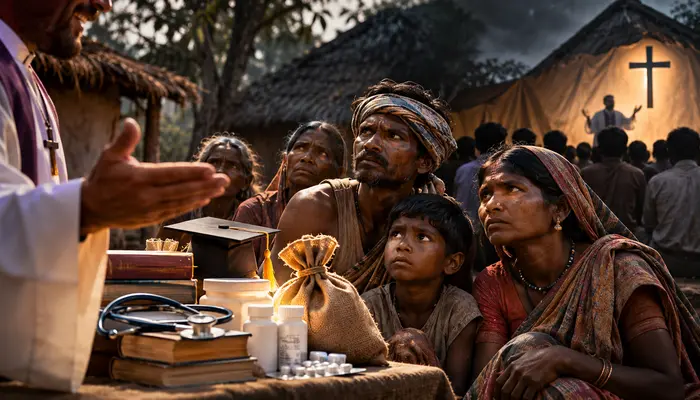
In Kabirdham district, Chhattisgarh, 61 Hindus from 10 villages in the tribal-dominated Kui-Kukdur forest region were brainwashed for religious conversion in prayer meetings through promises of healthcare benefits, education, employment and medicines. All 61 individuals later returned to Hinduism during a Ghar Wapsi ceremony, a Hindu reversion event in which people who had moved away from their ancestral faith returned to their original religion and traditional cultural practices. According to reports, several villagers came into contact with prayer meetings after being offered various benefits, including relief from health problems, education, employment opportunities, and medicines. One participant, identified as Ramlal, said he was taken to a prayer gathering after being promised health benefits. Recounting his experience, he said that for nearly three years he could not distinguish right from wrong. However, he eventually realised the significance of his ancestral faith and traditions and decided to return to his original religion. Other participants also described their return as an effort to reconnect with their traditional beliefs, ancestral customs and cultural roots. The development came amid growing concerns and discussions in the forest villages of Kabirdham district about religious conversion and preserving tribal and Baiga cultural identity. Sustained outreach and awareness activities had been underway across the forest villages. The tribal, Baiga and Sarvsamaj representatives had been holding meetings and engaging with villagers for the preceding three months, familiarising them with their traditional religious beliefs, centuries-old worship practices, customs and ancestral cultural heritage. Also, Hindu community members had been visiting villages and households for the past six months to counsel residents and reconnect them with their traditional faith and practices. Following these discussions and awareness initiatives, 61 people from 10 villages decided to return to their ancestral religious faith. The villages identified included Kushiyari, Karidhap (Badna), Kauanar (Badna), Khairapara (Kushiyari), Ghogharakhurd, Sajankhar, Chhirha, Parevachhapar and Navapara, along with other surrounding rural areas. The programme was organised on November 2, 2026, at Mahidbara Gram Panchayat in the Kui-Kukdur forest region of Kabirdham district, under the initiative of BJP MLA from Pandariya, Bhawna Bohra. Organised as a Sanskriti Gaurav Sammelan and Abhinandan Samaroh, the gathering drew tribal residents, Baiga community representatives, senior community members, and people from different sections of Sarvsamaj. Addressing the gathering, BJP MLA Bhawna Bohra said that 61 people had returned to their original faith, marking another milestone in the Ghar Wapsi campaign. She added that about 500 people had previously returned to their ancestral religion through the initiative. According to Bohra, representatives from various communities had joined the campaign after witnessing instances of religious conversion within their respective communities. She also highlighted welfare initiatives by the Central and Chhattisgarh governments aimed at tribal development, particularly in education, healthcare, employment, and the provision of basic facilities. The Ghar Wapsi programme followed traditional religious rituals and customary practices, with priests and senior community representatives performing the ceremonies. As part of the welcome ceremony, MLA Bhawna Bohra and other senior community office-bearers washed the feet of those returning to their ancestral faith, extending a traditional gesture of respect and honour. The gathering drew people from different sections of society, with attendees expressing their commitment to preserving their ancestral faith, customs and cultural traditions. Itwari Ram, a representative of the Baiga community, said that the entire community had now taken collective responsibility for protecting its culture and identity. He said community members regularly visit villages to guide and counsel residents, drawing inspiration from the Ghar Wapsi initiative launched by Bhawna Bohra. He added that several others remained in contact with community representatives and expressed concern over unauthorised constructions on government land, demanding legal action wherever such encroachments had taken place. He reiterated that the campaign would continue to safeguard tribal traditions and prevent the erosion of the community's cultural identity. Community representatives maintained that the initiative was not a political event but a collective social effort to preserve religious beliefs, ancestral traditions and tribal identity. They said the campaign would continue through village-level meetings, household visits, discussions, and awareness programmes, with representatives from different communities joining hands to protect their traditional religious and cultural heritage.
Why it is Hate Crime ?
The primary category selected in this case is: Predatory Proselytisation. The first subcategory selected is: Conversion/ attempts to convert by inducement Predatory Proselytisation is not just limited to threat, harassment, force and violence, but it also has contours of stealth. In several cases, the Hindu victim is exploited to convert, with non-Hindus taking advantage of their poverty. In such cases, the Hindu victim who is suffering financially is offered monetary benefits, including lucrative offers for jobs, health treatment, education, etc, to induce the victim into changing his/her religion. In such cases, the religious identity of the victim and the aim to disenfranchise him from his faith form the heart of the crime. Also, taking advantage of and exploiting an individual’s economic vulnerabilities is widely acknowledged as exploitation, forms of which are often penalised by law. Such cases therefore are considered religiously motivated hate crimes since the victim’s religious identity forms the very heart of the crime itself. The other subcategory selected is: Proselytisation by grooming, brainwashing, manipulation or subtle indoctrination. Under this, the tertiary category selected is: Pattern of targeting Hindus. Religious brainwashing essentially means the often subtle and forcible indoctrination to induce someone to give up their religious beliefs to accept contrasting regimented ideas. Religious grooming or brainwashing also involves propaganda and manipulation. It involves the systematic effort, driven by religious malice and indoctrination, to persuade “non-believers’ to accept allegiance, command, or doctrine to and of a contrasting faith. Cases of such grooming or brainwashing are far more nuanced than direct threats, coercion, inducement and violence. In such cases, it is often seen that there is repeated, subtle and continual manipulation of the victim to induce disaffection towards their own faith and acceptance of the contrasting faith of the perpetrator. While subtle indoctrination is widely acknowledged as predatory, an element which is often understated in such conversions or the attempts of such conversion is the role of loyalty and trust which might develop between the perpetrator and the victim. Fiduciary relationships are often abused to affect such religious conversion. For example, an educator transmitting religious doctrine of a competing faith to a Hindu student. The Hindu student is likely to accept what the teacher is transmitting owing to existence of the fiduciary relationship. The exploitation of the fiduciary relationship to religiously indoctrinate victims would also be included in this category. Since the underlying animosity towards the victim’s faith forms the basis of predatory proselytization, such cases are considered religiously motivated hate crimes. This case has been added to the tracker because Hindu villagers were brainwashed into religious conversion to Christianity through promises of healthcare benefits, education, employment and medicines at Christian prayer meetings. The inducements exploited the health concerns and vulnerability of Hindu families, using assurances of assistance and improved well-being to influence their religious decisions. By offering promises of healing and material assistance to influence religious conversion, the accused exploited the medical distress, vulnerability and hopes of Hindu villagers, coercing families into changing their religious faith in exchange for assistance. The exploitation of Hindu religious and cultural identity had begun with the use of material inducements to draw villagers into Christian prayer meetings. Hindu villagers were lured by promises of healthcare benefits, education, employment, medicines, and other forms of assistance. These inducements had exploited the economic and social vulnerabilities of Hindu families, turning their need for essential facilities into an opportunity to influence their religious beliefs. Rather than respecting their ancestral faith and allowing them to exercise their religious freedom independently, the individuals involved had linked material assistance with participation in Christian religious gatherings. This undermined the religious autonomy of Hindu households and weakened their connection with ancestral beliefs, traditional worship and generations-old customs. By exploiting the basic needs of Hindu villagers to facilitate a departure from their inherited faith, this brainwashing struck at the religious dignity, cultural identity and spiritual heritage of the affected communities. More seriously, the promise of healing and relief from illnesses had been used as a means of influencing Hindu villagers to convert to Christianity. The fear, distress and desperation of Hindu families struggling with health problems had been exploited, turning their hopes of recovery into an instrument of religious conversion. By associating Christian prayer meetings with promises of health benefits, they had taken advantage of vulnerable Hindu families at a time when they had needed genuine medical assistance and support. This had not only interfered with their independent religious choices but had also drawn them away from their ancestral faith by exploiting their suffering and emotional vulnerability. Ramlal, one of the victims, illustrated the impact of these practices. He stated that he had been taken to a prayer gathering after being promised health benefits and that, for approximately three years, he had struggled to understand what was right and wrong before realising the importance of his original faith and traditions. The use of illness and the promise of healing to secure religious conversions had represented a grave exploitation of Hindu families and an assault on their religious and cultural continuity. The Christian faith, by its very theological foundations, places a strong emphasis on proselytisation. In pursuit of conversion objectives, Christian evangelists often employ unethical means, ranging from psychological pressure and misinformation to inducements such as money or jobs. In such cases, Christian missionary groups often target and brainwash socially and economically vulnerable Hindus to further their agenda of religious conversions. This form of coercion strips Hindus of their agency and dignity and enforces forced conversions. These are not random or isolated incidents, but rather premeditated efforts to undermine the Hindu faith, persuade Hindus to discard their own faith, and convert to Christianity. Such acts are deeply rooted in religious animosity towards Hindu victims, and thus amount to a clear instance of a religiously motivated crime. Disclaimer: The Hinduphobia Tracker records incidents based on when an event occurred or when the victim's ordeal began. It is important to clarify that none of the media sources covering this case has specified the exact date when the incident occurred. However, a victim, Ramlal, stated that the brainwashing began three years ago, which was in 2023, and the first media report was published on 2 November 2026. By aligning both, we have taken the incident date as 2 November 2023. Therefore, for documentation purposes, we have recorded the date as 2 November 2023.
Victim Details
Total Victim
61
Deceased
0
Gender
- Male 0
- Female 0
- Third Gender 0
- Unknown 61
Caste
- SC/ST 61
- OBC 0
- General 0
- Unknown 0
Age Group
- Minor 0
- Adult 0
- Senior Citizen 0
- Unknown 61


Case Status
Unknown


Perpetrators Details
Perpetrators
Christian Extremists
Perpetrators Range
Unknown
Perpetrators Gender
unknown
 Sources



