Anti-Hindu hatred on display; violent slogans targeting popular Hindu outfit raised at Islamic university in Delhi
 New Delhi, Delhi, India
 22 October, 2026
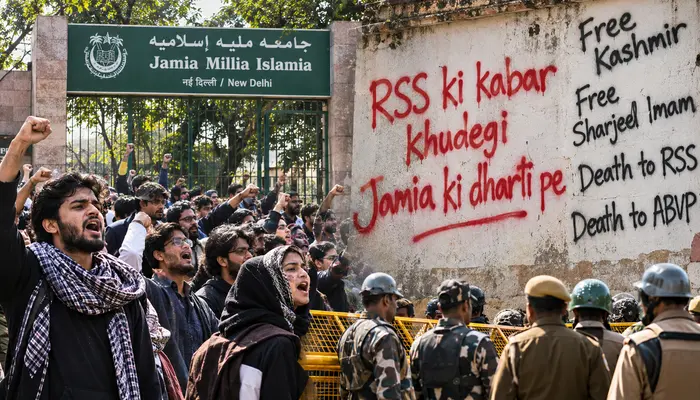
Case Summary
At Jamia Millia Islamia University in Delhi, violent slogans targeting the Rashtriya Swayamsevak Sangh (RSS), a revered Hindu organisation, were raised by left-wing and Muslim students. The perpetrators raised slogans such as “RSS ki kabar khudegi, Jamia ki dharti pe” (The RSS's grave will be dug on the soil of Jamia), threatening the Hindu organisation with violence. Furthermore, anti-Hindu and anti-India slogans, including “Free Kashmir”, “Free Sharjeel Imam”, “Death to RSS” and “Death to ABVP”, were also written on the university walls. The incident occurred amidst prolonged protests by left-wing and Muslim students demanding the restoration of student union elections, which had not been conducted at the university for nearly two decades. The agitation, which began on 12 October 2026, was led by the All India Students' Association (AISA), a left-wing organisation affiliated with the Communist Party of India (Marxist–Leninist). What began as a protest demanding student representation escalated into anti-Hindu sloganeering, with the RSS being directly targeted through violent threats. Other slogans raised during the agitation included “BJP ki kabar khudegi, Jamia ki dharti pe” (The BJP's grave will be dug on the soil of Jamia) and “Islamophobia ki kabar khudegi, Jamia ki dharti pe” (The grave of Islamophobia will be dug on the soil of Jamia). On 26 October 2026, the university administration accepted several key demands of the protesting students. An official notification announced that student union elections would be held within 15 days of the approval of the students' union constitution. It also revoked suspension orders and show-cause notices issued to students during the protests and announced the formation of a committee to investigate the conduct of university security personnel. However, the protesters refused to withdraw their agitation, claiming that the administration had not provided a fixed deadline for approving the union constitution or conducting the elections. They also demanded the resignation of the Proctor. Despite the administration's acceptance of these demands, the protests continued. Amidst the continuing agitation, more controversial anti-Hindu and anti-India slogans appeared on university walls on 23 October 2026. These included “Free Kashmir”, “Free Sharjeel Imam”, “Death to RSS” and “Death to ABVP”. The slogan “Free Kashmir” advocated Kashmir's separation from India, while “Free Sharjeel Imam” expressed support for Sharjeel Imam, a Muslim activist who is one of the co-conspirators in the February 2020 anti-Hindu Delhi riots. The slogans “Death to RSS” and “Death to ABVP” directly targeted Hindu organisations, including the Rashtriya Swayamsevak Sangh and the Akhil Bharatiya Vidyarthi Parishad (ABVP), a prominent Hindu student organisation associated with the RSS. The university administration subsequently removed the graffiti using chemical agents. It also noted that closed-circuit television (CCTV) wiring had been tampered with or cut in the specific areas where the slogans appeared. Meanwhile, the prolonged agitation had severely disrupted university activities. On 24 October 2026, the administration shifted all classes online as a precautionary measure amidst escalating tensions and security concerns. The situation deteriorated further over the weekend, with protesters attempting to enter the campus by climbing walls fitted with barbed wire and metal spikes. Scuffles broke out between demonstrators and security personnel, while students on a hunger strike locked themselves inside the Department of Political Science. More than 500 students gathered on 25 October 2026 to support the agitation, and several important campus areas, including the central library, university canteen and Gulistan-e-Ghalib, were cordoned off, restricting access for regular students. The university administration also lodged a complaint, following which Delhi Police registered a First Information Report (FIR) naming Congress MPs Imran Masood and Imran Pratapgarhi for trespassing on university premises and inciting unrest among students. Registrar Mahtab Alam Rizvi stated that political leaders were exploiting the agitation for political purposes. He specifically stated that Imran Masood had entered the campus by climbing over a boundary wall on 23 October 2026 and had publicly demanded justice for Sharjeel Imam. Meanwhile, student groups claimed that university security personnel had assaulted protesters during negotiations. On 27 October 2026, Delhi Police imposed Section 163 of the Bharatiya Nagarik Suraksha Sanhita (BNSS) outside the university to prohibit unlawful gatherings and assemblies, following a fresh call for agitation by AISA. Security was heightened, with personnel from the Delhi Police, Central Reserve Police Force (CRPF), Central Industrial Security Force (CISF) and Indo-Tibetan Border Police (ITBP) deployed around the campus. Barricades carrying warnings about the restrictions were installed outside the university gates. Despite the administration's acceptance of several demands and prolonged negotiations, the standoff continued, with protesters refusing to withdraw their agitation. Notably, Jamia Millia Islamia has repeatedly been at the centre of contentious political mobilisation involving left-wing student organisations and Muslim activist groups. This was particularly evident during the anti-Citizenship Amendment Act (CAA) protests of December 2019, when Jamia emerged as one of the principal centres of the agitation. The wider anti-CAA protests also witnessed provocative slogans targeting Hindutva, a pro-Hindu political and civilisational movement. At Aligarh Muslim University (AMU), students raised slogans such as “Hindutva ki kabr khudegi, AMU ki dharti par” (Hindutva’s grave will be dug on the soil of AMU), reflecting the anti-Hindu rhetoric that accompanied the agitation. The anti-CAA mobilisation subsequently became central to the investigation into the February 2020 anti-Hindu riots in north-east Delhi. The riots witnessed Hindu residents being brutally killed and Hindu homes, shops and other properties being attacked by violent Muslim mobs. The Delhi Police chargesheets detailed an organised conspiracy in which student activists and members of Muslim and left-wing groups used anti-CAA protest platforms, mobilisation networks and road blockades to escalate tensions and facilitate communal violence against Hindus. The investigation specifically examined the role of the Jamia Coordination Committee and activists associated with the wider protest movement, naming several individuals, including Jamia students and members of left-wing organisations. The violence claimed 53 lives and left hundreds injured.
Why it is Hate Crime ?
This case is being added to the tracker under the primary category: Hate Speech against Hindus. The subcategory selected is: Violent Threats. Violent threats, explicit, implicit or implied, is the most dangerous form of hate speech since it goes beyond discriminatory and prejudicial language to express the intent of causing harm to an individual or a group of people based on their religious identity and faith. There could be several different kinds of threats that are issued to Hindus based on religious animosity. An explicit threat would mean the direct threat of violence towards an individual Hindu, a group of Hindus or Hindus at large. Physical violence, death threats, threats of destruction of property belonging to Hindus and threats of genocide would mean explicit threats against Hindus for their religious identity. Implicit threats may not be a direct threat but implied through the use of symbols of actions – for example – in the Nupur Sharma case, other than explicit threats, there were also implicit threats when Islamists took to the streets to burn and beat her effigies. It implies that they want to do the same to Nupur Sharma – thereby is considered an implicit threat. Violent threats can be delivered in person, through letters, phone calls, graffiti, or increasingly through social media and other online platforms. It would be important to understand that a threat – explicit or implicit, online or offline – to an individual who happens to be a Hindu does not qualify as a religiously motivated threat. Such a threat, while vile and dangerous, could be owing to non-religious reasons and/or personal animosity. To qualify as a religiously motivated threat, it would need to exhibit an indication that the individual is being targeted for religious reasons and/or owing to his/her religious identity as a Hindu. This case constituted an anti-Hindu hate offence as Muslim and left-wing students raised violent slogans targeting prominent Hindu organisations and threatening them with death and violence. Slogans such as “RSS ki kabar khudegi” (The RSS's grave will be dug) and “Death to ABVP” explicitly called for violence against organisations associated with Hindu identity and representation. Such threats went beyond political disagreement and demonstrated hostility towards Hindu organisations and the community they represented. The Rashtriya Swayamsevak Sangh (RSS) is a prominent Hindu organisation that has played a significant role in Hindu social and cultural mobilisation. Through its network of volunteers, it promotes Hindu unity, cultural awareness, social service and the preservation of Hindu civilisational identity. The Akhil Bharatiya Vidyarthi Parishad (ABVP), a Hindu student organisation associated with the RSS, works among students and promotes national consciousness, cultural values, student participation and social engagement. Both organisations hold considerable significance for the Hindu community because of their work in representing and advancing Hindu cultural and civilisational interests. Consequently, calls for their deaths and threats of violence against them cannot be dismissed as inconsequential political slogans. The targeting of the RSS must also be understood in the context of the ideological opposition to Hindutva. Hindutva is a unifying ideology that seeks to consolidate Hindu society and preserve its cultural and civilisational identity, which has been systematically eroded and attacked through centuries of Islamic invasions, British colonial rule, Christian theological impositions and religious conversion campaigns. It is not a destructive ideology; rather, it serves as a unifying edifice for Hindus, seeking to strengthen their collective identity and safeguard their civilisational heritage. The RSS has been one of the principal organisations propagating this ideology and advancing Hindu interests. However, the term ‘Hindutva’ is frequently used as a euphemism for Hindu identity itself, allowing hostility towards Hindus, their religious beliefs and their cultural institutions to be disguised as opposition to a political ideology. This semantic manoeuvring makes it easier to justify hostility against Hindus by portraying them as proponents of an ideology supposedly deserving of attack, even when the hostility extends beyond political opposition to target their religious identity and faith. This was clearly demonstrated by the ‘Dismantling Global Hindutva’ conference held in the United States, where Hindutva was equated with Hinduism and the call to dismantle Hindutva extended to Hinduism itself. The distinction between opposing an ideology and targeting an entire religious community is deliberately blurred in this discourse. While left-wing groups and Muslim groups may frame their opposition to the RSS as ideological disagreement, their hostility in this instance was directed at the Hindu community, Hindu unity and the pro-Hindu civilisational ideology that the RSS represents. The threats against the RSS were therefore not merely political threats against an organisation; they were rooted in anti-Hindu hostility and opposition to the collective assertion and preservation of Hindu identity. The targeting of the RSS and ABVP in this manner exposed deep-seated religious animosity towards Hinduism and the Hindu community, making the incident an expression of anti-Hindu hate. The slogan “Free Kashmir”, which was also written on the walls of Jamia Millia Islamia, must be examined against the history of Islamic extremism and terrorism in Kashmir. This was not merely a political statement but an anti-Hindu ideological stand. The slogan has regularly been raised by Muslim extremists who advocate separating Kashmir from India, with the objective of establishing an independent state with a Muslim majority and, in the case of Islamist terrorist organisations, imposing an Islamic order. This demand must be viewed in light of Kashmir’s history as a Hindu-dominated region and the gradual persecution of its Hindu population over centuries. The persecution intensified with the rise of Islamic extremism and terrorism in the late 1980s, when Islamic terrorist organisations targeted Kashmiri Hindus through assassinations, death threats, intimidation and violence, ultimately forcing the mass exodus of the Kashmiri Pandit community from its ancestral homeland in 1990. The campaign of terror transformed the region’s demographic and cultural landscape by driving out a community that had been integral to Kashmir’s Hindu civilisational heritage. Against this historical background, the display of “Free Kashmir” at Jamia, alongside slogans targeting Hindu organisations, reflected hostility towards the Hindu community and its religious identity. The slogan “Free Sharjeel Imam” must be examined in the context of the February 2020 anti-Hindu Delhi riots. Sharjeel Imam was one of the main perpetrators named in the investigation and a principal accused in the larger conspiracy case relating to the riots. The Delhi Police chargesheets identified his role in the planning, mobilisation and escalation of the anti-CAA protests that culminated in the violence. The riots witnessed Hindu residents being brutally killed and their homes, shops and properties being targeted on account of their religious identity. In this context, students at Jamia Millia Islamia writing slogans in support of Sharjeel Imam and demanding his release demonstrated their support for an individual facing prosecution for his role in the anti-Hindu Delhi riots conspiracy. This act reflected hostility towards the Hindu community, particularly in the context of the violence inflicted upon Hindu residents. Overall, since this case meets multiple parameters of a religiously motivated offence, it is being added to the hate crime database of the Hinduphobia Tracker. Disclaimer: The exact number of individuals involved in the incident was not specified. However, the Delhi Police registered complaints against two Muslim Congress leaders, who were identified as the main conspirators and subsequently arrested. Although individuals affiliated with both left-wing groups and Muslim organisations were involved, the religious identity of the perpetrators has been recorded as Muslim, considering the involvement of the two principal accused. Accordingly, the perpetrator count has been recorded as two for documentation and categorisation purposes. The Hinduphobia Tracker records the date of an incident based on when the crime occurred, rather than when it was reported in the media. However, in the present case, media reports did not specify the exact date on which the slogan “RSS ki kabar khudegi, Jamia ki dharti pe” was raised. The only specific date mentioned was 23 October 2026, when anti-Hindu writings, including “Death to RSS” and “Death to ABVP”, were found on the university walls. Therefore, 23 October 2026 has been selected as the indicative incident date for documentation purposes only.


Case Status
Complaint registered


Perpetrators Details
Perpetrators
Muslim Extremists
Perpetrators Range
From 2 To 5
Perpetrators Gender
male
 Sources



