Hindu mathematical legacy erased: New York Time columnist credits Arabs for 'Zero', ignoring its Hindu origin
 Chicago, Illinois, United States
 26 October, 2026
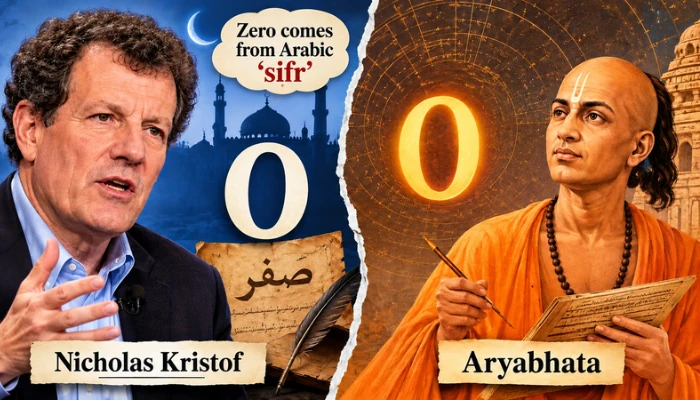
Case Summary
Nicholas Kristof, a columnist at The New York Times, misrepresented the history of zero by falsely attributing its invention to Arabs while overlooking and denying the contributions of the original inventors, the ancient Indian Hindu mathematicians Aryabhata and Brahmagupta. On 27 October 2026, he made this assertion in a post on X, presenting Arabs as the inventors of zero despite the well-established Indian origins of the mathematical concept. The incident arose after an X account, Bulwark Clips, shared a video on 26 October 2026 featuring Robert F. Kennedy Jr., the United States Secretary of Health and Human Services, speaking at a campaign event in Michigan. Kennedy stated: “There are five hundred million Arabs in the world. And yet they don't produce science. They don't win the Nobel Prize. They don't win the Fields Prize. They don't win the Wolf Prize. They don't produce literature.” In response, Kristof wrote: “I'll give RFK Jr. a 0 for this, using Arabic numerals, or perhaps a ‘zero,’ noting that the English word ‘zero’ comes from the Arabic ‘sifr.’” The Hinduphobia Tracker's examination of Kristof's X account revealed that he had been active on the platform since 2008 and had approximately 1.5 million followers. Further examination of his antecedents revealed a longstanding pattern of commentary defending Islam and Muslims against criticism and generalisations. Following the 11 September 2001 terrorist attacks in the United States, Kristof appeared on a television programme and argued against holding the entire Muslim population responsible for the actions of the perpetrators. He emphasised that the world should not blame Muslims collectively, taking a distinctly sympathetic position towards the community. His subsequent writings continued to distinguish between extremist and moderate Muslims while challenging generalisations about Islam and its followers. On 22 September 2010, Kristof published an article titled ‘Message to Muslims: I'm Sorry’, in which he apologised to Muslims for prejudice against them in the United States. He wrote: “Muslims are one of the last minorities in the United States that it is still possible to demean openly, and I apologise for the slurs.” His article centred on discrimination against Muslims and called for greater sensitivity towards their religious identity. Kristof also published an article titled ‘The Muslim Stereotype’ on 10 December 2006, in which he divided Islamic societies into more conservative and more tolerant strands. Rhea Saran criticised his portrayal in her article ‘Kristof's Big Hitch’, published in The Revealer on 13 December 2006. Saran criticised Kristof's simplistic categorisation of Muslims and pointed out the contradictions in his attempt to challenge stereotypes by creating another set of generalisations about Islamic societies. In May 2026, Kristof published another article titled ‘We Can’t Let Paranoia About Islamic Fundamentalism Drive Policy’, carried by The Springfield News-Sun. He criticised what he described as American paranoia about Islamic fundamentalism and argued against allowing fear of Islamist groups to shape public policy. The article continued his longstanding approach of challenging negative perceptions and scrutiny of Islamic fundamentalism. Kristof's treatment of India also attracted criticism. In March 2023, he published ‘Narendra Modi Is the World's Most Popular Leader. Beware’, in which he examined Prime Minister Narendra Modi's popularity and compared his leadership with that of Pakistan's former military dictator General Zia-ul-Haq. Zia had seized power in a military coup in 1977, overthrown the elected government of Zulfikar Ali Bhutto and ruled Pakistan until 1988, pursuing an extensive programme of Islamisation. The comparison drew a parallel between India's democratically elected Prime Minister and a military dictator who had dismantled an elected government. Ronald Radosh also criticised Kristof's approach in his article ‘The Worst Columnist in the Sunday NY Times: Nicholas D. Kristof’, published on 6 September 2010. Radosh challenged Kristof's portrayal of opposition to the proposed Park51 Islamic centre in New York as religious bigotry and criticised his tendency to dismiss criticism of Islam and radical Islamic movements by framing it as prejudice against Muslims. He also questioned Kristof's treatment of Ayaan Hirsi Ali, whose criticism of Islam Kristof had associated with the risk of encouraging religious intolerance.
Case Images

Why it is Hate Crime ?
This case has been added to the tracker under the primary category of - Hate speech against Hindus. Within it, the sub-category selected here is - Anti Hindu subversion and prejudice. Hate speech is defined as any speech, gesture, conduct, writing, or display that is prejudicial against a specific individual and/or group of people, which is leading to or may lead to violence, prejudicial action or hate against that individual and/or group. Media plays a specific and overarching reach in perpetuating prejudicial attitudes towards a community owing to unfair, untrue coverage and/or misrepresentation/misinterpretation, selective coverage and/or omission of facts of/pertaining to issues affecting a specific religious group. This type of bias can dehumanise the victim group, making it easier for others to justify harmful actions against them, which aligns with the objectives of hate speech laws aimed at preventing such harm. It is often observed that the media takes a prejudicial stand against the Hindu community driven by their need to shield the aggressor community which happens to be a numeric minority, however, is the one perpetrating violence against Hindus. For example, the media is often quick to contextualise religiously motivated crimes against Hindus, omit or misrepresent facts that point towards religiously motivated hate crimes, justify and/or downplay religiously motivated hate crimes or simply present fake news to stereotype Hindus. Such media bias leads to the denial of persecution and is often used to dehumanise Hindus, leading to justification for violence against them. For example, the media covered several fake allegations of Hindus targeting Muslims and forcing them to chant Jai Shree Ram. Most of these cases were proved false and fabricated after police investigation. These fake news reports were subsequently never retracted or clarified. Such fake news led to the justification of violence and dehumanisation of Hindus based on the argument that since Hindus targeted Muslims and forced them to chant Jai Shree Ram, the dehumanisation of Hindus and violence against them was par for the course and merely a retaliation. Such media bias leads to prejudicial portrayal of Hindus and offers a justification for violence against them and therefore, is considered hate speech under this category. This case was included in the Hinduphobia Tracker because Kristof deliberately misrepresented the history of zero by attributing its invention to Arabs, while deliberately omitting the foundational contributions of Hindu mathematicians. This was not merely a reference to the Arabic origin of the English word “zero”. It attributed a major Hindu intellectual achievement to another civilisation, erasing Hindu scholars' rightful place in the history of mathematics. The history of zero is firmly rooted in ancient Hindu mathematical tradition. The Hindu mathematician Aryabhata, in the fifth century, made significant contributions to the decimal place-value system, while the Hindu mathematician Brahmagupta, in 628 CE, laid down explicit rules for arithmetic involving zero in his treatise Brahmasphutasiddhanta. These developments formed part of the mathematical knowledge that travelled from India to the Arab world. The Sanskrit term shunya was rendered as sifr in Arabic, from which the English word “zero” eventually emerged. The distinction was clear: Hindu scholars developed the mathematical concept, while the word entered European languages through Arabic. By deliberately conflating the Arabic etymology of the word with the invention of the mathematical concept, Kristof reversed the historical sequence and attributed a Hindu civilisational achievement to Arabs. Furthermore, this misrepresentation became particularly significant when examined alongside Kristof's wider commentary on Islam and Hinduism. His writings repeatedly emphasised the need to protect Muslims from generalisations and prejudice, defended the community against criticism and urged a more sympathetic approach towards Islam. In contrast, when writing about India's democratically elected Prime Minister Narendra Modi, he compared him with Pakistan's military dictator Zia-ul-Haq, who had seized power through a coup. This comparison disregarded the fundamental distinction between a democratically elected leader and a military ruler. The disparity was striking: Kristof repeatedly cautioned against prejudice towards Muslims, yet showed no comparable regard for Hindu civilisational contributions or the political leadership of a Hindu-majority nation. His post on zero further reflected this disparity by denying Hindu mathematicians recognition for an achievement developed within their own intellectual tradition. More importantly, Kristof's attribution could not be dismissed as an innocent historical oversight. As a columnist at The New York Times, with approximately 1.5 million followers on X, he possessed the professional standing and resources to verify such a fundamental historical fact. The distinction between the word's Arabic origin and the mathematical concept's Hindu origins was readily verifiable. Yet, he chose to highlight the Arabic connection while completely disregarding the Hindu mathematicians and the Indian mathematical tradition behind it. This deliberate omission, coupled with attributing the invention to Arabs, presented a distorted version of history to a substantial audience. His position made the misrepresentation particularly consequential because his words carried the authority and reach of an influential media figure. Such deliberate distortion did not simply deprive individual Hindu mathematicians of recognition; it diminished Hindu civilisation's contribution to human knowledge. When Hindu achievements were omitted, reassigned or attributed to other civilisations, the historical record itself became a vehicle for prejudice. It created a narrative in which Hindu civilisation was denied credit for its intellectual achievements while others were presented as their originators. Kristof's post followed precisely this pattern. By deliberately attributing the invention of zero to Arabs and erasing its Hindu mathematical foundations, he advanced a distorted account of Hindu history. This constituted anti-Hindu subversion and prejudice and warranted its inclusion in the Hinduphobia tracker.


Case Status
Unknown


Perpetrators Details
Perpetrators
Christian Extremists
Perpetrators Range
One Person
Perpetrators Gender
male
 Sources



