Hindu temple targeted: Armed intruder enters with shoes, tramples prasad, threatens priest at swordpoint and hurls abuses
 Chandigarh, Chandigarh, India
 27 October, 2026
Case Summary
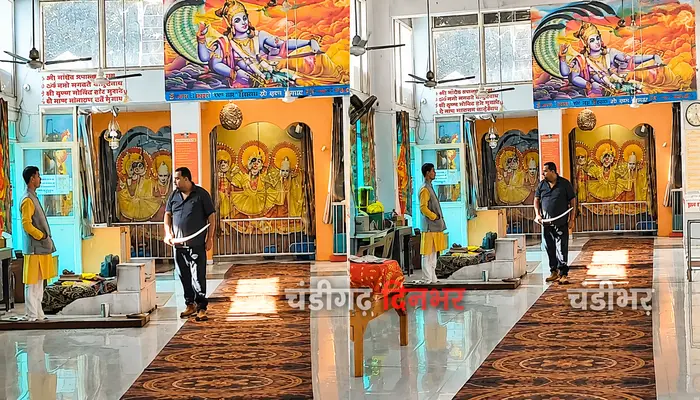
In Industrial Area, Phase 2, Chandigarh, a Hindu temple, Shiv Manas Temple, also known as Guru Ji Temple, was targeted when an armed intruder entered the premises wearing shoes and desecrated Hindu religious offerings by striking the prasad thali with a sword, scattering the prasad and trampling the offerings with his shoes. He damaged the prasad container and the thali, placed a naked sword against the temple priest's neck and threatened to cut his throat. He also hurled abuses and threats at the priest, disrupting the sanctity of the Hindu place of worship. The incident took place on 28 October 2026 at approximately 10:00 am. The intruder arrived at the temple in a Scorpio vehicle carrying an unsheathed sword. He entered the temple premises wearing shoes and immediately began creating a disturbance. His actions caused panic among the devotees and others present inside the temple. The temple priest, Ram Krishna, was present during the incident. During the confrontation, he repeatedly demanded to know the whereabouts of a person he called "Kala Pandit". Despite the priest informing him that no one by that name or description was associated with the temple, the intruder continued to threaten and abuse him. He placed the sword against the priest's neck and threatened to cut his throat. He subsequently struck the prasad thali with the sword, damaging both the plate and the container and scattering the religious offerings. Closed-circuit television (CCTV) cameras installed inside the temple captured the entire sequence of events. Following the incident, the temple committee informed the Chandigarh Police and lodged a formal complaint. Police personnel reached the spot, inspected the temple premises and took possession of the CCTV footage for examination. The footage later surfaced on social media, bringing the incident to wider public attention. In an interview, the temple priest, Ram Krishna, recounted the incident and described how the intruder entered the temple carrying a naked sword, hurled abuses at him, demanded to know the whereabouts of "Kala Pandit" and threatened to cut his throat. The priest also detailed how the intruder struck and damaged the prasad thali and its container. He confirmed that the temple administration had lodged a formal police complaint and was awaiting further updates on the police action. The Chandigarh Police identified the accused as a resident of Sector 19, Chandigarh, who lived in an upscale villa. Deputy Superintendent of Police (DSP), South Division, Gurjit Kaur, stated that the accused was mentally disturbed. Taking his mental-health condition into consideration, the police took him into custody and admitted him to the psychiatric department at Government Medical College and Hospital (GMCH), Sector 32, Chandigarh, for treatment. The police initiated an investigation into the incident, examining CCTV footage and the complaint submitted by the temple committee to establish the circumstances and motive behind it.
Why it is Hate Crime ?
This case is being added to the tracker under the primary category: Attack on Hindu religious representations. The subcategory selected is: Breaking rules of place of worship. Sanatan Dharma is not a religion of one book, which is to say that while it has religious scriptures that form the central tenets of the faith, there are several traditions followed through thousands of years, mostly passed from generation to generation orally. One of these oral traditions or written traditions is the rules of specific temples. Certain temples have rules which are traditional rules, dependent on the worship of the presiding deities. These rules and traditions have been followed for thousands of years whether they find scriptural mention or not. Such traditions are based on the nature and rules of worship of the presiding deity of that temple. Any non-compliance of these traditions owing to animosity towards the faith or for the sake of activism stems not only from the lack of faith in the presiding deity but also disregard for the faith of the devotees of that deity/temple and implicit bias against the faith, the tradition and the deity itself. Since these specific traditions are central to the faith of the devotees of that specific temple and presiding deity, any non-compliance with these traditional rules would be considered a religiously motivated hate crime. The other subcategory selected is: Attack on Temples. In Hinduism, a temple is the abode of the Deity. The Deity in the Temple is consecrated, thereby, making it a real, breathing entity. Hindus believe that not just the Deity but the temple premises itself are sacred to Hindus since Hindus hold the faith that the entire Temple space is an amalgamation of the divine energy of the deity. Given the central significance of Temples in Hindu Dharma, any attack against a Hindu Temple or its peripheral premises is an attack on the faith itself and is born out of animosity towards the faith, of which, the Temple is a central tenet. Any manner of attack against a Temple and/or its premises would therefore be considered a religiously motivated hate crime. The other subcategory selected is: Defiling religious customs. Sanatan Dharma is not a religion of one book, which is to say that while it has religious scriptures that form the central tenets of the faith, there are several traditions followed through thousands of years, mostly passed from generation to generation orally. There are several such customs and traditions that are followed by various Hindus and Hindu sects. Defiling of these traditions and customs is a breach of an individual or group’s religious practices. Such practices can range from dietary restrictions like not eating non-vegetarian food for a certain period of the year, not eating non-vegetarian food at all, not eating beef since the cow is considered holy in Hinduism, the sanctity of religious customs followed in the house (like many ISCKON devotees), etc. Any malicious action leading to the breach of such traditions or defilement of these traditions owing to animosity towards the faith or for the sake of activism stems not only from the lack of faith in the religion itself but also from disregard for the faith of the devotees who follow the customs/traditions and implicit bias against the faith, the tradition itself. Since these specific traditions are central to the faith of the devotees of that specific sect of Hindus, any non-compliance with these traditional rules would be considered a religiously motivated hate crime. This case is a clear example of a religiously driven hate crime because the sacred prasad at Shiv Manas Temple was desecrated when an armed intruder entered the temple wearing shoes, trampled the offerings and threatened the priest at swordpoint. The act targeted a sacred component of Hindu worship, violated the sanctity of the temple, disrupted religious activities and offended the sentiments of Hindu devotees. Of particular significance was the violation of Hindu temple customs through entry with footwear: Entering a Hindu temple with shoes on constituted a blatant disregard for the religious customs, traditions and sacred discipline governing Hindu places of worship. Removing footwear before entering a temple is a deeply rooted Hindu practice that symbolises reverence, humility, and respect for the divine presence. The intruder's disregard for this fundamental custom showed flagrant contempt for the temple's religious sanctity and the traditions upheld by Hindu devotees. By bringing footwear into a sacred space where worshippers gathered to pray and perform religious rituals, he violated the customary boundaries of Hindu worship and insulted the religious sentiments of devotees. Such conduct struck at the very principles of reverence, purity and discipline that governed Hindu temple traditions. Even more egregious was the desecration of sacred prasad through deliberate destruction and trampling: Prasad occupies a deeply sacred position in Hinduism, as it represents food offered to the deity and subsequently received by devotees as divine blessings. It is not ordinary food but an integral part of Hindu worship, carrying immense spiritual and religious significance. The act of striking the prasad thali with a sword, smashing the offering container and plate, scattering the sacred offerings and trampling them underfoot with shoes constituted a blatant desecration of Hindu religious offerings. By subjecting prasad to such humiliation and contempt, the intruder violated an essential element of Hindu religious observance and profaned something that devotees hold sacred. Trampling the offerings with footwear further intensified the desecration, turning a symbol of devotion and divine blessing into something deliberately degraded and defiled. This act represented a direct affront to Hindu religious traditions and the sentiments of Hindus. Equally grave was the armed intrusion into Shiv Manas Temple and the disruption of Hindu religious activities: Entering the temple with an unsheathed sword constituted a brazen intrusion into a Hindu place of worship with a weapon of intimidation and violence. A Hindu temple is a sacred institution dedicated to the worship of deities, the observance of religious traditions and the spiritual practices of devotees. The intruder's armed entry violently disrupted this religious environment and brought fear and intimidation into a space meant for prayer, devotion and spiritual tranquillity. Carrying a naked sword into the temple, creating a disturbance and disrupting religious activities demonstrated flagrant disregard for the sanctity of a Hindu religious institution. His conduct violated the right of Hindu devotees to worship without intimidation and turned a sacred place into a scene of fear and religious disruption. The intrusion was particularly serious because it involved the desecration of religious offerings and the intimidation of the temple priest within the very premises dedicated to Hindu worship. Most alarming was the violent intimidation of the Hindu priest through a direct threat to his life: Placing a naked sword against the priest's neck and threatening to cut his throat constituted a grave act of violence and intimidation against a Hindu religious functionary inside his place of worship. Hindu priests hold an important position within religious institutions, as they perform sacred rituals, facilitate worship, uphold temple traditions and serve the spiritual needs of devotees. Threatening a priest with a deadly weapon while he was carrying out his religious responsibilities represented a direct assault on his dignity, safety and the functioning of the temple itself. The intruder further compounded the intimidation by hurling abuses at the priest. Threatening to slit the throat of a Hindu priest inside a sacred Hindu institution was an especially disturbing violation of the security and dignity owed to religious personnel. The intimidation also terrorised devotees present at the temple, disrupted the atmosphere of worship and instilled fear among those gathered at a place of religious devotion. Such conduct constituted a serious affront to Hindu religious institutions, their priests and the devotees who depended on them for the peaceful observance of their faith. Accordingly, this case has been documented in the Hinduphobia Tracker's Hate Crime Database as an instance of religiously motivated hostility directed against Hinduism and the religious identity of the Hindu community. In several cases of vandalism and desecration of Hindu places of worship, a usual trope to shield the perpetrator is to attribute the crime to the mental health of the accused, claiming that the crime was committed because the perpetrator was ‘mentally ill’ or ‘mentally unstable’. The police and the media, in many such cases where the crime has been committed against the Hindu faith by a non-Hindu perpetrator, deny that the crime committed was in any way motivated by a religious bias and attribute it to the perpetrator’s mental health. Many a time, the police downplay incidents of low-level communal crime because it is their jurisdiction that comes under question. The police also often say that the crime was committed because the accused was mentally unstable, because they wish to ensure that, owing to the crime already committed, there is no further flare-up in the area. In fact, there are many cases where this strategy has been used by the media to downplay such incidents; for example, the attack on the Gorakhnath temple or the incident in Telangana where two Muslim women wearing burqa tried to damage temple and church idols. Likewise, in this case too, when a man was caught desecrating the Hindu temple, trampling sacred prasad and threatening the Hindu priest at swordpoint, the Chandigarh Police attributed his actions to his mental-health condition. The use of the "mental illness" explanation in cases involving attacks on Hindu temples and religious practices raises critical questions. If the perpetrator's actions were entirely attributable to mental instability, why did his conduct specifically involve the desecration of Hindu religious offerings, violation of Hindu temple customs and intimidation of a Hindu priest inside a Hindu place of worship? This selective targeting of sacred Hindu elements warrants scrutiny into whether religious animosity played any role in the incident. The repeated use of this narrative to downplay crimes against Hindus reflects a strategic effort to whitewash religious hatred, obscuring the true motivations and intentions behind the attacks.
Victim Details
Total Victim
1
Deceased
0
Gender
- Male 1
- Female 0
- Third Gender 0
- Unknown 0
Caste
- SC/ST 0
- OBC 0
- General 1
- Unknown 0
Age Group
- Minor 0
- Adult 1
- Senior Citizen 0
- Unknown 0


Case Status
Arrested


Perpetrators Details
Perpetrators
Others
Perpetrators Range
One Person
Perpetrators Gender
male
 Sources



