Hindu residents offered inducements for religious conversion by Christian pastor under the guise of healing meetings
 Lucknow, Uttar Pradesh, India
 31 October, 2026
Case Summary
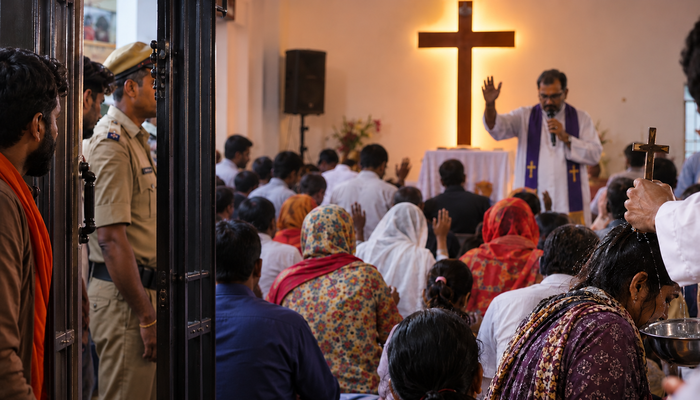
In Lucknow, Uttar Pradesh, Hindu residents were targeted for religious conversion under the guise of prayer meetings and curing illness by a Christian pastor. The incident occurred on 1 November 2026, when religious conversion activities were being conducted under the guise of healing meetings at a rented house in D Block of Rajajipuram, near Ratnam Eye Hospital. Workers of the Vishwa Hindu Parishad (VHP) and Bajrang Dal reached the premises after receiving information that people were being encouraged to convert to Christianity during prayer and healing gatherings. According to Bajrang Dal district coordinator Anuj Sharma, the house belonged to a police personnel and had been rented out some time earlier to a Christian priest and his son. A private clinic operated in the front portion of the house, while prayer meetings were conducted in a large hall at the rear. Sharma stated that the organisation had received complaints about religious conversion activities taking place under the guise of these gatherings. After receiving information about preparations for a mass conversion meeting involving approximately 120 people on Sunday, 1 November 2026, he reached the premises with other workers at around 10 am. According to Sharma, a female worker of the organisation entered the premises and found a large number of men, women and children praying inside. When the workers objected to the activities, a confrontation broke out, during which they were manhandled, and attempts were made to snatch their mobile phones. Following this, additional VHP and Bajrang Dal workers arrived at the location. Sharma further stated that a police inspector prevented them from entering the premises and threatened to register an FIR against them if they continued protesting. He also stated that the police allowed some people to leave through the front entrance and others through the rear entrance. The Hindu organisation stated that healing meetings were conducted at the house every Sunday between 9 am and 12 noon. Hindu residents were invited to attend with promises that their illnesses would be cured and that they would be freed from witchcraft. According to the organisation, after being brought to the meetings, attendees were bathed in water and pressured to convert to Christianity. The Hindu organisation also revealed that the same priest had previously conducted similar meetings at a rented house behind the police station in F Block of Rajajipuram, approximately three years earlier. Following protests by Hindu organisations at the time, the priest had been forced to vacate those premises. Following the disturbance, Talkatora police reached the location and took representatives of both sides to the police station for questioning. Inspector Kuldeep Dubey stated that the priest, who was a native of Ramanathapuram in Tamil Nadu, conducted healing meetings with members of the local community at his rented residence. He confirmed that a dispute had broken out between the priest and workers of a Hindu organisation. Anuj Sharma subsequently submitted a written complaint, on the basis of which the police initiated an investigation. The inspector also disclosed that approximately three years earlier, the priest had conducted healing services at a marriage lawn. Following protests by Hindu organisations, those services had been stopped at the venue and the priest had been instructed to conduct the meetings at a church instead.
Why it is Hate Crime ?
This case has been added to the tracker under the primary category of - Predatory proselytisation. Within it, the sub-category selected is - Conversion/ attempts to convert by inducement. Predatory Proselytisation is not just limited to threat, harassment, force and violence, but it also has contours of stealth. In several cases, the Hindu victim is exploited to convert, with non-Hindus taking advantage of their poverty. In such cases, the Hindu victim who is suffering financially is offered monetary benefits, including lucrative offers for jobs, health treatment, education, etc, to induce the victim into changing his/her religion. In such cases, the religious identity of the victim and the aim to disenfranchise him from his faith form the heart of the crime. Also, taking advantage of and exploiting an individual’s economic vulnerabilities is widely acknowledged as exploitation, forms of which are often penalised by law. Such cases therefore are considered religiously motivated hate crimes since the victim’s religious identity forms the very heart of the crime itself. The other sub-category selected here is - Harassment, threats, coercion for conversion. Harassment covers a wide range of behaviours of an offensive nature. It is commonly understood as behaviour that demeans, humiliates, and intimidates a person, including threats and coercion. Harassment and threats, in this case, find their root on discriminatory grounds which has the effect of nullifying a person’s rights or infringing upon his freedom to exercise his right specifically owing to the victim’s religious identity. Verbal and physical threats and psychological or physical harassment are often used against Hindu victims because they choose to practice their professed religion. Religious harassment also includes forced and involuntary conversions by harassment, threats or coercion. Coercion includes intimidatory tactics like force-feeding a Hindu victim beef to convert to another religion, forceful circumcision etc. In several cases documented, non-Hindu perpetrators or those who harbour specific animosity towards Hinduism, harass victims simply based on their religious identity. Such cases often also include harassment to ensure the Hindu victim abandons his/her professed religion and adopts the religion of the perpetrator. Such cases where Hindu victims are harassed to convert to the perpetrator’s religion are rooted in animosity towards the victim’s religious identity and are therefore documented as religiously motivated hate crimes. The incident demonstrated the exploitation of vulnerable individuals through religious inducements, with healing practices being used as a means of facilitating religious conversion. People seeking relief from illnesses and personal difficulties were approached with promises of cures and freedom from witchcraft, creating an opportunity to influence their religious beliefs by exploiting their desperation and vulnerability. Offering incentives or making false promises, especially when directed at vulnerable individuals in need, shows that these incentives are not acts of kindness or charity. Instead, they are calculated moves to exploit vulnerable Hindus because of religion. By providing inducements or promising healing in exchange for conversion, the accused were effectively blackmailing those who might have been desperate for assistance or hope. Such instances are seen in many cases where members of Christian missionary groups target socially and economically vulnerable Hindus to further their agenda of religious conversions. This form of coercion strips people of their agency and dignity and results in coerced conversions. These are not random or isolated incidents, but rather cases deeply rooted in religious animosity towards Hindu victims What was presented as a simple prayer gathering was in reality a covert attempt at religious conversion. These were not genuine community prayers but calculated efforts to exploit the trust of Hindus and manipulate them into abandoning their faith. By conducting such gatherings, the Christian missionaries sought to manipulate vulnerable Hindus, taking advantage of their emotional and social circumstances to push them towards conversion. The priest's previous involvement in similar healing meetings at other venues also established a pattern of conducting such gatherings aimed at targeting Hindus for religious conversion. When individuals or groups focus their efforts on converting members of a particular religion, in this case, Hindus, then it demonstrates a fundamental disregard for the Hindu faith. Conversion, especially when not based on personal conviction but rather on external persuasion or pressure, is not simply about sharing a different belief system. It is an attempt to undermine the values, traditions, and identity of the Hindu community. In this context, the Christian perpetrators specifically targeted Hindus, which demonstrates a lack of respect for Hinduism and its followers. Such actions are carried out to strip Hindu victims of their faith, making it a religiously motivated crime. The Christian faith, by its very theological foundations, places a strong emphasis on proselytisation. In pursuit of conversion objectives, Christian evangelists often employ unethical means, ranging from psychological pressure and misinformation to inducements such as money or jobs. These tactics are designed not as acts of charity but as tools to engineer religious change under the guise of social upliftment, particularly among vulnerable and underprivileged communities. The incident therefore constituted a case of religious coercion through inducement, in which healing promises and ritualistic practices were employed to facilitate conversions. The targeting of people through assurances of curing illnesses and removing witchcraft, followed by pressure to change their religion, formed the central basis for its hate-crime assessment.
Victim Details
Total Victim
120
Deceased
0
Gender
- Male 0
- Female 0
- Third Gender 0
- Unknown 120
Caste
- SC/ST 0
- OBC 0
- General 0
- Unknown 120
Age Group
- Minor 0
- Adult 0
- Senior Citizen 0
- Unknown 120


Case Status
Complaint filed


Perpetrators Details
Perpetrators
Christian Extremists
Perpetrators Range
One Person
Perpetrators Gender
male
 Sources



