Hindu tribal women and children targeted for Christian conversion under the pretext of medical treatment in Ratlam, Madhya Pradesh
 Ratlam, Madhya Pradesh, India
 31 October, 2026
Case Summary
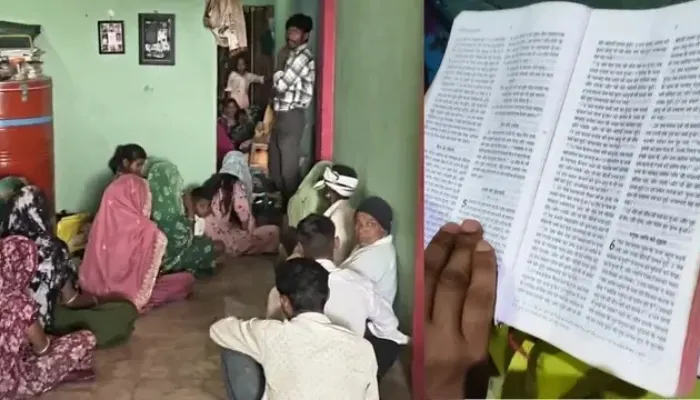
In Raoti, Ratlam district, Madhya Pradesh, Christian missionaries targeted Hindu tribal women and children for conversion to Christianity. The conversions were happening under the pretext of medical treatment. The prayer meeting was held at a house on Station Road on Sunday, 1st November 2026, at around 1:30 PM. Hindu Jagran Manch's Raoti section coordinator, Ritesh Jat, and co-coordinator, Shiva Raikwar, received information about the gathering and alerted the police. Provincial executive member Kamlesh Gwaliyari also informed the Raoti police about the prayer activities. A police team, including a female police officer, reached the house and found tribal women and children seated inside a room. One woman sat on a chair, while the others sat on the floor. During questioning, one woman told the female police officer that the house held prayer meetings. She said hospital treatment was expensive and often did not cure illnesses, while people found relief through prayers at the gathering. The police then searched the room and recovered three Bibles, a pen drive, identity cards and materials related to the prayer meeting. A video of the police action also surfaced. A woman sitting on a chair in the room objected when the police began recording. The police questioned those present and recorded statements from villagers. Raoti Police Station in-charge Manish Dabar said the initial investigation found no evidence of religious conversion. He also said that the attendees had been coming to the prayer meetings for a long time and that no newcomers had been identified. The police continued recording villagers' statements and stated that legal action would follow if evidence of conversion emerged.
Why it is Hate Crime ?
The primary category selected for this case is: Predatory Proselytisation. The subcategory selected is: Conversion/ attempts to convert by inducement. Predatory Proselytisation is not just limited to threat, harassment, force and violence, but it also has contours of stealth. In several cases, the Hindu victim is exploited to convert, with non-Hindus taking advantage of their poverty. In such cases, the Hindu victim who is suffering financially is offered monetary benefits, including lucrative offers for jobs, health treatment, education, etc, to induce the victim into changing his/her religion. In such cases, the religious identity of the victim and the aim to disenfranchise him from his faith form the heart of the crime. Also, taking advantage of and exploiting an individual’s economic vulnerabilities is widely acknowledged as exploitation, forms of which are often penalised by law. Such cases therefore are considered religiously motivated hate crimes since the victim’s religious identity forms the very heart of the crime itself. The other primary category selected is: Proselytisation by grooming, brainwashing, manipulation or subtle indoctrination. The tertiary category selected is: Conversion of minor. Religious brainwashing essentially means the often subtle and forcible indoctrination to induce someone to give up their religious beliefs to accept contrasting regimented ideas. Religious grooming or brainwashing also involves propaganda and manipulation. It involves the systematic effort, driven by religious malice and indoctrination, to persuade “non-believers’ to accept allegiance, command, or doctrine to and of a contrasting faith. Cases of such grooming or brainwashing are far more nuanced than direct threats, coercion, inducement and violence. In such cases, it is often seen that there is repeated, subtle and continual manipulation of the victim to induce disaffection towards their own faith and acceptance of the contrasting faith of the perpetrator. While subtle indoctrination is widely acknowledged as predatory, an element which is often understated in such conversions or the attempts of such conversion is the role of loyalty and trust which might develop between the perpetrator and the victim. Fiduciary relationships are often abused to affect such religious conversion. For example, an educator transmitting religious doctrine of a competing faith to a Hindu student. The Hindu student is likely to accept what the teacher is transmitting owing to existence of the fiduciary relationship. The exploitation of the fiduciary relationship to religiously indoctrinate victims would also be included in this category. Since the underlying animosity towards the victim’s faith forms the basis of predatory proselytization, such cases are considered religiously motivated hate crimes. The religious dimension of this incident arose from the use of prayer and claims of relief from illness at a gathering attended by Hindu tribal women and children. Christian religious material was also found at the venue. The concern was that health-related needs were being used to draw Hindu families into Christian religious activities, while the presence of children raised concerns about their exposure to another faith from an early age. Firstly, the appeal to prayer as a means of curing illness connected religious participation with the need for medical relief. One woman told the police that hospital treatment was expensive and that people received relief through prayers at the gathering. Presenting prayer as an alternative to medical treatment could influence families who were struggling with the cost of healthcare or seeking relief from illness. Using such needs to attract Hindu participants into Christian religious activities exploited their search for treatment and placed religious conversion alongside a promise of physical relief. Secondly, the Bibles and other Christian prayer materials found at the house established the gathering's religious nature. The meeting was not limited to providing medical assistance or general support; it involved Christian prayer and religious material. When health-related appeals were made in this setting, they connected the search for relief with participation in Christian religious practices. This created a route through which Hindu participants could be introduced to a contrasting faith by associating it with healing. Third, the repeated nature of the prayer meetings raised a separate concern about their gradual influence on attendees. The police station in-charge stated that the attendees had been visiting the gathering for a long time, while another account described the meetings as weekly. Repeated exposure to the prayers and teachings of another faith can gradually make its beliefs and practices familiar to participants. Such continued contact can also build trust in the people conducting the meetings, making their religious teachings more influential. Lastly, the presence of children at the gathering made the religious influence on minors an important concern. Children are still developing their understanding of religion and often place trust in the adults who guide them. Regular exposure to the prayers and teachings of another faith can shape their beliefs before they can assess those teachings independently. Their presence alongside adult attendees therefore raised concerns about the effect of repeated religious instruction on their Hindu upbringing and religious identity. The Christian faith, by its very theological foundations, places a strong emphasis on proselytisation. In pursuit of conversion objectives, Christian evangelists often employ unethical means, ranging from psychological pressure and misinformation to inducements such as money or jobs. In such cases, Christian missionary groups often target and brainwash socially and economically vulnerable Hindus to further their agenda of religious conversions. This form of coercion strips Hindus of their agency and dignity and enforces forced conversions. These are not random or isolated incidents, but rather premeditated efforts to undermine the Hindu faith, persuade Hindus to discard their own faith, and convert to Christianity. Such acts were deeply rooted in religious animosity towards Hindu victims, and thus, this case was added to the tracker.


Case Status
Complaint filed


Perpetrators Details
Perpetrators
Christian Extremists
Perpetrators Range
One Person
Perpetrators Gender
female
 Sources



