Only Hindu family in a Muslim-majority locality attacked; makeshift shelter vandalised in Lalitpur, Uttar Pradesh
 Lalitpur, Uttar Pradesh, India
 23 October, 2026
Case Summary
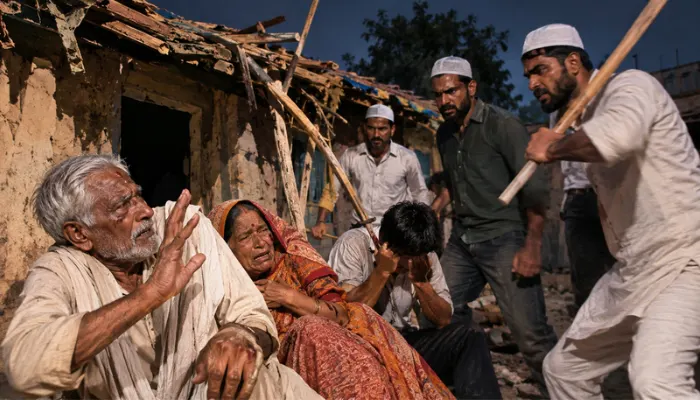
In Lalitpur, Uttar Pradesh, a Hindu family consisting of an elderly couple and their blind son was attacked by a group of Muslim individuals in Mohalla Rawatyana, a Muslim-majority locality where the family was the only Hindu household. The attackers entered the family's residence at night, assaulted its members, threatened them with death, demolished their makeshift hut and ordered them to leave the area. The family had been living in the locality for approximately 40–45 years. The incident took place on 24th October 2026, at approximately 8:45 PM, within the jurisdiction of Kotwali Sadar police station. Jhansi Division VHP coordinator Vijay Bajrangi stated that the attackers entered the family's residence carrying swords and sticks, hurled abuses and beat Lakhan with sticks. When his wife intervened, she was also assaulted, and their blind son was among those attacked. In a video account, the older man described the ordeal. He said that the family was eating and he was scolding his son when a group of Muslims from the neighbourhood barged into his house with sticks and swords. They struck repeatedly on his head and chest. When asked whether he lived in his own house, he replied that it was not his own, but he had been living in the locality for 40–45 years. He described the entire neighbourhood as Muslim and said that living there had become difficult because of the Muslim residents. The blind son specifically stated that they were the only Hindu family in that Muslim neighbourhood and he had been told multiple times by his Muslim neighbours to run away from the area. His account reflected the pressure the family was facing to leave the locality despite having lived there for several decades. Notably, prior to this attack, some Muslim individuals had forcefully encroached upon the Hindu family's property also. The attack, destruction of its shelter and direct orders to leave the area added to the family's insecurity and the pressure it faced to abandon its home and locality. In the video, a member of a Hindu organisation stated that the Muslim individuals had broken into the family's house and beaten its members. The speaker also stated that the attackers had strangled and assaulted the children. He added that they had received information about the matter and would discuss it the following day with Nekpal, Taisheerlal, and the Sub-Divisional Magistrate (SDM). He said such a situation should not arise in Lalitpur and added that if it did and the administration failed to act, they would come and serve the community. Lalitpur Kotwali police registered an FIR on 25th October against two named individuals and other unidentified persons. Police subsequently arrested two individuals and initiated legal proceedings. The Vishva Hindu Parishad (VHP) and Bajrang Dal demanded a time-bound, impartial investigation, protection for the family, and strict action against those responsible. The VHP also raised concerns that the family was being pressured to leave its home. The organisations submitted a memorandum to the Superintendent of Police seeking intervention and security for the family. On Wednesday, 28th October 2026, more than 30 VHP activists staged a sit-in protest at the Ghantaghar (Clock Tower) intersection, blocking traffic and demanding justice for the family. VHP Organisation Secretary Aman, District Vice President Bharat Richhariya, Brijendra Singh Gaur and other activists participated in the demonstration. The protest continued for approximately two hours and ended after SDM Sadar Hemant Patel and CO Sadar Ajay Kumar assured the protesters of a fair investigation and appropriate action. Lalitpur police also confirmed that they had arrested two individuals and initiated legal proceedings.
Why it is Hate Crime ?
The primary category selected for this case is: Attack not resulting in death. The subcategory selected is: Attacked to induce migration from a non-Hindu-dominated area. There have been cases where Hindus living in an area, often with a majority dwelling belonging to non-Hindus or those harbouring animosity towards the Hindu faith, experience threats and violence. The violence is employed with the aim of making the Hindus leave the area and relocate, so the area could be turned into an exclusive ghetto for adherents of the non-Hindu faith or those who harbour animosity towards the Hindu faith. In several cases, the aim of exodus is explicit. However, in several cases, the demand for the exodus of Hindu residents is not explicit; violence by non-Hindu residents leaves the Hindu residents no option but to leave the area, thereby turning the area into an exclusive ghetto of non-Hindu residents. In such cases, there are instances of violence against the Hindu residents explicitly. For example, in the Hauz Qazi case of 2019, the Muslim residents claimed that mob violence against the Hindu residents had been triggered by a parking dispute. However, the violence did turn religious with a temple being desecrated and was directed specifically against the Hindu residents. The Hindu residents of the area were clear that the violence was religiously motivated, and one of the motives was to affect an exodus of the Hindu residents. In such cases, even if the perpetrators have not explicitly expressed an aim to force an exodus, the circumstances, violence, and precedent point to that intention and would therefore be categorised under this sub-category. Such crimes are religiously motivated and therefore are hate crimes. The religious dimension of this case lies in the vulnerability of a Hindu household living as a religious minority in a Muslim-majority locality. When a family is singled out in such circumstances and pressured to abandon its home, the issue extends beyond an ordinary neighbourhood dispute. It raises concerns about whether Hindus can continue to reside in areas where they lack the support of a wider community. No religious majority has the right to determine whether a Hindu family is entitled to remain in its own locality. The demand that the family leave the area is particularly significant because it establishes an explicit element of forced displacement. Violence becomes a means of coercion when it is accompanied by a demand that the victims surrender their residence and relocate. Such intimidation communicates that their continued presence is unwelcome and that refusing to leave may expose them to further harm. This undermines the fundamental right of Hindu families to live in their homes without being forced out on account of their religious identity. The issue of property adds another dimension to the family's vulnerability. When land and residential security are compromised alongside physical safety, the pressure on a minority household becomes both social and economic. Property is not merely an asset; it represents stability, independence and the ability to maintain a permanent presence in a locality. Dispossession can therefore become an instrument of displacement, weakening a family's ability to resist pressure to relocate and retain its place in the community. The fact that this was the locality's only Hindu household makes the consequences of its displacement especially serious. Its departure would remove the remaining Hindu presence from the area, leaving no Hindu household in a locality already dominated by another religious community. This is how the forced migration of even a single family can contribute to the religious homogenisation of an area. The exclusion of minority households should not be treated as an isolated personal tragedy when it also changes the religious composition of the locality. The use of violence against an entire household also carries a wider message of intimidation. When elderly family members and a person with a disability are not spared, it demonstrates the extent to which the household's vulnerability is exploited. Such violence can instil fear not only in the immediate victims but also in other minority residents who may witness the consequences of resisting pressure to leave. It creates conditions in which migration becomes a means of escaping hostility rather than a voluntary decision. A person's right to reside in a locality cannot depend on whether their religious community forms the majority there. Hindu families are entitled to the same security of residence, protection of property and freedom from intimidation as every other citizen. Allowing violence and threats to determine who may continue living in a neighbourhood would effectively place the rights of religious minorities at the discretion of the local majority. Such coercion has no place in a society governed by equal citizenship and the rule of law. The circumstances of this case therefore reflect the use of violence and intimidation to induce the migration of a Hindu family from a non-Hindu-majority locality. The explicit demand for its departure, combined with the wider pressure on its residence and property, gives the attack a clear displacement dimension. Forcing the only Hindu household to leave would not merely deprive one family of its home; it would eliminate the remaining Hindu presence from the locality. This is a serious form of religious exclusion in which violence is used to make the continued presence of Hindus untenable. Here it is also important to note that the fact that the group of Muslims took offence at the Hindu family merely living in the area they consider a "Muslim area" reveals a disturbing sense of Islamic supremacy harboured by the attackers. In this case, the perpetrators viewed the predominantly Muslim-occupied region as an exclusive zone where non-Muslims, particularly Hindus, were unwelcome. This sense of entitlement and superiority not only reflects deep-seated prejudice but also highlights an attempt to assert religious dominance over public spaces. The assault on the family was motivated by this supremacist ideology, where Islamists in the area looked down upon Hindus, believing that they had the right to dictate who could move freely through their community. The act of attacking the family for simply living in the area illustrates a dangerous mindset rooted in exclusion, intolerance and religious animosity, making this case an ideal example for inclusion in a hate tracker.
Victim Details
Total Victim
3
Deceased
0
Gender
- Male 2
- Female 1
- Third Gender 0
- Unknown 0
Caste
- SC/ST 0
- OBC 0
- General 0
- Unknown 3
Age Group
- Minor 0
- Adult 1
- Senior Citizen 2
- Unknown 0


Case Status
Arrested


Perpetrators Details
Perpetrators
Muslim Extremists
Perpetrators Range
From 2 To 5
Perpetrators Gender
male
 Sources



