800-year-old idol of Lord Purushottam Narayan vandalised at ancient Hindu temple in Ujjain, Madhya Pradesh
 Ujjain, Madhya Pradesh, India
 28 October, 2026
Case Summary
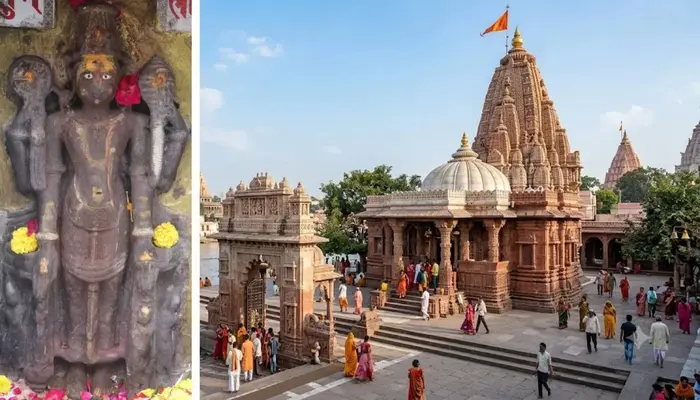
In Ujjain, Madhya Pradesh, the 800-year-old idol of Lord Purushottam Narayan at the ancient Shri Purushottam Narayan Temple was vandalised by unidentified miscreants, who broke off the nose of the deity's idol. According to reports, the incident took place on the night of 29 October 2026, at the Shri Purushottam Narayan Temple located near Kshirsagar in Ujjain, during the auspicious month of Kartik. The damage was discovered the next morning, following which the temple priest, Pandit Shankar Laxminarayan Joshi, lodged a complaint with the police. The Shri Purushottam Narayan Temple held special religious significance as one of the nine ancient Narayan temples of Ujjain, with the ancient idol of the deity enshrined inside it. The incident angered devotees. The temple had no entrance gate at the time of the incident, leaving its premises open and accessible. According to the temple priest, a brass gate had been installed at the temple a few years earlier for security purposes, but thieves had broken it and stolen it. The temple's brass urn had also previously been stolen. Despite these repeated incidents, no proper security arrangements had been made to protect the ancient shrine. The lack of security was suspected to have enabled unidentified individuals to enter the temple and damage the idol. Yogesh Pal, curator and archaeologist at the Triveni Art Museum, stated that the idol of Lord Vishnu appeared to date back to the 12th or 13th century. The sandstone sculpture was considered significant from an archaeological and artistic perspective. The four-armed idol featured a conch and a mace in its two upper hands, while one of its lower hands held a conch and the other was positioned in the Varada Mudra, a gesture associated with granting blessings. The idol was also adorned with intricately carved ornaments. The vandalism created a dilemma for the temple priests regarding the continuation of worship. According to the report, the priests stated that Sanatan Dharma traditions prohibited the worship of damaged idols. They were therefore examining religious scriptures to determine whether a new idol should be installed in the temple or whether worship could continue with the original, damaged idol. The incident thus not only damaged an ancient and historically significant Hindu deity but also disrupted the religious practices associated with the shrine.
Why it is Hate Crime ?
This case has been added to the tracker under the primary category: Attack on Hindu religious representations. The subcategory selected is: Desecration of Hindu religious symbols. Icons and symbols or a religious representation of a spiritual ideal are widely revered in Hinduism. Iconography is of vital significance in the Hindu milieu. It helps connect people’s spiritual beliefs with the real world. Iconography within the Hindu faith takes several shapes and forms. Murtis are of most significance to Hindus, to which daily rituals, prayers and offerings are done. Besides the murtis, there are several other symbols which have deep significance in the Hindu faith – the Om and Swastika for example. Since these Hindu religious symbols hold paramount importance in Hinduism, any desecration of symbols, icons, murtis, religious representations and manifestations, is driven by animosity towards the faith itself which manifests itself through these murtis, icons and symbols. Therefore, any desecration of these Hindu religious symbols and representations is considered religiously motivated hate crimes under this category. The incident constituted an act of vandalism directed at a sacred object of Hindu worship, striking at the religious sentiments and spiritual practices of the Hindu community. The idol of Lord Purushottam Narayan was not merely an archaeological artefact or an ordinary stone sculpture but an object of religious reverence, representing the presence of the deity for devotees who worshipped at the temple. Deliberately damaging the physical form of a Hindu deity therefore carried a religious significance that extended beyond the destruction of property. The breaking of the deity's nose interfered with the sanctity of an object central to Hindu worship and constituted an affront to the faith of the devotees. Furthermore, attacks on Hindu idols and sacred objects cannot be viewed merely through the lens of ordinary property damage when the object targeted is intrinsically connected to religious worship. Hindu temples and their deities occupy a central place in the community's religious and cultural life. Deliberately desecrating such objects can communicate contempt for the faith they represent, undermine the security of religious spaces and intimidate devotees by demonstrating that even their most sacred places of worship are vulnerable to attack. The targeting of a deity's physical representation is particularly significant because it directly affects the object around which worship, rituals and religious observances are organised. The religious significance of the act was further underscored by the consequences it had for the temple's worship practices. In Hindu religious traditions, the condition of a consecrated idol has a bearing on the rituals performed before it. The damage consequently placed the temple priests in a difficult position, as they had to consult religious scriptures to determine whether worship could continue or whether a replacement idol needed to be installed. This demonstrated that the vandalism had consequences beyond physical damage, directly interfering with the religious observances and devotional relationship of the Hindu community with its deity. The act effectively compromised the use of a sacred object for its intended religious purpose. Taken together, the deliberate damage to a Hindu deity's idol, the religious disruption resulting from the desecration and the affront to the devotional sentiments of the Hindu community provided grounds for treating the incident as an attack on a Hindu religious institution and its sacred symbols. Although the perpetrators remained unidentified, such actions stem from religious animosity towards the Hindu faith and its religious symbols. Therefore, this case has been added to the hate crime database.


Case Status
Complaint filed


Perpetrators Details
Perpetrators
Unknown
Perpetrators Range
Unknown
Perpetrators Gender
unknown
 Sources



