Hindu minor girls lured to dargah, brainwashed to convert to Islam and undergo nikah by Muslim individuals; made to wear burqa, perform Namaz and recite Kalma
 Gir Somnath, Gujarat, India
 23 October, 2026
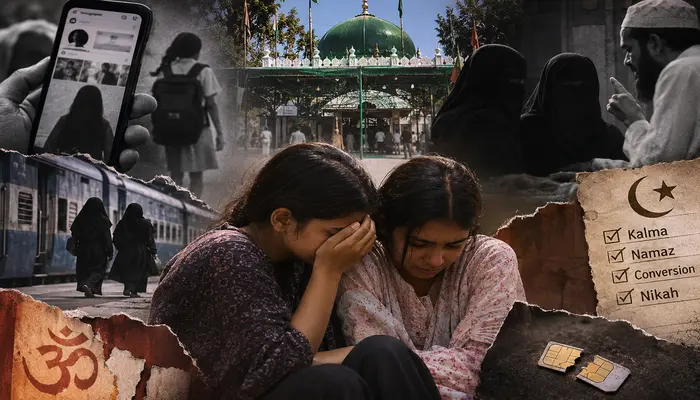
Case Summary
In the Kodinar area of Gir Somnath district, Gujarat, two minor Hindu girls were lured and brainwashed to convert to Islam by Muslim individuals. They were made to wear a burqa, recite the kalma and perform namaz. According to reports, two minor Hindu girls went missing after leaving home for their examinations on 24 October 2026. Based on the complaint lodged by the mother of one of the girls, the Kodinar police initiated an investigation and examined CCTV footage and mobile phone locations. The investigation led the police to Unava village in Unjha taluka of Mehsana district, where a team from Kodinar, with the assistance of local police, traced both girls to the Mira Datar Dargah. The girls were found wearing burqas and were safely rescued and brought back to Kodinar, where female police officers counselled and questioned them. According to the girls’ statements and details recorded in the FIR, one of the victims had met a Muslim girl who introduced herself as Nayrabanu outside her school after examinations on 23 October 2026. Nayrabanu told her that she was staying at her maternal uncle Abdul Haji Sandhi’s house. The following day, after the examinations, the minor victims went to Abdul’s house, where Nayrabanu and Abdul’s three daughters were present. Nayrabanu then invited her to visit the Pani Darwaza shrine in Kodinar for prayers and gave her a black burqa. Both girls wore burqas and travelled to the shrine in an autorickshaw. After returning, Abdul instructed them to proceed to a dargah in Unjha, where a person known as Babli would make arrangements for them. The girls subsequently travelled from Veraval railway station towards Gandhinagar on a train departing at around 9 PM and continued towards Unjha. They travelled in a general compartment without tickets and arranged money for their onward journey. Shakir alias Babli, identified as Saqir Pathan, who had been in contact with one of the minors through Instagram for approximately seven months and had followed her account, picked them up from Unjha railway station in an autorickshaw and took them to the Mira Datar Dargah in Unava. The girls were given black burqas and remained at the dargah for two to three days. During this period, their names were changed; they were made to wear burqas, recite the Kalma and perform Namaz. One of the girls’ Hindu names was changed to Rojitabanu, while another report identified the changed name as Kazi Naira. A Muslim cleric identified as Maulvi Asif Kawali spoke to the minor Hindu girl and persuaded her to leave Hinduism and embrace Islam. He told her that converting to Islam would alleviate her difficulties and bring her benefits. He also made her perform Islamic religious practices and recite the Kalma. The cleric further proposed her nikah to Shakir alias Babli. The investigation also revealed preparations to arrange the nikah of one of the minors to a Muslim youth named Babli. When the people at the dargah learnt that the police were searching for the girls, one of the men instructed them to destroy the SIM cards in their mobile phones to prevent their families and the police from tracing them. The girls subsequently broke their SIM cards. The police registered a case against four individuals: Abdul Haji Sandhi, Shakir alias Babli, identified as Saqir Pathan, Maulvi Asif Kawali, and Nishad Qazi. Abdul had facilitated the girls’ journey from Kodinar, Babli had received them at Unjha railway station and taken them to the dargah, Asif had facilitated the religious conversion, and Nishad had assisted in the operation and was also accused of destroying the girls’ SIM cards. Police arrested three of the four individuals, while Nishad Qazi remained absconding. The police registered the case under Sections 137(2), 87 and 54 of the Bharatiya Nyaya Sanhita (BNS), Section 4(1) of the Gujarat Freedom of Religion Act, Sections 17 and 18 of the Protection of Children from Sexual Offences (POCSO) Act, and Section 3(2)(v) of the Scheduled Castes and Scheduled Tribes (Prevention of Atrocities) Act. The police continued investigating the circumstances surrounding the girls’ disappearance, the attempted religious conversion and nikah, and the possible involvement of other individuals or a wider conversion network.
Why it is Hate Crime ?
This case has been added to the tracker under the primary category of - Predatory Proselytisation. Within it, the sub-category selected here is - Proselytisation by grooming, brainwashing, manipulation or subtle indoctrination, with the tertiary category being - Conversion of minor. Religious brainwashing essentially means the often subtle and forcible indoctrination to induce someone to give up their religious beliefs to accept contrasting regimented ideas. Religious grooming or brainwashing also involves propaganda and manipulation. It involves the systematic effort, driven by religious malice and indoctrination, to persuade “non-believers’ to accept allegiance, command, or doctrine to and of a contrasting faith. Cases of such grooming or brainwashing are far more nuanced than direct threats, coercion, inducement and violence. In such cases, it is often seen that there is repeated, subtle and continual manipulation of the victim to induce disaffection towards their own faith and acceptance of the contrasting faith of the perpetrator. While subtle indoctrination is widely acknowledged as predatory, an element which is often understated in such conversions or the attempts of such conversion is the role of loyalty and trust which might develop between the perpetrator and the victim. Fiduciary relationships are often abused to affect such religious conversion. For example, an educator transmitting religious doctrine of a competing faith to a Hindu student. The Hindu student is likely to accept what the teacher is transmitting owing to existence of the fiduciary relationship. The exploitation of the fiduciary relationship to religiously indoctrinate victims would also be included in this category. Since the underlying animosity towards the victim’s faith forms the basis of predatory proselytization, such cases are considered religiously motivated hate crimes. The other sub-category selected here is - Conversion/ attempts to convert by inducement. Predatory Proselytisation is not just limited to threat, harassment, force and violence, but it also has contours of stealth. In several cases, the Hindu victim is exploited to convert, with non-Hindus taking advantage of their poverty. In such cases, the Hindu victim who is suffering financially is offered monetary benefits, including lucrative offers for jobs, health treatment, education, etc, to induce the victim into changing his/her religion. In such cases, the religious identity of the victim and the aim to disenfranchise him from his faith form the heart of the crime. Also, taking advantage of and exploiting an individual’s economic vulnerabilities is widely acknowledged as exploitation, forms of which are often penalised by law. Such cases therefore are considered religiously motivated hate crimes since the victim’s religious identity forms the very heart of the crime itself. The second primary category selected here is - Crimes against women in relationships and other sexual crimes. Within it, the sub-category selected is Brainwashed and/or groomed, with the tertiary category being - Conversion of minor. In our database, we have not added incidents where women have converted to another religion of their free will and no allegations of forced/involuntary conversion have been made. However, there are certain cases of conversion where the consent itself is a result of the brainwashing or grooming of a minor by the non-Hindu perpetrator trying to victimise a woman for her Hindu religious identity. The phenomenon of grooming points to non-Hindu perpetrators identifying their Hindu victims’ vulnerabilities and exploiting them over months and sometimes years, to extract the supposed ‘consent’ in order to convert their religion. In most cases of grooming, the victims are minors or the grooming started when the victim was a minor. In other cases of grooming, the non-Hindu perpetrator brainwashes and grooms a minor victim to extract their trust and then proceeds to rape them repeatedly with the intent of converting them to their faith. It is pertinent to understand here that when the victim is a minor, the ‘consent’ to convert or enter into a romantic relationship with an adult itself is redundant – addressed by POCSO. While every case of conversion of a minor and incidents of establishing a physical relationship with a minor by an adult is a crime, for the purpose of this database, a case would be considered a hate crime only if there is a distinct religious angle to the grooming. For example, in the UK, if a Hindu minor is targeted by Pakistani grooming gangs, it would be considered a hate crime because the victims are specifically targeted owing to their non-Muslim religious identity with the perpetrators being Muslim. In other cases, if a Hindu minor is brainwashed into entering a physical relationship with the non-Hindu adult perpetrator and the family alleges grooming/brainwashing of the minor to convert her religion, it would form a part of this database. If the victim is a Hindu adult, the case would form a part of this database only if the victim herself says that she was brainwashed/groomed to convert her religion. However, if the victim is deceased (murdered or otherwise), the case would form a part of this database if her family/friends provided testimony that the victim was brainwashed/groomed to convert her religion. Since these crimes have a distinct religious angle where the victim is being targeted owing to her Hindu religious identity, these cases are considered a hate crime. The other sub-category selected here is - Forced conversion before marriage, with tertiary category being - Forced to do nikah, Forced to wear hijab and Forced to follow non-Hindu religious practices.In such cases, a non-Hindu man is in a relationship with a Hindu woman when the pressure to convert her religion begins to manifest. In such cases, typically, two patterns emerge. First, when the relationship is consensual, and the religious identity of the perpetrator is known to the Hindu woman in the relationship, however, at some point during the relationship, the non-Hindu man starts to force the victim to convert her religion and give up her Hindu religious identity. The second is when the woman gets into a marriage with the man pretending to share her faith. Later, when the truth is revealed, the man starts pressuring the woman to convert her religion and give up her religious identity. In both the situations, the methods used to force the victim to convert her religion often revolve around force-feeding beef, forcing her to wear hijab, forcing her to read the Kalma or even pressurizing the victim to do ‘Nikah’, which is marriage under Islamic law, with a prerequisite being conversion to Islam. Cases where a Hindu woman consensually converts to Islam in a relationship will be left out of the hate crime database, even though it could be argued in several cases that the conversion was a result of religious brainwashing. This case constituted a serious instance of targeted religious coercion involving two Hindu minor girls, whose religious identities and vulnerability were exploited to facilitate their separation from their families, their introduction to Islam and the proposed nikah. The significance of the incident lay not merely in the girls having gone missing or being taken to another district, but in the systematic attempts to alter their religious identities and make them abandon their existing faith. Firstly, it is important to note here that the victims were minors, which means the element of consent and genuine change of conscience was missing ab initio. Minors, due to their young age and lack of maturity, are particularly vulnerable to manipulation and coercion. They may not have the ability to fully understand the implications of converting to another religion, and the Muslim perpetrators purposely targeted and exploited this vulnerability of the victim. Since this case exemplifies the use of coercion and manipulation to achieve religious conversion, it is a blatant act of religious hate. Such acts are not merely criminal in nature; they are ideologically charged, revealing religious prejudice and a calculated intent to alter the religious identity of a minor without her volition. The use of grooming, where trust is built only to exploit, is an insidious method that exploits the child’s naivety and dependence. Secondly, the fact that the girls were taken to a dargah and kept there for several days was particularly significant, as the setting facilitated their sustained exposure to Islamic religious practices and enabled those involved to groom them towards accepting Islam by exposing them to Islamic religious practices. Taking the minors away from their homes and familiar surroundings also served to isolate them from their families and wider social circles, cutting them off from the people who could have intervened, supported them or reinforced their existing religious identities. Such isolation would have made the girls more susceptible to psychological manipulation and religious indoctrination, allowing those involved to exercise greater influence over their beliefs and decisions. The circumstances therefore demonstrated a deliberate exploitation of the minors' isolation and vulnerability to facilitate their religious conversion. Thirdly, the involvement of a Muslim cleric further strengthened the religious dimension of the incident. The role of Maulvi Asif Kawali was particularly concerning because he was not merely facilitating the girls' stay at the dargah but was also involved in persuading minors to abandon Hinduism and embrace Islam. His assurances that conversion would alleviate the girl's difficulties and provide her with benefits constituted a form of inducement and psychological grooming intended to influence her religious choices and persuade her to convert to Islam. Such assurances were not incidental remarks but formed part of an effort to make conversion appear beneficial and desirable to a vulnerable minor. By exploiting her difficulties and offering perceived benefits in return for embracing Islam, the cleric sought to influence her beliefs through inducements and manipulation, thereby facilitating the intended replacement of her Hindu religious identity with an Islamic one. Fourth, the proposed nikah of one of the minors also had to be examined in conjunction with the conversion effort. The intention to arrange her nikah to a Muslim youth, after persuading her to leave Hinduism and adopt Islam, indicated an attempt to consolidate the change in her religious identity through a marital arrangement. Under traditional Islamic jurisprudence, a Muslim man’s marriage to a non-Muslim woman is subject to restrictions, and a woman who does not fall within the recognised categories of permissible non-Muslim spouses would be required to embrace Islam for the marriage to be recognised as valid under that framework. The proposed nikah was not an isolated development but formed part of a broader sequence in which the minor was being separated from her family, introduced to another religious identity and prepared for a marriage within that religious framework. The fact that both girls were minors made the circumstances particularly grave, as their religious autonomy and personal safety were being compromised. Fifth, the accused attempted to force the two Hindu minor girls to renounce their religion and embrace Islam. Pressuring Hindu individuals, particularly vulnerable minors, to abandon their religious faith and adopt another is a direct attack on their religious identity and freedom of conscience. This was not merely a matter of personal religious choice, as the use of inducements, psychological grooming and coercive religious practices indicated an effort to bring about their conversion against their existing religious identity. The attempt to replace their Hindu faith with Islam, coupled with the change of their Hindu names and the imposition of Islamic religious practices, demonstrated that their Hindu identity was being specifically targeted for erasure. Such conduct went beyond an ordinary criminal dispute and reflected religiously motivated coercion directed at their identity as Hindus. Sixth, the deliberate imposition of Islamic religious practices on the two Hindu minors further demonstrated the effort to influence and alter their religious identities. Making the girls wear burqas, recite the Kalma and perform Namaz exposed them to Islamic religious practices in a sustained manner, was done with the intention of familiarising them with Islam and making them more susceptible to accepting conversion. These were not isolated or incidental acts, but formed part of a broader effort to distance the minors from their Hindu faith and facilitate their religious assimilation. The change of their Hindu names to Islamic names was equally significant, as it represented an attempt to erase their existing Hindu identities and replace them with identities associated with Islam. Taken together, the imposition of Islamic practices and the replacement of their names indicated a deliberate effort to weaken the girls' connection with their Hindu background and prepare them to abandon their religion. Taken together, the conduct demonstrated a clear religious dimension to the targeting of the two Hindu girls. The attempt to make them abandon Hinduism, replace their Hindu names with Islamic names, adopt Islamic religious practices and prepare one of them for marriage after conversion went beyond ordinary criminality and directly implicated their Hindu religious identities. Such acts are carried out by Muslim perpetrators due to indoctrination by Islamic theology, which advocates that all non-Muslims (referred to as kafirs) are inferior and subject to subjugation unless they convert to Islam or live under Islamic rule (dhimmitude). These ideas are not mere abstractions; they manifest in actions where non-Muslims, especially Hindus in India, are seen as targets for religious domination, coercion, or humiliation. This theological framework fosters an "us versus them" mindset, in which any assertion of Hindu identity or religious freedom is seen not only as undesirable but as a threat to Islamic supremacy. As a result, perpetrators who are shaped by such teachings feel justified, even morally obligated, to harass, suppress, or violently attack Hindus, particularly when Hindus assert their religious rights or resist conversion. As a result, Muslim perpetrators invoke such doctrines to justify coercive attempts to convert non-Muslims, particularly Hindus, portraying conversion as a means of abandoning Kufr (a state of disbelief in Islam or disbelief in Islam) and attaining salvation. Such acts, therefore, are not isolated but driven by a broader ideological hostility towards Hindus as non-believers and reflect an attempt to impose religious dominance. Since this case was also not a random isolated incident of grooming of a minor but a premeditated attack motivated by bias and hatred against the Hindu community, which is a defining feature of hate crimes, this has been added to the tracker.
Victim Details
Total Victim
2
Deceased
0
Gender
- Male 0
- Female 2
- Third Gender 0
- Unknown 0
Caste
- SC/ST 2
- OBC 0
- General 0
- Unknown 0
Age Group
- Minor 2
- Adult 0
- Senior Citizen 0
- Unknown 0


Case Status
Case sub-judice


Perpetrators Details
Perpetrators
Muslim Extremists
Perpetrators Range
From 2 To 5
Perpetrators Gender
male
 Sources



