Hindu man lured into relationship and forcibly converted to Islam by Muslim woman and her relatives; threatened with false cases upon resisting
 Pilibhit, Uttar Pradesh, India
 4 April, 2019
Case Summary
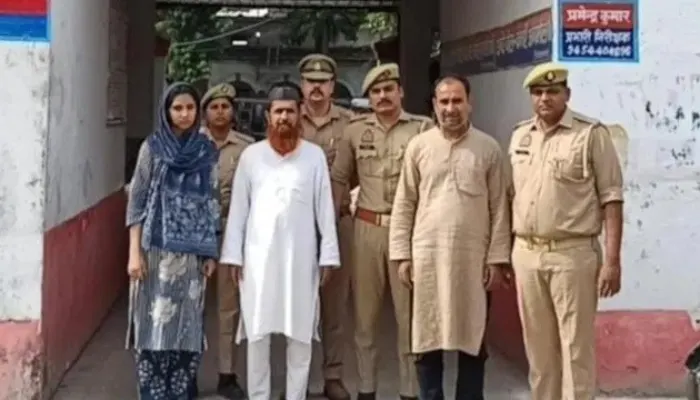
In Pilibhit, Uttar Pradesh, a Hindu man, Hitesh Kumar Saxena, was lured into a relationship and forcibly converted to Islam by a Muslim woman, Raunak Fatima, and her relatives. When he resisted, they threatened to implicate him in false criminal cases. Hitesh, a resident of Barf Wali Gali in the Khakra locality of Pilibhit, was pursuing a B.Ed degree and also worked as a tuition teacher. Around 2019–20, he came into contact with Raunak while teaching children at the residence of her relative, Rizwan Hussain, in Mohalla Wasil. Another report stated that they first became acquainted during Hitesh’s B.Ed studies at a private school where Raunak’s maternal grandfather, Sajjad Hussain, taught. Rizwan later hired Hitesh to tutor children at his residence. Hitesh and Raunak began communicating and speaking over the phone, and their acquaintance gradually developed into a closer relationship. According to Hitesh’s complaint, Raunak and her relatives conspired to lure him into the relationship. They subsequently pressured him to marry Raunak and convert to Islam. From 2023 onwards, they repeatedly threatened to implicate him in false criminal cases when he resisted and refused to change his religion. These threats were used to intimidate him and pressure him into abandoning his Hindu faith. On 4 April 2025, Hitesh was called to Sajjad Hussain’s house in Mohalla Wasil, where he was threatened and forcibly converted to Islam against his wishes. Reports also stated that he was subjected to harassment and torture following the conversion. Subsequently, Hitesh approached the Kotwali police station and submitted a written complaint. On 28 October 2026, he lodged a formal complaint naming Raunak Fatima and her relatives. Based on his complaint, the police registered an FIR under relevant provisions of the Bharatiya Nyaya Sanhita (BNS) and Sections 3 and 5 of the Uttar Pradesh Prohibition of Unlawful Conversion of Religion Act, 2021. Acting on the complaint, Kotwali police arrested three people on the night of 28 October 2026. They were identified as Rizwan Hussain, aged 48, Raunak’s maternal uncle and a resident of Mohalla Wasil; Sajjad Hussain, aged 62, Raunak’s maternal grandfather and also a resident of the Wasil locality; and Raunak Fatima, aged 19, a resident of Bara Majhalia village under the Amaria police station area. A report published by Jagran stated that the police questioned the three individuals and that they confessed during interrogation to carrying out religious conversions. On 29 October 2026, City Circle Officer Amarnath Verma confirmed that all three arrested individuals had been produced before a court at approximately 5:00 PM and sent to jail. He stated that further legal action was underway and the investigation was continuing.
Why it is Hate Crime ?
The primary category selected for this case is: Predatory proselytisation. The subcategory selected is: Harassment, threat, coercion for conversion. Harassment covers a wide range of behaviours of an offensive nature. It is commonly understood as behaviour that demeans, humiliates, and intimidates a person, including threats and coercion. Harassment and threats, in this case, find their root in discriminatory grounds which have the effect of nullifying a person’s rights or infringing upon his freedom to exercise his rights specifically owing to the victim’s religious identity. Verbal and physical threats and psychological or physical harassment are often used against Hindu victims because they choose to practice their professed religion. Religious harassment also includes forced and involuntary conversions by harassment, threats or coercion. Coercion includes intimidatory tactics like force-feeding a Hindu victim beef to convert to another religion, forceful circumcision, etc. In several documented cases, non-Hindu perpetrators or those who harbour specific animosity towards Hinduism harass victims simply based on their religious identity. Such cases often also include harassment to ensure the Hindu victim abandons his/her professed religion and adopts the religion of the perpetrator. Such cases where Hindu victims are harassed to convert to the perpetrator’s religion are rooted in animosity towards the victim’s religious identity and are therefore documented as religiously motivated hate crimes. The other sub-category selected here is - Proselytisation by grooming, brainwashing, manipulation or subtle indoctrination. Religious brainwashing essentially means the often subtle and forcible indoctrination to induce someone to give up their religious beliefs to accept contrasting regimented ideas. Religious grooming or brainwashing also involves propaganda and manipulation. It involves the systematic effort, driven by religious malice and indoctrination, to persuade “non-believers’ to accept allegiance, command, or doctrine to and of a contrasting faith. Cases of such grooming or brainwashing are far more nuanced than direct threats, coercion, inducement and violence. In such cases, it is often seen that there is repeated, subtle and continual manipulation of the victim to induce disaffection towards their own faith and acceptance of the contrasting faith of the perpetrator. While subtle indoctrination is widely acknowledged as predatory, an element which is often understated in such conversions or the attempts of such conversion is the role of loyalty and trust which might develop between the perpetrator and the victim. Fiduciary relationships are often abused to affect such religious conversion. For example, an educator transmitting religious doctrine of a competing faith to a Hindu student. The Hindu student is likely to accept what the teacher is transmitting owing to existence of the fiduciary relationship. The exploitation of the fiduciary relationship to religiously indoctrinate victims would also be included in this category. Since the underlying animosity towards the victim’s faith forms the basis of predatory proselytization, such cases are considered religiously motivated hate crimes. The other primary category selected is: Men attacked for being associated with non-Hindu women. The subcategory selected is: Threatened to convert by family of partner. When Hindu men are in a relationship with non-Hindu women, there are cases where the man faces threats to convert and change his religious identity by the non-Hindu woman or her family. Such relationships may be consensual, with the religious identity of the non-Hindu woman known to the victim. Somewhere along the relationship, the non-Hindu woman or her family starts forcing/pressurizing the Hindu man to convert to Islam and also assaults the victim to force him to convert. Such cases are driven by specific religious motivations and against the religious identity of the victim and are therefore qualified as hate crimes. Cases where the Hindu man converts to Islam and does not file a complaint about the force or threat, are not considered a part of the hate tracker, even though, it may be argued that the man was brainwashed or threatened to convert to Islam. The other subcategory selected is: Blackmailed to convert. When Hindu men are in a relationship with non-Hindu women, there are cases where the man is blackmailed to convert his religion. Such relationships may be consensual with the religious identity of the non-Hindu man known to the victim; however, there could be cases where the relationship is not consensual and the non-Hindu woman starts blackmailing a Hindu man to convert his religion. In these cases, it is often seen that the Hindu man is blackmailed with intimate photos and/or videos, threats of harm to his family, threats of violence, etc. Such cases are driven by specific religious motivations and against the religious identity of the victim and are therefore qualified as hate crimes. The religious dimension of this case lies in the pressure exerted on a Hindu man to abandon his faith and convert to Islam. The relationship was used as a means to exert pressure on him to change his religion, with threats of false criminal cases employed to intimidate him into compliance. Hitesh’s Hindu identity is the central religious marker. Every individual has the right to retain their faith, practise their religion and make personal decisions about their beliefs. That freedom includes the right to refuse conversion. Pressuring someone to give up Hinduism and accept another religion disregards their freedom of conscience and treats their religious identity as something that another person can control. The interfaith relationship provides the context in which this pressure developed. A relationship between people of different religions is a personal choice and is not, by itself, an act of religious hostility. The concern arises when one partner or their relatives use the relationship to demand that the Hindu partner change religion. In this case, Hitesh’s complaint states that Raunak and her relatives pressured him to marry her and convert to Islam, making his continued adherence to Hinduism a source of conflict. The threats of implicating Hitesh in false criminal cases were used as leverage to compel him to comply. They were specifically employed to punish his refusal to abandon Hinduism and accept Islam. His religious identity and his decision to retain his faith thus became the basis for the intimidation directed against him. The use of criminal threats to overcome his resistance demonstrates how coercion was \employed to deprive him of his freedom of religious choice. This transformed the pressure into intimidation: refusal to convert was met with the threat of serious legal consequences. Such tactics undermine free choice by making a person’s decision about religion subject to fear rather than personal conviction. Such intimidation represents an attempt to undermine an individual's freedom of conscience by making the consequences of retaining his existing faith appear too dangerous to resist. The forced conversion described in the complaint as having taken place on 4 April 2025 marks the culmination of this coercion. There is a clear distinction between freely embracing a religion and being made to convert against one's wishes. Individuals may share their beliefs or invite others to consider their faith, but they cannot use threats, intimidation or pressure to force acceptance. Religious conversion is meaningful only when it is voluntary. These actions of the accused stemmed from inherent hostility towards the victim's professed faith, since Abrahamic faiths believe that any non-adherent to the faith is subject to being dehumanised till they convert. This mindset does not merely tolerate the existence of another faith but seeks its erasure or assimilation. As a result, Hindus are often targeted not because of who they are as individuals, but because of their religious identity. The violence, deception, or humiliation inflicted in such cases is therefore not random, but part of a broader ideological hostility toward Hinduism and its symbols, practices, and adherents. Here, too, the predatory actions stemmed from doctrinal animosity towards the Hindu faith, which is why this case is being documented as a religiously motivated hate crime. The case was not merely a disagreement over an interfaith relationship. It involved the use of that relationship, collective family pressure and threats of false criminal proceedings to force a Hindu man to abandon his faith and convert to Islam. The perpetrators sought to override his religious autonomy and compel him to relinquish his Hindu identity against his will. Therefore, this case has been added to the hate crime database. Disclaimer: The Hinduphobia Tracker records the date of the incident based on when the crime occurred. The media reported this case on 30 October 2025. However, the media reports do not specify the exact date of the beginning of the victim’s ordeal. The victim came in contact with the perpetrators in 2019-20, and on 4 April 2025, he was forced to convert to Islam. Considering these two pieces of information, we are using an indicative date of 5 April 2019 as the date of the incident. This date is used for documentation purposes only and represents the estimated beginning of her ordeal.
Victim Details
Total Victim
1
Deceased
0
Gender
- Male 1
- Female 0
- Third Gender 0
- Unknown 0
Caste
- SC/ST 0
- OBC 0
- General 1
- Unknown 0
Age Group
- Minor 0
- Adult 1
- Senior Citizen 0
- Unknown 0


Case Status
Arrested


Perpetrators Details
Perpetrators
Muslim Extremists
Perpetrators Range
From 2 To 5
Perpetrators Gender
both
 Sources



