Hindu religious symbols denigrated by Christian missionary; accused abused his OCI status to run conversion racket in India
 Chennai, Tamil Nadu, India
 28 October, 2026
Case Summary
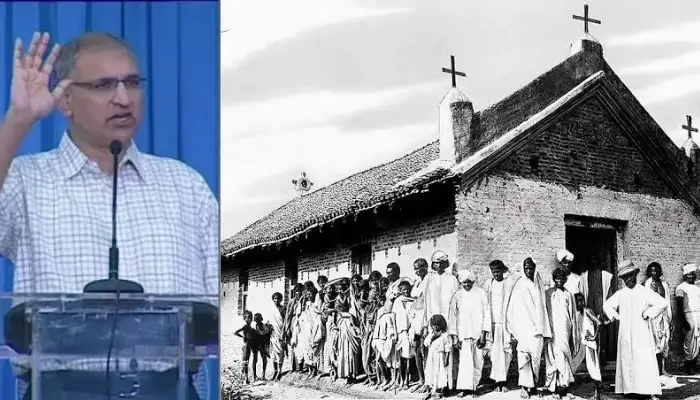
In a sermon circulated online, John Daniel, an Indian-origin US citizen associated with the Laymen’s Evangelical Fellowship of India (LEFI), mocked Hindu men and women in Chennai, Tamil Nadu, for observing religious practices. He joked about Hindu men and women in Chennai, Tamil Nadu, wearing tilaks, including the naamam (Vaishnava tilak) and bindis. He ridiculed the sacred Vaishnava tilak as “white paint” and imitated someone applying a naamam to the forehead. Referring to Hindu men and women who wore this religious symbol, he said that he felt sorry for them and attributed the practices to “mantras and tantras”. During the sermon, Daniel also went on to mock Hindus by insinuating that they also apply dung on their foreheads. He asked, “Do they do that with dung, brother? Instead of white, it can be brown.” He repeatedly mocked the Vaishnava tilak and suggested that the people wearing them should wipe them off. He further said, “If I have a handkerchief, I will give it to them to wipe it off. Don’t give it back! Throw it in the garbage!” He concluded by describing those who followed these religious practices as having “no clear mind”. His remarks specifically ridiculed the naamam and bindi, comparing sacred Hindu symbols to paint and dung and portraying their observance as irrational and worthy of contempt. Daniel’s remarks came against the backdrop of a legal battle over his Overseas Citizen of India (OCI) status. Daniel, who held US citizenship, had received OCI registration on 6 February 2015. On 8 September 2025, the Ministry of Home Affairs issued him a show-cause notice concerning missionary activities in India without the required special permission. The notice referred to his preaching, religious meetings and prayer activities in villages across Tamil Nadu and Andhra Pradesh, and also raised concerns about Christian conversions through his evangelical activities. In his reply dated 20 September 2025, Daniel denied engaging in missionary activities or promoting conversions. The Government of India subsequently cancelled his OCI registration through an order dated 4 September 2026. Daniel challenged the cancellation before the Madras High Court through W.P. No. 37464 of 2026, seeking restoration of his OCI registration. On 26 October 2026, the High Court dismissed his petition and upheld the cancellation. The Court noted that substantial material showed Daniel had repeatedly addressed congregations, gatherings, and religious meetings at different locations in Tamil Nadu and Andhra Pradesh, and that advertisements had invited the public to attend his meetings. It also referred to religious meetings held at LEF Grounds in Stuartpuram village, Andhra Pradesh, between 15 and 20 January 2019. The Court held that missionary preaching required prior special permission and that Daniel had conducted such activities without obtaining it. It rejected his denial of missionary activities and upheld the cancellation of his OCI registration. The Court clarified that he could apply for a regular visa to visit his mother and could conduct religious meetings in India only after obtaining the requisite official permission. The Legal Rights Protection Forum (LRPF) also pursued the matter, stating that it had submitted repeated complaints and followed up with the Ministry of Home Affairs' Foreigners Division, the Bureau of Immigration, and Indian consular offices in the United States. LRPF attributed the cancellation of Daniel’s OCI registration to these sustained efforts. LEFI, which is registered in Nungambakkam, Chennai, is associated with Daniel and conducts religious and missionary activities in India. LRPF highlighted the organisation’s presence in the coastal districts of Prakasam, Guntur and Nellore in Andhra Pradesh, as well as its wider network of churches across the country. LRPF also highlighted LEFI’s activities in Stuartpuram village, Andhra Pradesh. The village was historically associated with communities classified as “criminal tribes” under the British colonial Criminal Tribes Act of 1871. This classification imposed collective stigma and suspicion on entire communities and did not reflect any inherent criminality. LRPF stated that Christian organisations, including LEFI, had conducted outreach activities in the region involving religious conversions under the guise of moral education and employment initiatives.
Why it is Hate Crime ?
This case has been added to the tracker under the primary category: Hate speech against Hindus. Within it, the sub-category selected here is: Anti-Hindu slurs, mocking faith. Anti-Hindu slurs and the deliberate mocking of the Hindu faith owing to religious animosity involve the use of derogatory terms, stereotypes, or offensive references to religious practices, symbols, or figures. One of the common anti-Hindu slurs used against Hindus is “cow-worshipper” and “cow piss drinker”. The intention of using this term is to demean and mock Hindus as a group and their religious beliefs, since Hindus consider the cow holy. Additionally, some symbols and the slurs attached to them have a historical context that exacerbates the insult, hate, stereotyping, dehumanisation and oppression against Hindus. Cow worship has been used for centuries to denigrate Hindus, insult their faith and oppress Hindus specifically as a religious group. There has been overwhelming documentation about how cow slaughter has been used to persecute Hindus with cow meat being thrown in temples and places of worship. There has also been overwhelming documentation that cow meat (beef) has been force-fed to Hindus to either forcefully convert them to Islam or denigrate their faith. Apart from cow worship, the Swastika – which holds deep religious significance for the Hindus – has also been misinterpreted and distorted to be used as a slur against Hindus. Similarly, the worship of the Shivling has been used by supremacist ideologies and religions to denigrate Hindus owing to religious animosity. Such slurs and denigration stem out of inherent animosity and hate towards Hindus and their faith, therefore, it is categorised as hate speech targeted at Hindus specifically owing to their religious identity. The other category selected here is: Predatory proselytisation. Within this, the subcategory selected is: Proselytisation by grooming, brainwashing, manipulation or subtle indoctrination, and the tertiary category selected is: Pattern of targeting Hindus. Religious brainwashing essentially means the often subtle and forcible indoctrination to induce someone to give up their religious beliefs to accept contrasting regimented ideas. Religious grooming or brainwashing also involves propaganda and manipulation. It involves the systematic effort, driven by religious malice and indoctrination, to persuade “non-believers’ to accept allegiance, command, or doctrine to and of a contrasting faith. Cases of such grooming or brainwashing are far more nuanced than direct threats, coercion, inducement and violence. In such cases, it is often seen that there is repeated, subtle and continual manipulation of the victim to induce disaffection towards their own faith and acceptance of the contrasting faith of the perpetrator. While subtle indoctrination is widely acknowledged as predatory, an element which is often understated in such conversions or the attempts of such conversion is the role of loyalty and trust which might develop between the perpetrator and the victim. Fiduciary relationships are often abused to affect such religious conversion. For example, an educator transmitting religious doctrine of a competing faith to a Hindu student. The Hindu student is likely to accept what the teacher is transmitting owing to existence of the fiduciary relationship. The exploitation of the fiduciary relationship to religiously indoctrinate victims would also be included in this category. Since the underlying animosity towards the victim’s faith forms the basis of predatory proselytization, such cases are considered religiously motivated hate crimes. The hate speech aspect in this case stemmed from the deliberate use of degrading comparisons and humiliating language to ridicule Hindu religious symbols and the people who observe these traditions. The naamam is a sacred Vaishnava tilak that signifies devotion and religious affiliation. The bindi also carries religious, spiritual and cultural significance for Hindu women and serves as a visible expression of Hindu identity. These markings are not merely physical decorations; they are connected to religious observance, personal devotion and the traditions followed by Hindu communities. Directing contempt towards these symbols therefore amounts to denigrating an important expression of Hindu religious identity. Daniel's comparison of the white markings to paint and dung was particularly degrading. By suggesting the markings could be brown instead of white, he used the dung reference to associate Hindu religious observance with filth and impurity. This was not a theological explanation or a reasoned disagreement with the beliefs behind the practices. It reduced sacred religious markings to something dirty and ridiculous. His remarks about giving devotees a handkerchief to wipe the markings off, followed by the instruction to throw it in the garbage, further conveyed that these symbols were unworthy of respect and should be removed and discarded. The language targeted not only the markings but also the Hindu men and women who wore them. His description of those observing these practices as having “no clear mind” added another layer of denigration. It portrayed Hindu devotees as irrational and incapable of thinking clearly because they followed their religious traditions. This moved the remarks beyond mocking a particular symbol and extended the insult to the people whose faith and devotion it expressed. By treating the observance of Hindu practices as evidence of intellectual deficiency, the sermon demeaned Hindus on the basis of their religious identity. Hindus have the right to wear their religious markings, practise their faith and express their devotion without being subjected to humiliation on that account. The deliberate use of filthy comparisons, ridicule and language portraying Hindu devotees as irrational shows the basis for recording this incident under hate speech against Hindus, anti-Hindu slurs, and mocking faiths. The missionary's hostility towards Hindus could further be understood by the conversion racket he was conducting. These actions of the accused stemmed from inherent hostility towards the victim's professed faith since Abrahamic faiths believe that any non-adherent to the faith is subject to being dehumanised till they convert. This mindset does not merely tolerate the existence of another faith but seeks its erasure or assimilation. As a result, Hindus are often targeted not because of who they are as individuals, but because of their religious identity. The violence, deception, or humiliation inflicted in such cases is therefore not random, but part of a broader ideological hostility toward Hinduism and its symbols, practices, and adherents. Here, too, the missionary's predatory actions stemmed from doctrinal animosity towards the Hindu faith. Disclaimer: The Hinduphobia Tracker records incidents based on the date on which the event occurred. The source does not specify the exact date on which the sermon was delivered. Therefore, for documentation purposes, 29 October 2026, the date on which the incident was reported in the media, has been recorded as the incident date.


Case Status
Case sub-judice


Perpetrators Details
Perpetrators
Christian Extremists
Perpetrators Range
One Person
Perpetrators Gender
male
 Sources



