Hindu man severely attacked by Muslim man for refusing extortion demands in Bangladesh, locals said accused selectively targeted Hindu families
 Brahmanbaria District, Bangladesh
 26 October, 2026
Case Summary
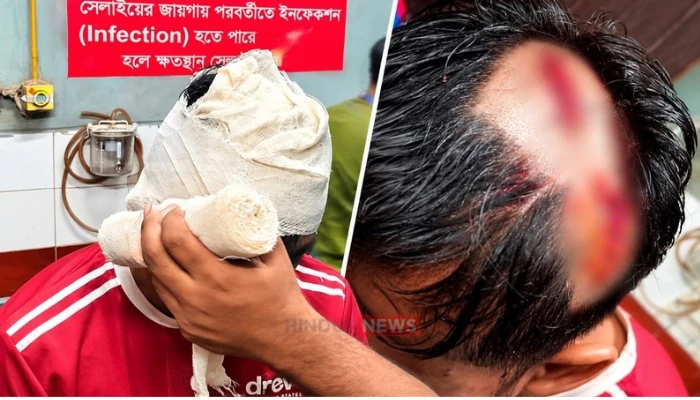
In Bitghar village of Panishwar union, Sarail upazila, Brahmanbaria, Bangladesh, a Hindu youth, Tapas Debnath, was hacked with a sharp weapon and seriously injured after he refused to pay extortion money. The victim’s family stated that a Muslim man, Hefuj Mia, carried out the premeditated attack, inflicting serious injuries to Tapas’s head. The victim, Tapas Debnath, 30, lived in Bitghar village, and the accused, Hefuj Mia, lived in the same area. According to the victim’s family, the accused had demanded extortion about three months before the attack. When the family refused to pay, he threatened them with death on several occasions. Locals also stated that the accused had demanded extortion from other Hindu families in Bitghar village. The victim’s family stated that the matter was raised before local dignitaries and community representatives. After mediation, the parties reached a social solution, after which the accused left the area and stayed elsewhere for some time. However, he recently returned to the area and again began demanding extortion money. When the family informed the accused’s relatives, they refused to take responsibility for his actions and avoided the matter, stating that they had no connection with him. Many residents of Bitghar village were aware of the accusations of extortion and threats, and the matter had been discussed at the local level. At around 9:15 pm on Tuesday, 27 October 2026, the accused attacked the victim on the road in front of his house in Bitghar village. He attacked Tapas with a sharp weapon, causing serious injuries to his head in two places. The victim was taken for treatment in an injured condition, where he received more than ten stitches to the head wound. The victim’s family filed a complaint regarding the attack and sought legal action against the accused. They demanded a proper investigation into the incident and measures to ensure the safety of the victim’s family and local Hindu residents. The attack raised concern among the village’s traditional religious community over continued extortion, threats and violence.
Why it is Hate Crime ?
The primary category selected for this case is: Attack not resulting in death. Within this, the subcategory selected is: Attacked for opposing radicals or trying to save victim. In several cases, Hindus are attacked for opposing religiously motivated crimes being committed against a fellow Hindu or simply for voicing an opinion opposing radical elements, who either have in the past or continue to persecute Hindus. In such cases, the initial attack against the victim, against which the Hindu was trying to defend the victim, would also need to be classified as a religiously motivated hate crime. Since the initial crime itself was religiously motivated and the subsequent crime of attempting to save the victim or speaking against the radical elements ends up inviting a violent attack, it would also be classified as a religiously motivated hate crime under this category. The other category selected is: Hate speech against Hindus. The subcategory selected for this case is: Violent Threats. Violent threats, explicit, implicit or implied, is the most dangerous form of hate speech since it goes beyond discriminatory and prejudicial language to express the intent of causing harm to an individual or a group of people based on their religious identity and faith. There could be several different kinds of threats that are issued to Hindus based on religious animosity. An explicit threat would mean the direct threat of violence towards an individual Hindu, a group of Hindus or Hindus at large. Physical violence, death threats, threats of destruction of property belonging to Hindus and threats of genocide would mean explicit threats against Hindus for their religious identity. Implicit threats may not be a direct threat but implied through the use of symbols of actions – for example – in the Nupur Sharma case, other than explicit threats, there were also implicit threats when Islamists took to the streets to burn and beat her effigies. It implies that they want to do the same to Nupur Sharma – thereby is considered an implicit threat. Violent threats can be delivered in person, through letters, phone calls, graffiti, or increasingly through social media and other online platforms. It would be important to understand that a threat – explicit or implicit, online or offline – to an individual who happens to be a Hindu does not qualify as a religiously motivated threat. Such a threat, while vile and dangerous, could be owing to non-religious reasons and/or personal animosity. To qualify as a religiously motivated threat, it would need to exhibit an indication that the individual is being targeted for religious reasons and/or owing to his/her religious identity as a Hindu. This case was included in the Hinduphobia Tracker because the assault and intimidation were directed not only at one Hindu man but collectively at several Hindu families, specifically, making their religious identity the defining common feature of the victim group. The significance lies not merely in the demand for money, but in the selective targeting of several members of the same religious minority through threats severe enough to place both their lives and their families in fear. When a group of Hindus is singled out in this manner without any separate individual provocation, the targeting acquires a clear religion-linked character. The threats went beyond ordinary extortion. Rangdari—the practice of demanding “protection money” under threat of violence—has historically been used as a means of intimidating vulnerable Hindu communities in Bangladesh. For Hindus living as a religious minority, such demands can become more than ordinary extortion when Muslim perpetrators use threats of violence to assert control over them. By demanding that Hindus pay money for “protection” from those who themselves threaten their safety, the practice can reinforce a sense of Islamic dominance in which the Hindu minority is expected to submit, comply and pay for the privilege of living safely within its own community. This dimension is particularly significant when rangdari is directed specifically at Hindu victims. The demand is not merely for money; backed by threats of murder, attacks on family members or displacement, it places Hindus in a position of enforced submission. Such conduct reflects an assertion of religious supremacy when Muslim perpetrators treat Hindu security, property and continued presence as conditions that they have the power to determine—and for which Hindus must pay. That context is directly relevant to the present case. The man and the rest of the families targeted were all Hindu. The accused assaulted and threatened to kill the Hindu man for refusing to pay the extortion money. He also singled out and targeted other Hindu families in the locality. The victims were therefore being compelled to purchase “protection” through fear of violence. When a Hindu minority is made to pay Muslim perpetrators for protection from the very violence they threaten to inflict, the extortion becomes a mechanism of intimidation, control and religious subordination rather than a purely financial crime. In this instance, the accused created a climate in which Hindus were made to feel that their safety and continued public presence were conditional upon submission to coercive demands. This kind of intimidation is especially serious in the context of a numerically vulnerable minority because it reinforces insecurity and communicates that members of the community can be individually identified, pressured and threatened with little regard for their basic right to live and work without fear. Against the broader history of anti-Hindu persecution in Bangladesh, the incident further illustrates how economic intimidation can be used alongside threats of violence to keep the Hindu minority vulnerable and compliant. The religious element lies not simply in the identities of the perpetrators and victims, but in the manner in which power is exercised over Hindus as a minority: through fear, forced compliance and the expectation that they must submit to the authority of those asserting dominance over them. Such an unprovoked attack on a Hindu man for simply refusing to submit to extortion, particularly when several other Hindu families were also targeted, reflects a mindset of hostility and contempt towards the victim's religious community. The repeated attacks and intimidation of Hindu families through threats of violence often happen due to indoctrination by Islamic theology, which advocates that all non-Muslims (referred to as kafirs) are inferior and subject to subjugation unless they convert to Islam or live under Islamic rule (dhimmitude). These ideas are not mere abstractions; they manifest in actions where non-Muslims, especially Hindus in India, are seen as targets for religious domination, coercion, or humiliation. This theological framework fosters an "us versus them" mindset, in which any assertion of Hindu identity or religious freedom is seen not only as undesirable but as a threat to Islamic supremacy. As a result, perpetrators who are shaped by such teachings feel justified, even morally obligated, to harass, suppress, or violently attack Hindus, particularly when Hindus assert their religious rights or resist conversion. As a result, Muslim perpetrators invoke such doctrines to justify violence against non-Muslims, particularly Hindus. Such acts, therefore, are not isolated but driven by a broader ideological hostility towards Hindus as non-believers and reflect an attempt to impose religious dominance. Since this case was also not a random, isolated incident of extortion but a premeditated attack motivated by bias and hatred against the Hindu community, which is a defining feature of hate crimes, it has been added to the tracker. Disclaimer: The locals confirmed that several Hindu families were selectively targeted by the accused. However, since the exact number of victims is not specified, besides the Hindu man who was assaulted by the accused, the victim count has been conservatively kept at one.
Victim Details
Total Victim
1
Deceased
0
Gender
- Male 1
- Female 0
- Third Gender 0
- Unknown 0
Caste
- SC/ST 0
- OBC 0
- General 0
- Unknown 1
Age Group
- Minor 0
- Adult 1
- Senior Citizen 0
- Unknown 0


Case Status
Complaint filed


Perpetrators Details
Perpetrators
Muslim Extremists
Perpetrators Range
One Person
Perpetrators Gender
male
 Sources



