Hindu salon owner stabbed to death by Muslim man after refusing free haircut in Mymensingh, Bangladesh
 Mymensingh District, Bangladesh
 26 October, 2026
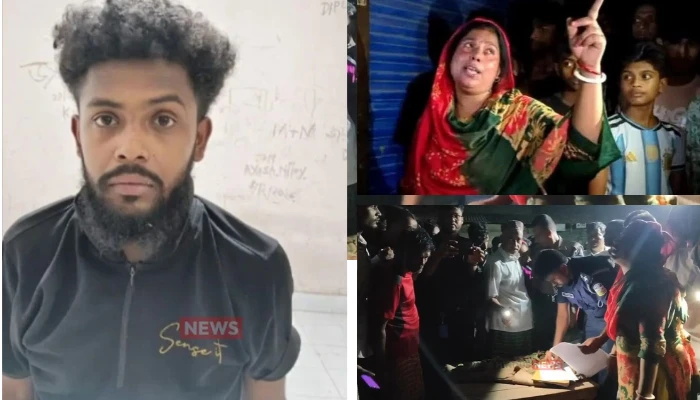
Case Summary
In Muktijoddha Market, Jamirdia area, Mymensingh, Bangladesh, a Hindu salon owner was stabbed to death by a Muslim man. The accused, Saddam Hussain, chased Rabindra Rishi from his salon to a nearby courtyard and killed him with a knife. The victim, Rabindra Rishi, was 43 years old and the son of Ranjit Rishi of Uttarpara in Dhobaura upazila, Mymensingh. He lived with his wife in a rented house next to Noman Composite Factory in Jamirdia and ran a traditional salon, Apurba Hair Cutting, in Muktijoddha Market. The accused, the son of Babul Hossain, lived in the same area. His father had a shop at the same location as the victim. According to the report the accused used to go to the victim's salon for haircuts and beard trims, and often did not pay. He also took money from the victim for drugs. A dispute arose when the victim demanded the money owed and refused to cut his hair. The victim's wife, Suchitra, stated that the accused had been demanding money for a long time and had threatened on several occasions to kill him for not providing salon services free of charge. The family also pointed to a dispute over the harassment of the victim's daughter about three months earlier. At around 5:30 pm on Tuesday, 27 October, 2026 the victim was sitting in his salon talking to his brother-in-law, Manik Rishi. The accused entered with a knife and stabbed the victim in the neck several times. The victim ran to the accused’s father shop to save his life. The accused followed him there and stabbed him in the chest. The victim then tried to take shelter in the courtyard of a nearby house. The accused threw him to the ground and stabbed him repeatedly in the chest, back and hand. The victim died on the spot from excessive bleeding. The accused fled. The victim's mother, Sulak Rani Rishi, filed the case. Bhaluka Model Police Station reached the spot immediately, recovered the body and sent it to the Mymensingh Medical College Hospital morgue for autopsy. After the autopsy, the body was handed over to the family. Officer-in-Charge Mohammad Zahidul Islam of Bhaluka Model Police Station stated that the accused was arrested on the night of the incident and that the knife used in the murder was recovered at the time. The accused was produced in court on Wednesday, 28 October, and a five-day remand application was filed for his questioning. This incident occurred against the broader backdrop of the historical persecution faced by Hindus in Bangladesh. While the Hindu minority has endured discrimination, targeted violence, and religious hostility over decades, such persecution has intensified in distinct spurts during periods of political and social instability. The latest major escalation began after the ouster of Sheikh Hasina’s government in August 2024, continued after the death of Sharif Osman Bin Hadi in December 2025, and surged again in the immediate aftermath of the 13th National Parliamentary Election in 2026. Following the ouster of Sheikh Hasina, multiple incidents involving attacks on Hindu homes, temples and religious institutions were documented, alongside intimidation, arson and mob violence targeting Hindu localities. The Hinduphobia Tracker recorded 336 incidents involving the Hindu minority during this period, reflecting the scale of the escalation and the continuing vulnerability of Hindus in Bangladesh. A further spurt of violence followed the death of Sharif Osman Bin Hadi, a Muslim political activist and student leader known for his anti-Hindu and anti-India rhetoric, in December 2025. In the aftermath, Hindu communities were subjected to retaliatory violence, with Hindu homes and properties selectively attacked and several families forced to flee. Among the victims was Dipu Chandra Das, who was lynched and whose body was subsequently set ablaze by a Muslim mob over false blasphemy allegations. The Hinduphobia Tracker documented 51 incidents of anti-Hindu violence in the period following Hadi’s death alone, further illustrating how existing hostility towards the Hindu minority intensified during moments of communal mobilisation. During the same period, posters and written material calling for the extermination of Hindus were also displayed in public spaces. Such rhetoric, when viewed alongside incidents of arson, vandalism, assault and targeted intimidation, reflected an environment in which hostility towards Hindus was not merely episodic but repeatedly resurfaced in more intense forms during periods of unrest. The most recent escalation followed the 13th National Parliamentary Election in 2026. In the immediate aftermath of the election results, Hindu families in districts including Noakhali, Rangpur, Nilphamari, Sylhet, Thakurgaon and Dinajpur faced attacks involving arson, looting, assault and vandalism of Hindu homes and temples. In several instances, Hindu properties were selectively targeted, and families were threatened with displacement. The present incident therefore occurred within a much longer history of persecution of Hindus in Bangladesh, where hostility towards the community has persisted over time and intensified in repeated spurts. The latest cycle began after the ouster of Sheikh Hasina and continued through subsequent periods of political and communal upheaval, leaving the Hindu minority increasingly vulnerable to targeted violence, intimidation and religious hostility.
Why it is Hate Crime ?
This case is being added to the Undecided database of the Hinduphobia Tracker because the available details do not explicitly establish a religious motive behind the crime. In the case, Rabindra Rishi, a Hindu salon owner, was chased and stabbed to death by Saddam Hussain, a Muslim man, and the response was far out of proportion to the dispute behind it. The violence reflected a sense of religious supremacy over a Hindu who refused to submit. The victim belonged to a Hindu minority in Bangladesh, where Hindus have repeatedly faced killings, attacks on homes and temples, intimidation and other targeted hostility. Against this background, the killing of a Hindu man by a Muslim accused warrants scrutiny of what drove it. However, classifying this particular incident as a religiously motivated hate crime requires evidence specific to the case. At the time of documentation, no such religious markers were available. The immediate trigger for the violence was to ask for payment for unpaid haircuts and refuse a demand for money for drugs. The only act was to ask for what he was owed and refuse to give more. Such disagreement usually ends in an argument or a lost customer, but not in a killing. What marks this case as distinct is the distance between the cause and the response. The earlier threats to kill show that the killing was premeditated and did not arise at the spur of the moment. This further shows that a Hindu in Bangladesh had no right to deny a demand or even to ask for what was rightfully his. Such conduct stems from a sense of religious supremacy. The accused treated the victim's refusal as defiance that deserved the harshest punishment, and he acted on the assumption that a Hindu could be made to serve and pay without question. The disproportion, the pursuit and the premeditation all point to a belief that the victim was owed no equal standing. Therefore, the possibility of a communal motive cannot be completely ruled out, but the presently available evidence is equally consistent with a violent personal confrontation arising from the dispute over the dues. However, no anti-Hindu slur, reference to the victim's faith or demand for conversion was recorded. The Hinduphobia Tracker requires identifiable indicators connecting the crime to the victim's Hindu identity before an incident is classified as a confirmed hate crime. Without such a marker, the religious nexus rests on inference from the conduct and is not explicitly established. The case is therefore retained in the Undecided database. If further information emerges showing anti-Hindu remarks, prior communal hostility or religiously motivated targeting, it will be reassessed and moved to the Hate Crime Database.
Victim Details
Total Victim
1
Deceased
1
Gender
- Male 1
- Female 0
- Third Gender 0
- Unknown 0
Caste
- SC/ST 0
- OBC 0
- General 0
- Unknown 1
Age Group
- Minor 0
- Adult 1
- Senior Citizen 0
- Unknown 0


Case Status
Arrested


Perpetrators Details
Perpetrators
Muslim Extremists
Perpetrators Range
One Person
Perpetrators Gender
male
 Sources



