Navratri celebrations targeted; media outlet deliberately depicts Muslim men dancing Garba with Hindu women
 Maharashtra, India
 13 October, 2026
Case Summary
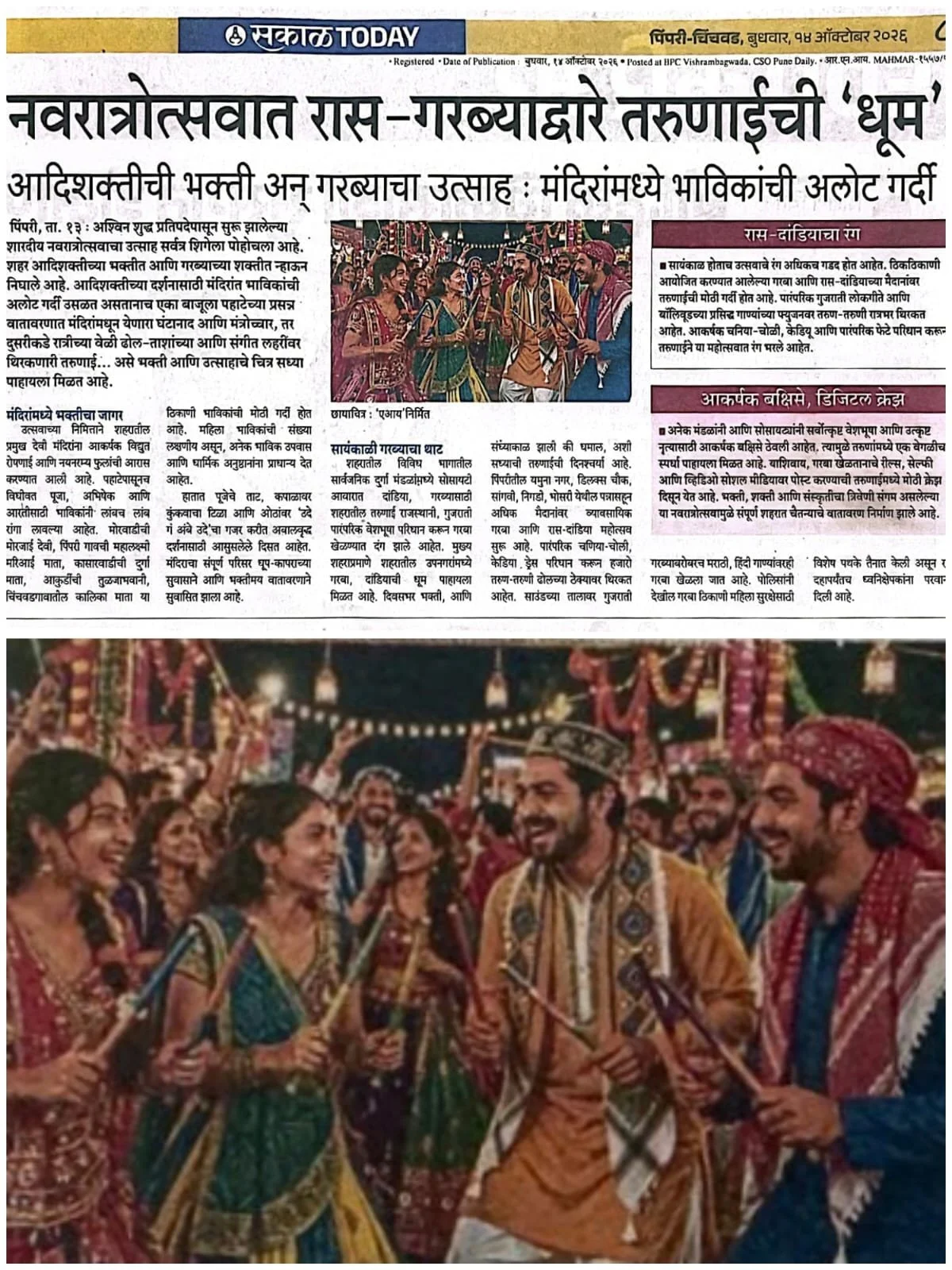
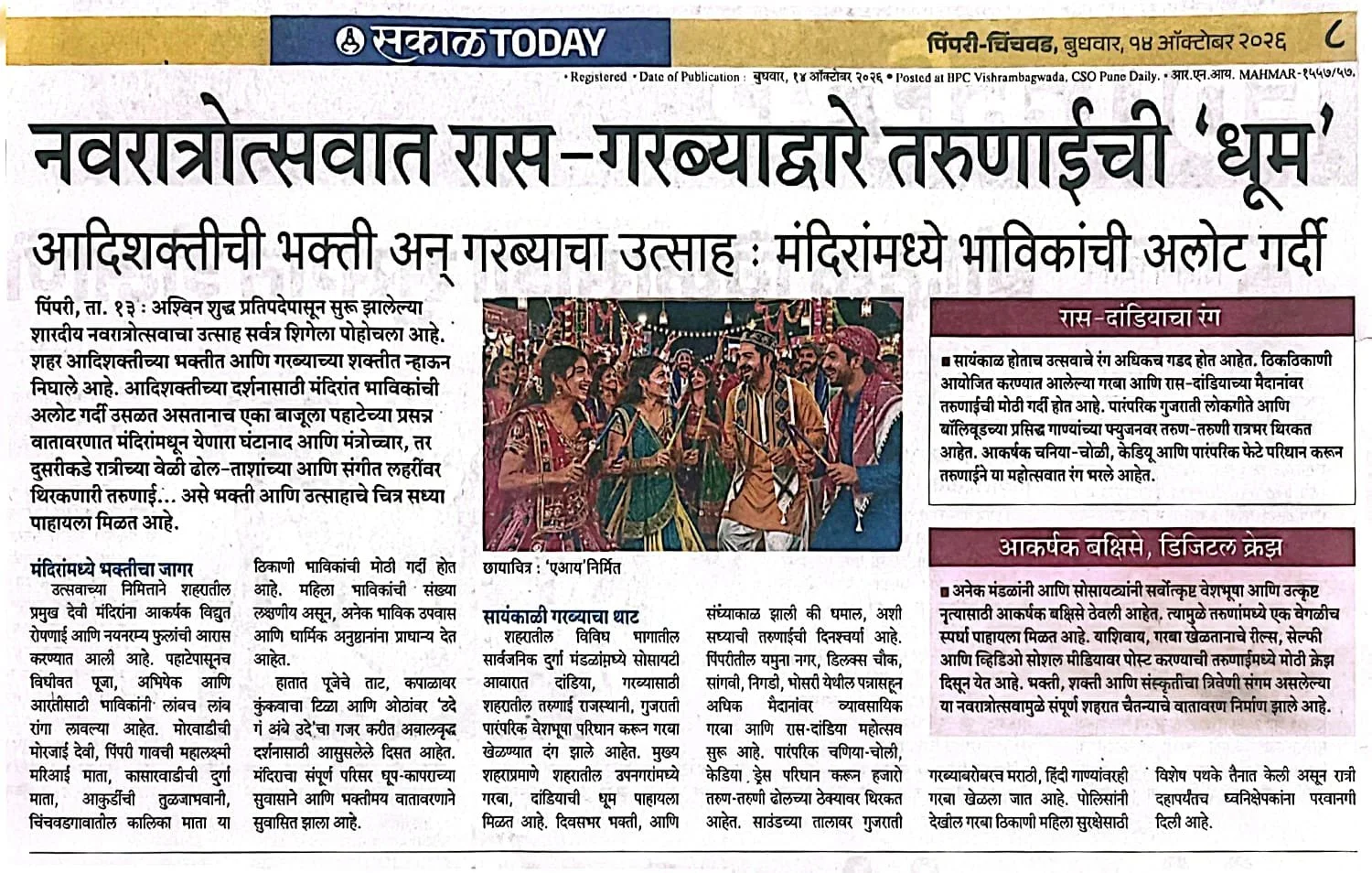
In Maharashtra, the Marathi newspaper Sakal Today targeted Navratri by publishing an image depicting Muslim men dancing Garba with Hindu women. The portrayal came against the backdrop of repeated incidents involving the religiously motivated targeting and exploitation of Hindu women by Muslim men at Garba events. On 14 October 2026, Sakal Today published an article in its Pimpri-Chinchwad edition titled “Young people revel in Raas-Garba during Navratri”, with the subheading “Devotion to Adi Shakti and enthusiasm for Garba; temples witness overwhelming crowds of devotees”. The article covered Navratri celebrations across the city, including temple visits, devotional activities, and Garba and Dandiya events. However, the accompanying image, which the newspaper captioned as AI-generated, depicted Muslim men dancing alongside Hindu women, drawing attention to the religious identities of the participants in the context of a Hindu festival. Several pro-Hindu social media handles subsequently shared the article and stated that the newspaper was deliberately portraying Muslim men dancing Garba with Hindu women to denigrate the Hindu festival. They also characterised Sakal Today as a left-leaning publication and criticised the depiction in the context of previous incidents involving the targeting and exploitation of Hindu women by Muslim men at Garba events. The newspaper's ownership also became a subject of discussion among social media users, who pointed out that Sakal Today was owned by Abhijit Pawar, a media executive associated with the Sakal Media Group. Abhijit Pawar is the nephew of Sharad Pawar, a prominent Maharashtra politician, and the cousin of Ajit Pawar, the former Deputy Chief Minister of Maharashtra.
Case Images
Why it is Hate Crime ?
This case is being added to the tracker under the primary category: Hate Speech against Hindus. The subcategory selected is: Anti-Hindu slurs, mocking faith. Anti-Hindu slurs and the deliberate mocking of the Hindu faith owing to religious animosity involve the usage of derogatory terms, stereotypes, or offensive references to religious practices, symbols, or figures. One of the common anti-Hindu slurs used against Hindus is “cow-worshipper” and “cow piss drinker”. The intention of using this term is to demean and mock Hindus as a group and their religious beliefs since Hindus consider the cow holy. Additionally, some symbols and the slurs attached to them have a historical context that exacerbates the insult, hate, stereotyping, dehumanisation and oppression against Hindus. Cow worship has been used for centuries to denigrate Hindus, insult their faith and oppress Hindus specifically as a religious group. There has been overwhelming documentation about how cow slaughter has been used to persecute Hindus with cow meat being thrown in temples and places of worship. There has also been overwhelming documentation where cow meat (beef) has been force-fed to Hindus to either forcefully convert them to Islam or denigrate their faith. Apart from cow worship, the Swastika – which holds deep religious significance for the Hindus – has also been misinterpreted and distorted to use as a slur against Hindus. Similarly, the worship of the Shivling has been used by supremacist ideologies and religions to denigrate Hindus owing to religious animosity. Such slurs and denigration stem out of inherent animosity and hate towards Hindus and their faith, therefore, it is categorised as hate speech targeted at Hindus specifically owing to their religious identity. The other subcategory selected is: Anti-Hindu subversion and prejudice. Hate speech is defined as any speech, gesture, conduct, writing, or display that is prejudicial against a specific individual and/or group of people, which is leading to or may lead to violence, prejudicial action or hate against that individual and/or group. Media plays a specific and overarching reach in perpetuating prejudicial attitudes towards a community owing to unfair, untrue coverage and/or misrepresentation/misinterpretation, selective coverage and/or omission of facts of/pertaining to issues affecting a specific religious group. This type of bias can dehumanise the victim group, making it easier for others to justify harmful actions against them, which aligns with the objectives of hate speech laws aimed at preventing such harm. It is often observed that the media takes a prejudicial stand against the Hindu community driven by their need to shield the aggressor community which happens to be a numeric minority, however, is the one perpetrating violence against Hindus. For example, the media is often quick to contextualise religiously motivated crimes against Hindus, omit or misrepresent facts that point towards religiously motivated hate crimes, justify and/or downplay religiously motivated hate crimes or simply present fake news to stereotype Hindus. Such media bias leads to the denial of persecution and is often used to dehumanise Hindus, leading to justification for violence against them. For example, the media covered several fake allegations of Hindus targeting Muslims and forcing them to chant Jai Shree Ram. Most of these cases were proved false and fabricated after police investigation. These fake news reports were subsequently never retracted or clarified. Such fake news led to the justification of violence and dehumanisation of Hindus based on the argument that since Hindus targeted Muslims and forced them to chant Jai Shree Ram, the dehumanisation of Hindus and violence against them was par for the course and merely a retaliation. Such media bias leads to prejudicial portrayal of Hindus and offers a justification for violence against them and therefore, is considered hate speech under this category. This case exemplifies anti-Hindu bias in media, as Sakal Today published an AI-generated image depicting Muslim men dancing Garba with Hindu women during the Hindu festival of Navratri. The deliberate choice of imagery undermined the Hindu religious identity of the festival by presenting a sacred devotional practice through a portrayal that detached it from its religious significance. Rather than depicting Garba in its traditional devotional context, the publication presented an image that reduced the festival to a generic social activity. This demonstrated a disregard for the religious sanctity of a Hindu festival and reflected a pattern in which Hindu religious traditions are presented through a secularised lens that diminishes their distinct religious character. Navratri is one of the most significant Hindu festivals dedicated to the worship of Goddess Durga and her various manifestations. Garba, traditionally performed during Navratri, is closely associated with devotion to the goddess and symbolises the celebration of divine feminine power. For Hindu devotees, it is not merely a form of entertainment or a commercial dance event, but a cultural and religious expression rooted in their faith. The deliberate portrayal of Muslim men participating in Garba with Hindu women, therefore, stripped the festival of its distinctly Hindu devotional context and presented it as an activity detached from the faith that gives it meaning. By publishing such an image, the newspaper contributed to the secularisation of a sacred Hindu tradition, treating a religious observance as a generic social event rather than respecting its religious and spiritual significance. The choice of imagery was particularly significant given the recurring controversies surrounding Garba events, where Muslim men have targeted Hindu women by concealing their religious identities, entering Garba pandals under false pretences, trapping women in predatory relationships and subjecting them to sexual harassment and violence. The Hinduphobia Tracker has documented 26 cases involving Muslim men targeting Garba events in one way or another between 1 January 2023 and 29 October 2026. Of these, 13 cases involved Muslim men pretending to be Hindus or concealing their religious identities to enter Garba pandals and target Hindu women, while nine cases involved other forms of targeting, including disruption of Garba celebrations, desecration of Garba venues, shouting of “Allahu Akbar” slogans and other acts directed at the religious gatherings. These incidents highlight the concerns surrounding the safety of Hindu women attending Garba celebrations and the preservation of the religious character of these gatherings. Against this backdrop, the newspaper's decision to deliberately publish an AI-generated image depicting Muslim men dancing Garba with Hindu women displayed a disregard for the context surrounding these incidents and the religious sensitivities of Hindu devotees. By presenting such imagery without acknowledging the religious significance of Garba or the documented history of incidents involving the targeting of Hindu women at these events, the publication trivialised these concerns and reinforced a portrayal that disregarded the festival's distinctly Hindu religious identity. The fact that the image was AI-generated further underscores the significance of the editorial choice involved in its publication. The participants, their appearance and the setting were digitally generated rather than captured at an actual event. The resulting image deliberately presented Muslim men alongside Hindu women in a Hindu religious celebration, reinforcing the portrayal of Garba as an activity detached from its devotional origins. In the context of Navratri, this imagery amounted to more than a generic representation of festive participation; it contributed to the dilution of the festival's Hindu identity and displayed disregard for its religious significance. The publication of such imagery exemplified the tendency to impose a secularised interpretation on Hindu religious traditions while overlooking the faith and devotion at their core. A similar pattern of secularising Hindu festivals has been observed across India, where their religious foundations are increasingly sidelined in favour of secular or cultural interpretations. These efforts form part of a broader attempt to de-Hinduise Hindu traditions, with left-wing ideological groups, Christian missionary organisations and Islamist elements repeatedly downplaying or disregarding the Hindu religious roots of traditional festivals. By detaching these celebrations from their religious origins and presenting them primarily as cultural or secular occasions, such efforts diminish their distinct Hindu identity and undermine their religious significance. For example, Onam is a Hindu festival celebrated in Kerala, rooted in Hindu religious traditions and the legend of King Mahabali and Lord Vishnu’s Vamana avatar. According to Hindu tradition, the festival commemorates Mahabali’s annual return, while the story of Vamana recounts how Lord Vishnu restored cosmic order through his three steps. Despite these religious foundations, left-wing ideological groups have repeatedly promoted a portrayal of Onam as merely a secular harvest festival, sidelining its Hindu religious origins and traditions. This attempt to detach Onam from its Hindu identity and reduce it to a generic cultural celebration exemplifies the broader pattern of secularising Hindu festivals and reflects an anti-Hindu bias that disregards their religious significance and historical traditions. A similar pattern can be observed in Bihu in Assam, particularly Bohag Bihu, which marks the Assamese New Year and the arrival of spring. Although the festival incorporates agricultural customs and community celebrations, its traditions are also intertwined with Hindu religious practices, including prayers, offerings and the worship of deities associated with prosperity and well-being. Its presentation exclusively as an agrarian or secular cultural festival overlooks the religious customs practised by many Hindu Assamese communities. By emphasising only its agricultural and cultural dimensions, such interpretations obscure the Hindu traditions that have shaped important aspects of the festival. This reflects the broader tendency to separate regional festivals from their Hindu heritage and present them as purely secular expressions of regional identity. Diwali, one of the most widely celebrated Hindu festivals, is similarly reduced to the generic description, "Festival of lights". Its religious significance extends far beyond the lighting of lamps, encompassing Lord Rama's return to Ayodhya after his victory over Ravana, as well as the worship of Goddess Lakshmi and other traditions observed across different regions of India. These narratives and rituals are central to the religious observances of millions of Hindu devotees. However, when Diwali is presented primarily through decorative lights, fireworks and cultural festivities, its spiritual significance and Hindu religious foundations risk being overshadowed. Holi, too, is frequently reduced to a festival of colours, with its religious narratives and devotional significance pushed into the background. The festival is closely associated with the story of Prahlad and Holika, which symbolises the triumph of devotion and righteousness over evil, while celebrations in many regions are also connected with Lord Krishna and his divine pastimes. These traditions give Holi a distinct place within Hindu religious life, beyond the familiar images of coloured powders and public festivities. When the festival is portrayed solely as an occasion for revelry, its religious foundations that have sustained its observance for generations are overlooked. This selective presentation diminishes the spiritual significance of a sacred Hindu celebration by treating it as a generic cultural event. Taken together, these examples illustrate how the repeated sidelining of Hindu religious narratives can diminish the distinct religious identity of festivals that are deeply rooted in Hindu traditions. The concern is not that festivals cannot have cultural, regional or agricultural dimensions, but that presenting them exclusively through these dimensions obscures their religious foundations. In the case of Garba, portraying the celebration without regard for its devotional association with Goddess Durga follows a similar pattern of separating a Hindu religious practice from the faith that gives it meaning. Such portrayals contribute to the dilution of Hindu religious identity and reflect the anti-Hindu bias in the representation of Hindu traditions in public discourse. Overall, this case exemplifies anti-Hindu bias in media through the portrayal of a sacred Hindu festival in a manner that diminished its religious identity and disregarded the sentiments of Hindu devotees. The incident is therefore being added to the hate crime database of the Hinduphobia Tracker.


Case Status
Unknown


Perpetrators Details
Perpetrators
Others
Perpetrators Range
One Person
Perpetrators Gender
unknown
 Sources



