Hindu man assaulted by wife's Muslim relatives; wife, who embraced Hinduism after leaving Islam, also attacked and abducted
 Khandwa, Madhya Pradesh, India
 24 October, 2026
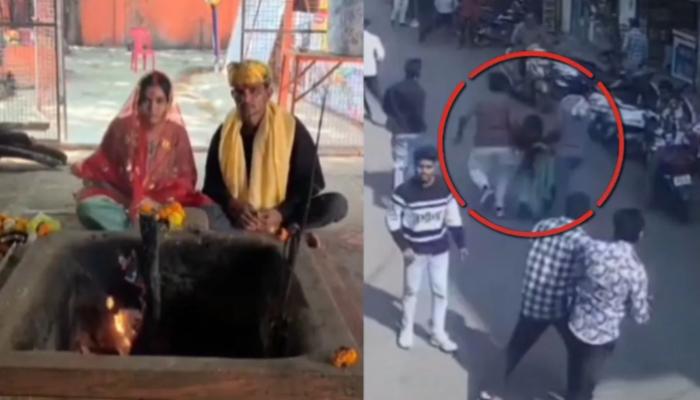
Case Summary
In Khandwa, Madhya Pradesh, a Hindu man was assaulted by his Muslim wife's relatives, who forcibly took her away after their temple wedding. The woman, formerly Muslim, had embraced Hinduism and adopted the name Tejaswini before marrying him according to Vedic rituals. According to reports, a Muslim woman, Tanzim Mansoori, had adopted the name Tejaswini and embraced Hinduism after marrying a Hindu man, Tejpal Rajput. Both were residents of Chhaigaon Makhan village in Khandwa district. Tejpal, who had completed his education up to Class 10, and Tanzim, who had completed Class 12, had known each other for around five years and had been in a romantic relationship for several years. According to Tejpal, they had mutually decided to live together on 20 February 2026 and had subsequently moved to Pithampur, near Indore, and completed the necessary documentation for their live-in relationship at a court in Indore. Meanwhile, Tanzim’s family had also filed a missing-person complaint at the Chhaigaon Makhan police station after she left home. On the morning of 25 October 2026, the couple married according to Vedic rituals at the Mahadevgarh temple at around 11 am. They then went to a notary’s office in the Malikuan area to complete the paperwork relating to their marriage. According to Tejpal, around 20-25 members of Tanzim’s Muslim family arrived at the office, assaulted him, pushed him and dragged him towards a car parked some distance away. They then forcibly took Tanzim away in the vehicle despite her protests. Tejpal stated that he had intended to visit the Padmanagar police station after completing the paperwork so that Tanzim could record her statement. However, the family members arrived before they could do so. He subsequently approached the Kotwali police station and submitted an application demanding that a case of assault and kidnapping be registered against those involved. He also provided copies of the documents prepared in connection with their live-in relationship in Indore, an affidavit and photographs and videos of their marriage. Following the marriage, Tanzim had released a video statement in which she described herself as an adult capable of making her own decisions. She stated that she had accompanied Tejpal of her own free will, that they had married and that she had not been subjected to any coercion or force. She also said that she was happy with him. In the same statement, she appealed to her family not to harass Tejpal’s family by involving the police, reiterating that she had chosen to be with him voluntarily. Ashok Paliwal, the caretaker of the Mahadevgarh temple, also confirmed that the couple had come together willingly, had been in a relationship for a considerable period and had decided to marry. He stated that Tanzim had developed an inclination towards Sanatan Dharma and that the couple had previously lived together before deciding to solemnise their marriage according to Vedic rituals. Paliwal described the family’s act of taking Tanzim away after the wedding as an injustice to the couple. Following the incident, Tejpal was accompanied by Paliwal and members of Hindu organisations to the Kotwali police station. Concerns were raised about Tanzim’s safety and the possibility that she could be pressured into making false allegations against Tejpal. Members of Hindu organisations also staged a protest at the police control room, raised slogans and submitted a memorandum to the Superintendent of Police demanding that Tanzim be traced and returned safely and that action be taken against those responsible for the incident. On 27 October 2026, the police traced Tanzim and brought her before the court. During her court proceedings, she expressed her wish to remain with Tejpal and stated that she did not want any action to be taken against her parents. She reiterated that she wished to live with her husband, and the authorities subsequently permitted her to leave with him. Her reunion with Tejpal followed the initial complaint, the circulation of CCTV footage and protests by Hindu organisations seeking her recovery.
Why it is Hate Crime ?
The primary category selected for this case is: Men attacked for being associated with non-Hindu women. The subcategory selected is: Attacked by a non-Hindu partner/or her family. When Hindu men are in a relationship with non-Hindu women, there are cases where the man is forced to convert his religion and upon his refusal to do so, the partner or/and her family attacks the victim. Such relationships may be consensual with the religious identity of the non-Hindu woman known to the victim. Somewhere along the relationship, the non-Hindu woman or her family starts forcing/pressurizing the Hindu man to convert. In some of these cases, the association could be non-consensual as well or, the religious identity of the non-Hindu woman could be previously unknown to the Hindu victim. In such cases, the Hindu man is first forced/pressurized to change his religion by the non-Hindu woman or her family. The force/pressure could involve threats. The trigger for directing violence against the Hindu man is in these cases his refusal to comply and change his religion under threat and/or force. In other cases that have been documented, it is also seen that the Hindu partner is assaulted by the non-Hindu woman or her family simply for his relationship with the non-Hindu woman and by virtue of him following the Hindu faith and not the religion of the non-Hindu woman. In such cases, the relationship is consensual in most cases and the religion of both partners is known to the other. Often, in such cases, there is no direct force/pressure to convert either, however, the attack is a result of the Hindu man being in a relationship with the non-Hindu partner and not following her religion/following Hinduism specifically. Such cases are driven by specific religious motivations and against the religious identity of the victim and are therefore qualified as hate crimes. The other subcategory selected here is- Attacked/killed for being associated or suspicion of being associated with Muslim woman. There have been several cases documented of Hindu men/boys being attacked specifically by Muslim groups/mobs for merely being associated or suspicion of being associated or being seen with a Muslim woman in public. In most of such cases, the Hindu man is not in a relationship with the Muslim woman, however, the mob proceeds to threaten and/or assault the Hindu man for merely being associated with the Muslim woman in any capacity. The rise of such crimes stems from a particularly sinister campaign run by several Muslim ideologues and activists. The campaign claims that Hindu men are attempting to ‘lure’ Muslim women into relationships to ensure that Muslim women leave their faith and follow Hinduism. The propaganda has been spearheaded with the help of WhatsApp groups and the extensive use of social media, sans evidence of the same. In many cases, pamphlets were fabricated to lend credence to this campaign. The root of this campaign lies in the fact that several cases of sectarian crimes against Hindu women in relationships with Muslim men have been documented. In such cases, Hindu women have often been forced/pressured to convert to Islam, assaulted, threatened and even murdered owing specifically to their religious identity and their refusal to give up that religious identity to adopt Islam. To delegitimize the suffering of Hindu women when such sectarian crimes are committed against them, the theory of ‘Bhagwa Love Trap’ was floated by sections of the Muslim community. As this theory gained traction, Muslim mobs started targeting Hindu men who were seen with Muslim women. In several such cases, the Hindu man was assaulted merely for offering to drop a Muslim woman in his vehicle or being friends. The differentiating factor between such cases and legitimate cases of Hindu women being targeted while in a relationship with Muslim men is that there is no sectarian violence, and force/pressure to convert. The nature of sectarian violence against Hindu women is not about two adults in a consensual relationship, working together, studying together, or even marrying each other where religious considerations are declared. In this category of crimes, it is pertinent to remember that in none of the cases, there is an element of the Hindu man masking his identity or forced religious conversion. Such cases are driven by specific religious motivations and against the religious identity of the victim and are therefore qualified as hate crimes. The second primary category selected here is - Attack not resulting in death. Within it, the sub-category selected here is - Attacked for Hindu identity. In several cases, Hindus are attacked merely for their Hindu identity without any perceived provocation. A classic example of this category of religiously motivated hate crime is a murder in 2016. 7 ISIS terrorists were convicted for shooting a school principal in Kanpur because they got ‘triggered’ seeing the Kalava on his wrist and tilak that he had put. In this, the Hindu victim had offered no provocation except for his Hindu religious identity. The motivation for the murder was purely religious, driven by religious supremacy. Such cases where Hindus are targeted merely for their religious identity would be documented as a hate crime under this category. In this case, two primary factors establish the religious context of the attack on the Hindu man. The first is the sequence of events surrounding the couple’s marriage and the wife’s decision to embrace Hinduism. Tejpal Rajput and Tanzim Mansoori had been in a relationship for several years, and Tanzim had adopted the name Tejaswini after embracing Hinduism. Shortly after their temple wedding, members of her Muslim family assaulted Tejpal and forcibly took her away despite her protests. The second factor is the nature of the incident itself. The Hindu man was subjected to physical violence in the immediate context of his marriage to a woman who had left Islam and embraced Hinduism. In cases where a Hindu man is in a relationship with a Muslim woman, in this case the Muslim woman had embraced Hinduism, the family of the Muslim woman ends up assaulting or attacking the man because of their disapproval of the relationship. In such cases, the relationship is consensual, and the man and woman are with each other, knowing each other's identity fully well. Such cases are often called ‘honour- related crimes' and are seen in associations across religions, castes, economic strata, etc. The justification for such actions stems from the conspiracy theory of ‘Bhagwa Love Trap’, which is explicitly rooted in anti-Hindu sentiment. This false narrative vilifies Hindu men by portraying them as predators targeting Muslim women, despite no basis in reality. It is weaponised to legitimise violence against Hindus, as seen in this case, where a group of Muslim men took it upon themselves to harass the duo for simply being seen together. This act underscores a discriminatory mindset that seeks to target individuals based solely on their religious affiliation, irrespective of the situation. Such incidents highlight the systematic and deliberate nature of religious intolerance, deeply rooted in hatred for Hindus and their faith. Considering these factors, the case has been categorised as a religiously motivated hate crime, driven by the perpetrators' hostility toward the Hindu community and its beliefs. In this case, the couple had married according to Vedic rituals, and Tanzim had adopted the name Tejaswini after embracing Hinduism. The fact that the confrontation occurred immediately after their temple wedding places the attack within the context of the couple's decision to marry across religious lines and Tanzim's adoption of Hinduism. Her own statement before the incident affirmed that she had chosen Tejpal voluntarily, was happy with him and had not been coerced. Following her recovery, she also expressed her wish to remain with her husband. These details establish that the couple's relationship and marriage were consensual and central to the sequence of events that culminated in the assault and separation. The attack also targeted Tejaswini for her decision to embrace Hinduism and marry a Hindu man. Her family’s use of physical force to separate the couple following their temple wedding reflected hostility towards her religious choice and relationship. By assaulting Tejpal and forcibly taking Tejaswini away despite her protests, the Muslim perpetrators directed their actions against a relationship that crossed religious boundaries, demonstrating that the incident was rooted in religious animosity towards the Hindu man and the couple’s decision to build their life together. The incident involved the use of physical force to disrupt a consensual interfaith marriage and override a woman's decision to embrace Hinduism. The assault on Tejpal and the forcible abduction of Tanzim, despite her protests, demonstrated hostility towards the couple's relationship and her religious choice. The attack was therefore rooted in religious animosity towards the Hindu man and his wife's decision to embrace Hinduism.
Victim Details
Total Victim
2
Deceased
0
Gender
- Male 1
- Female 1
- Third Gender 0
- Unknown 0
Caste
- SC/ST 0
- OBC 0
- General 0
- Unknown 2
Age Group
- Minor 0
- Adult 2
- Senior Citizen 0
- Unknown 0


Case Status
Complaint filed


Perpetrators Details
Perpetrators
Muslim Extremists
Perpetrators Range
From 10 to 100
Perpetrators Gender
male
 Sources



