Revered Hindu deity worship disrupted, Lord Hanuman subjected to derogatory remarks, devotees abused and barred from worshipping
 Kushinagar, Uttar Pradesh, India
 26 October, 2026
Case Summary
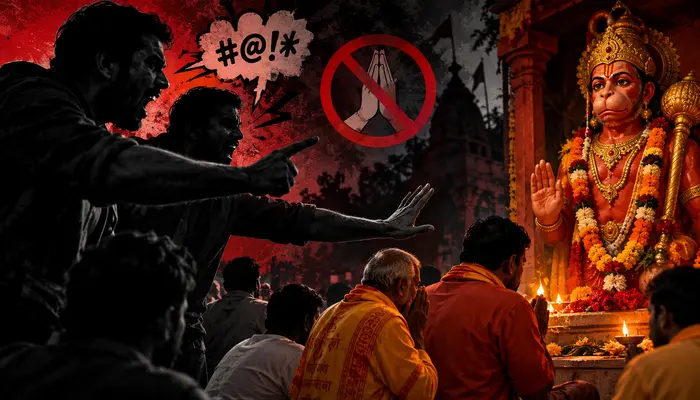
In Tamkuhi Raj, Kushinagar district, Uttar Pradesh, devotees were prevented from worshipping Lord Hanuman. Perpetrators abused and insulted the Hindu deity and the Hindu devotees who were engaged in the rituals. The incident took place at around 7 pm on Tuesday, 27 October 2026, in the western hamlet of Gairi Jagdish village, within the jurisdiction of Sevarahi Police Station. According to the written complaint, village residents Bujesh Prasad and Govardhan Prasad stopped the people who were worshipping Lord Hanuman and directed abusive language and offensive comments towards the deity and devotees. The incident caused resentment among those present and raised fears of tension developing in the village. On Wednesday, 28 October 2026, members of the National Bajrang Dal reached Tamkuhi Raj Tehsil to protest against the incident. They submitted a written application to Sub-Divisional Magistrate Kunal Gaurav, demanding that the police register a criminal case against the accused and arrest them. The complainants said the incident hurt religious sentiments and disturbed peace in the village. The National Bajrang Dal workers urged the administration to treat the matter seriously, conduct an impartial investigation and initiate appropriate legal proceedings against the accused in accordance with the law. They emphasised the need for appropriate action in matters involving religious faith to ensure peace and communal harmony in the area. After receiving the written representation, Sub-Divisional Magistrate Kunal Gaurav directed the Station House Officer of Sevarahi Police Station to take necessary action. The police investigation and subsequent action remained pending. Those present during the protest included Ranjit Gupta, Vinay Yadav, Jwala Patel, Sunil Bharti, Madhusudan Chauhan, Santosh Yadav, Ram Nishad, Sunil Paswan, Raju, Prince, Sonu, Sandeep and Abhishek, along with several other National Bajrang Dal workers.
Why it is Hate Crime ?
This case is being added to the tracker under the primary category: Restriction/ban on Hindu practices. The subcategory selected is: Restriction on expression of Hindu identity. An example of the state-affected prejudicial and targeted orders against the Hindu community would be a government denying the right of a Hindu or a group of Hindus to hold a religious procession owing to the animosity of non-Hindu groups. Denial of the religious right of the Hindus to assuage the non-Hindu group which harbours animosity to a point where it could lead to violence against Hindus is not only a failure of law and order but is a prejudicial order against Hindus, denying them their fundamental rights to express their religious identity. An example of a hate crime against Hindus by a non-Hindu would be a non-Hindu institution forcing its Hindu employees to abandon religious symbols that a Hindu would wear as an expression of faith owing to inherent prejudice against the faith professed by the victim or a non-Hindu group of people restricting a Hindu group from constructing a place of worship simply because the demography of the area in which the temple is being built is dominated by non-Hindus. Such actions are driven by religious animosity and/or prejudice against Hindus and their faith and would therefore be categorized as a hate crime. The next category selected is: Attack not resulting in death. The subcategory within this is: Attack against Hindu devotees. Hindu devotees are a few of the easiest targets of religiously motivated hate crimes because during the festival/procession/puja etc, for non-Hindus it is easy to profile their victims on the basis of religion. Hindu devotees come under attack on several occasions by individual non-Hindus or mobs of non-Hindus owing to their animosity against Hinduism, its symbols and tradition/practices. There are several instances of Hindu devotees being attacked while they worship in temples or temporary religious structures, during religious processions, doing bhajan/kirtan/puja in their own homes, in the residential society etc. These attacks are perpetrated by non-Hindus primarily because of their animosity towards Hindus and their faith. In some cases, the trigger for the violence may be non-religious, however, there are two elements that make these hate crimes. First, the Hindus who come under attack are attacked violently while indulging in religious activity. Whether they are in a place of worship or not is immaterial to the crime. When individuals are attacked while indulging in religious practices, the attack in itself is a hindrance to their freedom to practice religion and therefore constitutes a hate crime. Secondly, religious supremacist doctrines and ideologies deem religious practices of Hindus to be offensive ab initio since they are considered “sinful” by these ideologies, worthy to be annihilated by force or coercion. Driven by these religious supremacist ideologies and doctrines, the attacks against Hindu devotees stem from intrinsic animosity towards Hinduism. In some cases, the trigger for the violence may be non-religious, however, it develops into a religiously motivated crime during the course of the violence. Since these attacks stem from animosity towards Hindus and Hinduism, they are considered religiously motivated hate crimes under this category. The next category selected is: Hate Speech against Hindus. The subcategory selected is: Anti-Hindu slurs, mocking faith. Anti-Hindu slurs and the deliberate mocking of the Hindu faith owing to religious animosity involve the usage of derogatory terms, stereotypes, or offensive references to religious practices, symbols, or figures. One of the common anti-Hindu slurs used against Hindus is “cow-worshipper” and “cow piss drinker”. The intention of using this term is to demean and mock Hindus as a group and their religious beliefs, since Hindus consider the cow holy. Additionally, some symbols and the slurs attached to them have a historical context that exacerbates the insult, hate, stereotyping, dehumanisation and oppression against Hindus. Cow worship has been used for centuries to denigrate Hindus, insult their faith and oppress Hindus specifically as a religious group. There has been overwhelming documentation about how cow slaughter has been used to persecute Hindus with cow meat being thrown in temples and places of worship. There has also been overwhelming documentation where cow meat (beef) has been force-fed to Hindus to either forcefully convert them to Islam or denigrate their faith. Apart from cow worship, the Swastika – which holds deep religious significance for the Hindus – has also been misinterpreted and distorted to use as a slur against Hindus. Similarly, the worship of the Shivling has been used by supremacist ideologies and religions to denigrate Hindus owing to religious animosity. Such slurs and denigration stem out of inherent animosity and hate towards Hindus and their faith, therefore, it is categorised as hate speech targeted at Hindus specifically owing to their religious identity. This case represents a clear instance of religious insult targeting the Hindu faith through objectionable remarks directed at Lord Hanuman and the obstruction of Hindu worship. Preventing devotees from worshipping and using abusive language against a revered deity extended beyond the expression of a personal opinion because it targeted beliefs that are fundamental to the religious identity of the Hindu community. Such conduct demeaned the faith itself by targeting such a sacred figure in Hinduism. The use of abusive language and derogatory remarks directed at Lord Hanuman constituted a direct insult to one of the most revered deities in Hinduism and an affront to the religious faith of Hindus. Lord Hanuman embodies unwavering devotion, extraordinary strength, courage, selfless service and absolute dedication to Lord Shri Ram. He holds an exalted place in Hindu religious consciousness, with devotees praying to him for strength, protection, perseverance, and spiritual guidance. His worship is an integral part of Hindu religious life, and the reverence accorded to him spans generations, communities, and regions. Directing derogatory and insulting language towards Lord Hanuman therefore struck at the very heart of Hindu devotion and demonstrated contempt for a figure whom Hindus held sacred. Such conduct went beyond an ordinary verbal insult because it targeted the divine figure at the centre of a deeply held religious conviction. It degraded the figure of Hindu worship, disrespected the spiritual values associated with the deity and wounded the religious sentiments of devotees whose faith was inseparably connected with his veneration. The use of derogatory remarks against Lord Hanuman consequently represented a grave affront to Hindu religious dignity and an attack on the sanctity that his worship held within Hinduism. Equally significant was the obstruction of puja-archana (religious worship) dedicated to Lord Hanuman, which constituted a direct interference with Hindu religious practice and an assault on devotees’ freedom to express their faith. Worship is a fundamental expression of Hindu spirituality through which believers demonstrate reverence towards their deities, offer prayers and maintain their relationship with the divine. The worship of Lord Hanuman carries profound religious significance for devotees who regard him as a source of courage, strength, protection and unwavering devotion. Preventing Hindus from carrying out their prayers therefore interfered with an essential act of religious observance and obstructed their ability to practise a deeply cherished aspect of their faith. Such interference disregarded the sanctity of Hindu worship and treated a religious practice of profound spiritual importance as something that could be arbitrarily disrupted. Hindu religious observances are an essential part of the community’s spiritual and cultural identity, and obstructing them undermined devotees' dignity and the religious traditions they uphold. The act consequently represented a serious affront to Hindu religious freedom and an attack on the ability of Hindu devotees to practise their faith without interference. Beyond the obstruction of worship itself, the verbal abuse directed at devotees for practising their Hindu faith constituted a direct affront to their dignity and an expression of contempt towards their religious identity. The devotees had gathered to worship Lord Hanuman, an act rooted in their faith, devotion and reverence for a sacred Hindu deity. Subjecting them to verbal abuse in connection with that worship demeaned them for exercising a fundamental expression of their religious beliefs. Such conduct did not merely target individuals; it struck at the religious identity they expressed through their devotion and disrespected the Hindu traditions they sought to uphold. It also undermined the basic dignity that Hindu worshippers deserved while participating in religious observances. Verbal hostility directed at devotees during worship turned an act of spiritual reverence into an occasion of humiliation and hostility, demonstrating disregard for the sanctity of their religious practice. By abusing people for participating in Hindu worship, the conduct attacked the very expression of faith that connected them to their deity and religious community. It also threatened to create an atmosphere in which Hindu devotees felt intimidated or unwelcome while practising their religion. Such treatment represented an affront to Hindu religious dignity, an insult to the devotees’ sincere faith and a direct challenge to the respect that Hindu religious observances deserved. Such actions are an insult to Hindu religious sentiments and a violation of the sanctity of the temple, making it a kind of religious harassment worthy of being listed in the hate tracker.


Case Status
Complaint filed


Perpetrators Details
Perpetrators
Others
Perpetrators Range
From 2 To 5
Perpetrators Gender
male
 Sources



