Durga Puja immersion procession targeted; Muslim men vandalise Durga idol, assault Hindu devotees and molest women
 Basti, Uttar Pradesh, India
 25 October, 2026
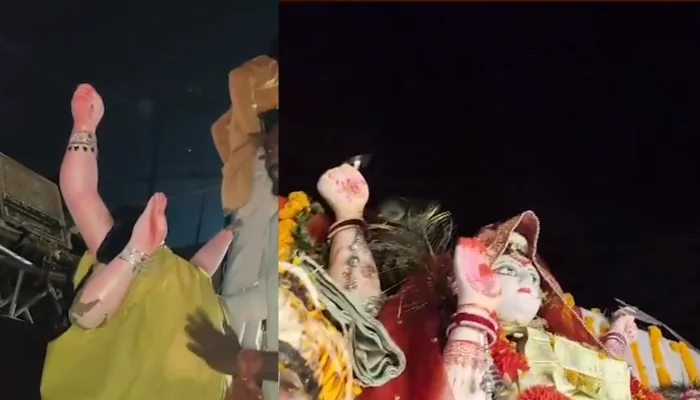
Case Summary
A Durga Puja idol immersion procession was attacked by a group of Muslim men in Basti, Uttar Pradesh. The perpetrators vandalised an idol of Goddess Durga, physically assaulted Hindu devotees and molested Hindu women participating in the procession. The incident took place at around 11 pm on 26 October 2026, near Gate No. 3 of the District Hospital, within the jurisdiction of the Old Basti police station. Following the Navratri celebrations, several idols of Hindu goddesses had been loaded onto vehicles for immersion at Amahat Ghat. The procession was travelling from Pipra Ramkishun towards the ghat via Jigina when a confrontation broke out between Hindu devotees and a group of Muslim men. Subsequently, the situation escalated as the Muslim men vandalised a Durga idol. The attack disrupted the religious procession, prompting members of the organising committee to halt near Hospital Crossing and refuse to proceed with the immersion. Following the incident, the organisers stated that members of the Muslim community had vandalised the Durga idol. Shubham Jaiswal, a resident of Pipra Ramkishun, subsequently submitted a written complaint naming 10 individuals: Salman Qureshi, Anees, Irfan, Fazal, Nafish, RDX, Arman, Mantu Pathan, Sameer and Rehan. The complaint further stated that the perpetrators molested Hindu women and girls participating in the procession, looted their jewellery and physically assaulted Hindu devotees using swords, knives, bricks and stones. The incident sparked widespread outrage, with devotees and organisers demanding the immediate arrest of those responsible and the registration of a criminal case. Protesters blocked Hospital Crossing and Roadways Junction, staged demonstrations and raised slogans against the attack. Members of the Bajrang Dal and the Vishva Hindu Parishad also reached the scene in response to the incident. As tensions mounted, a large police contingent and senior administrative officials arrived at the location. Those present included Additional Superintendent of Police Shyamkant, City Circle Officer Mansi Dahiya, City Kotwal Brijanand Singh and Station House Officer Shashank Shekhar Rai. The police attempted to pacify the protesters and instructed the organisers to submit a written complaint against the accused. The organisers also stated that they had alerted police personnel deployed on duty to the possibility of a confrontation but that the police had failed to respond promptly. The police later resorted to mild force to remove the damaged idol from the scene and made arrangements for its immersion at Amahat Ghat. The authorities assured the protesters that stringent action would be taken against those responsible. Following these assurances, the procession resumed at around 2 am, and the immersion was completed. Acting on Shubham Jaiswal's written complaint, the police registered a First Information Report against 10 named Muslim individuals and 20 unidentified persons. Six people were taken into custody for questioning. Additional Superintendent of Police Shyamkant stated that action had been initiated against those responsible for creating disorder and that no one involved would be spared.
Why it is Hate Crime ?
This case is being added to the tracker under the first primary category: Attack not resulting in death. The subcategory selected is: Attack on Hindu religious procession. The outward celebration and display of religious symbols in an intrinsic part of Hinduism. Religious processions on various festivals are age-old traditions and a way to manifest faith and form a part of the religious practices of Hindus. On several occasions, such religious processions come under attack by non-Hindu mobs, in a manifestation of their animosity towards Hinduism and their practices. The reasons cited for such violent attacks are many and range from crossing a non-Hindu resident-dominated area to playing loud music, crossing from an area where there is a religious structure of another faith etc. The violent attacks are triggered by the outward display of religiosity by Hindus. The attacks are mainly a manifestation of religious supremacist doctrine which believes that idolatry, essentially the Hindu faith, is one that deserves to be annihilated since the very tenets of Hinduism, its practices and traditions are considered a sin in those doctrines. Since these attacks emanate from intrinsic and doctrinal animosity towards Hindus and Hinduism, it is considered a religiously motivated hate crime under this category. The other subcategory selected is: Attack against Hindu devotees. Hindu devotees are a few of the easiest targets of religiously motivated hate crimes because during the festival/procession/puja etc, for non-Hindus it is easy to profile their victims on the basis of religion. Hindu devotees come under attack on several occasions by individual non-Hindus or mobs of non-Hindus owing to their animosity against Hinduism, its symbols and tradition/practices. There are several instances of Hindu devotees being attacked while they worship in temples or temporary religious structures, during religious processions, doing bhajan/kirtan/puja in their own homes, in the residential society etc. These attacks are perpetrated by non-Hindus primarily because of their animosity towards Hindus and their faith. In some cases, the trigger for the violence may be non-religious, however, there are two elements that make these hate crimes. First, the Hindus who come under attack are attacked violently while indulging in religious activity. Whether they are in a place of worship or not is immaterial to the crime. When individuals are attacked while indulging in religious practices, the attack in itself is a hindrance to their freedom to practice religion and therefore constitutes a hate crime. Secondly, religious supremacist doctrines and ideologies deem religious practices of Hindus to be offensive ab initio since they are considered “sinful” by these ideologies, worthy to be annihilated by force or coercion. Driven by these religious supremacist ideologies and doctrines, the attacks against Hindu devotees stem from intrinsic animosity towards Hinduism. In some cases, the trigger for the violence may be non-religious, however, it develops into a religiously motivated crime during the course of the violence. Since these attacks stem from animosity towards Hindus and Hinduism, they are considered religiously motivated hate crimes under this category. The second primary category selected is: Attack on Hindu religious representations. The subcategory selected is: Desecration of Hindu religious symbol. Icons and symbols or a religious representation of a spiritual ideal are widely revered in Hinduism. Iconography is of vital significance in the Hindu milieu. It helps connect people’s spiritual beliefs with the real world. Iconography within the Hindu faith takes several shapes and forms. Murtis are of most significance to Hindus, to which daily rituals, prayers and offerings are done. Besides the murtis, there are several other symbols which have deep significance in the Hindu faith – the Om and Swastika for example. Since these Hindu religious symbols hold paramount importance in Hinduism, any desecration of symbols, icons, murtis, religious representations and manifestations, is driven by animosity towards the faith itself which manifests itself through these murtis, icons and symbols. Therefore, any desecration of these Hindu religious symbols and representations is considered religiously motivated hate crimes under this category. This case constituted a clear example of religiously driven violence, as a group of Muslim men targeted a Durga Puja idol immersion procession, vandalised an idol of Goddess Durga, physically assaulted Hindu devotees and molested Hindu women participating in the procession. The perpetrators' actions targeted both a sacred Hindu religious observance and the devotees gathered to practise their faith, demonstrating hostility towards Hindu traditions, sacred symbols and the public expression of Hindu identity. To understand the gravity of the incident, it is essential to recognise the religious significance of Navratri and the idol immersion procession. Navratri is one of the most revered Hindu festivals, celebrated over nine nights in honour of the Divine Feminine, particularly Goddess Durga. It commemorates the triumph of good over evil, symbolised by the goddess's victory over the buffalo demon Mahishasura, and is observed through prayers, fasting, devotional singing and sacred rituals. The festival celebrates the divine power, protection and victory of Goddess Durga and holds immense spiritual and cultural significance for Hindu devotees. The idol immersion procession marks the ceremonial farewell to the goddess at the conclusion of the festivities, as devotees accompany her idol to the water for immersion while offering prayers, chanting religious slogans and participating in traditional devotional celebrations. It is a sacred expression of Hindu faith, devotion and collective religious identity, bringing devotees together to honour their deity through an important religious ritual. The vandalism of Goddess Durga's idol during this sacred procession demonstrated blatant disrespect for Hinduism and its religious beliefs. Hindu idols are sacred representations of deities and occupy a central place in worship, prayer and religious rituals. During Navratri, the idol of Goddess Durga becomes the focus of elaborate ceremonies and devotional practices through which devotees honour the goddess and seek her blessings. Vandalising the idol during its immersion procession desecrated an object of profound religious reverence at the very moment devotees were participating in a sacred ritual. This was not merely the destruction of a physical object; it was a violation of the sanctity of a religious observance and an affront to the faith that the idol represented. Deliberately desecrating a revered Hindu idol demonstrated contempt for Hindu religious sentiments, beliefs and traditions, making it a religiously driven crime. Attacking a Hindu religious procession and physically assaulting its participants constituted an attack on their Hindu identity and their right to express their faith publicly. Such processions are sacred expressions of Hindu devotion, bringing devotees together to honour their deities and participate in religious observances. By disrupting the procession and assaulting Hindu devotees with swords, knives, bricks and stones, while molesting Hindu women and girls and looting jewellery, the perpetrators violated the sanctity of the religious gathering, hurt Hindu religious sentiments and inflicted fear and insecurity upon the community. Such violence sends a disturbing message to Hindu devotees that the public expression of their religious identity may expose them to intimidation and physical harm. When devotees are attacked while participating in sacred religious observances, the violence targets not only the individuals but also the faith and religious identity they are expressing. Such acts demonstrate religious animosity towards Hinduism and the Hindu community, making this incident a clear example of a hate crime. Such attacks on Hindu idols, processions and devotees cannot be seen as random incidents. Such acts are calculated and ideologically rooted expressions of religious hatred. In Islamic theology, idol worship, referred to as Shirk, is regarded as the gravest sin. The Qur'an strictly condemns it, and Islamic teachings emphasise the complete rejection of any practice associated with idol worship. Muslims are taught from a young age that idolatry is an unforgivable sin. While this belief is central to Islamic faith, it has also led, historically and in contemporary times, to intolerance and hostility towards idol-worshipping religions, especially Hinduism. When Muslim individuals deliberately desecrate Hindu idols and attack Hindu devotees and religious processions, it demonstrates contempt for Hindu religious beliefs, traditions and practices. Such actions target the religious identity, faith and dignity of Hindus, reflecting hostility towards their sacred symbols and public expressions of devotion, making this an instance of a religiously motivated offence. Overall, since this case meets the parameters of a religiously driven hate crime, it is being added to the hate crime database of the Hinduphobia Tracker. Disclaimer: In this case, the total number of perpetrators has been recorded as 30, comprising 10 named Muslim perpetrators and 20 unidentified Muslim perpetrators. This figure has been recorded for documentation purposes only.


Case Status
Case sub-judice


Perpetrators Details
Perpetrators
Muslim Extremists
Perpetrators Range
From 10 to 100
Perpetrators Gender
male
 Sources



