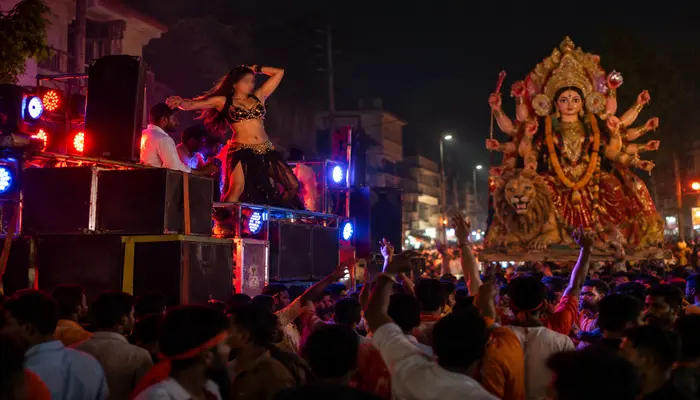
Navratri celebrations desecrated by obscene songs and dance performances during Durga idol immersion procession in Bihar
 Siwan, Bihar, India
 23 October, 2026
Case Summary
Navratri celebrations were desecrated in Siwan, Bihar, where obscene songs were played and obscene dance performances were held during a Durga idol immersion procession. The incident occurred on 24 October 2026, at around 7.15 pm, at Ambedkar Chowk in the Chainpur police station area of Siwan district. During the Durga Puja idol immersion procession, several Puja committees played obscene and objectionable songs at high volume through large disc jockey (DJ) sound systems. A female dancer was also made to perform an obscene dance during the procession, while the participants created a disturbance. The police identified several Puja committees in connection with the incident, including Mahaviri Puja Samiti Akhara No. 2, Harijan Tola Puja Samiti, Akhara No. 3 Gola Bazaar, VIP Mahavir Durga Puja Samiti Mubarakpur, Navayuvak Mahaviri Puja Samiti Dulam Sthan and Bahubali Akhara Samiti Nayagaon, among others. The committees' licence holders and members were among those named in the case. Before Durga Puja, the Sub-Divisional Officer had instructed all licence holders during a peace committee meeting to comply with the prescribed noise limits and time restrictions. However, the DJ volume was not reduced despite these instructions. The DJ sound boxes also did not display the names and addresses of their operators and owners, making their identification difficult. Following the incident, Chainpur Station House Officer Vijay Ranjan Kumar initiated legal action by submitting a written statement. The police registered a First Information Report (FIR) naming 101 people and listing more than 150 unidentified individuals as accused, bringing the total number of accused to over 250. The police stated that video footage would be examined to identify the unidentified accused and DJ operators. The FIR was registered under Sections 223 and 296 of the Bharatiya Nyaya Sanhita and Section 9 of the Bihar Loudspeaker Act. Further investigation and legal action were underway at the time of writing this report.
Why it is Hate Crime ?
This case is being added to the tracker under the primary category: Attack on Hindu religious representations. The subcategory selected is: Defiling religious customs. Sanatan Dharma is not a religion of one book, which is to say that while it has religious scriptures that form the central tenets of the faith, there are several traditions followed through thousands of years, mostly passed from generation to generation orally. There are several such customs and traditions that are followed by various Hindus and Hindu sects. Defiling of these traditions and customs is a breach of an individual or group’s religious practices. Such practices can range from dietary restrictions like not eating non-vegetarian food for a certain period of the year, not eating non-vegetarian food at all, not eating beef since the cow is considered holy in Hinduism, the sanctity of religious customs followed in the house (like many ISCKON devotees), etc. Any malicious action leading to the breach of such traditions or defilement of these traditions owing to animosity towards the faith or for the sake of activism stems not only from the lack of faith in the religion itself but also from disregard for the faith of the devotees who follow the customs/traditions and implicit bias against the faith, the tradition itself. Since these specific traditions are central to the faith of the devotees of that specific sect of Hindus, any non-compliance with these traditional rules would be considered a religiously motivated hate crime. This case amounted to an act of religious disrespect towards Hinduism, as Navratri celebrations were desecrated by obscene songs and dance performances during a Durga idol immersion procession. The playing of obscene music and the performance of obscene dances during a sacred religious procession disregarded the religious significance of the occasion and the sanctity associated with Hindu worship and festive observances. To understand the severity of the violation, one must understand the religious significance of Navratri. Navratri is a sacred Hindu festival dedicated to the worship of Goddess Durga and her various manifestations over nine nights. It symbolises the triumph of good over evil and is observed through prayers, rituals, fasting, devotional singing and other religious practices. The Durga Puja idol immersion procession forms an important part of these celebrations, marking the farewell to the goddess's idol before it is immersed in water. The procession is traditionally accompanied by prayers, Hindu religious slogans, devotional music and customary celebrations. It is a sacred occasion during which devotees pay their respects to the goddess and bid her farewell until the following year. Such processions are conducted with reverence for the deity and respect for the religious character of the occasion, leaving no place for obscene songs and dance performances. In this case, the playing of obscene and objectionable songs at high volume and the performance of an obscene dance by a female dancer during the Durga idol immersion procession desecrated the sanctity of the religious occasion. Such conduct disregarded the sacred character of the festival and demonstrated a lack of respect for the religious traditions associated with Navratri and the worship of Goddess Durga. Turning a sacred religious procession into an occasion for obscene entertainment undermined the dignity of the celebration and hurt the religious sentiments of the Hindu community. The use of a Hindu religious occasion as a setting for such performances constituted an act of religious hostility and disrespect towards Hinduism, making this a clear case of a religiously driven hate crime. Overall, as this case met the parameters of a hate crime, it was added to the hate crime database of the Hinduphobia Tracker.


Case Status
Complaint registered


Perpetrators Details
Perpetrators
Others
Perpetrators Range
From 10 to 100
Perpetrators Gender
unknown
 Sources



