Goddess Durga mandap targeted in attempted arson by Muslim mob ahead of Durga Puja immersion in Muslim-majority village in West Bengal
 Uttar Dinajpur district, West Bengal, India
 25 October, 2026
Case Summary
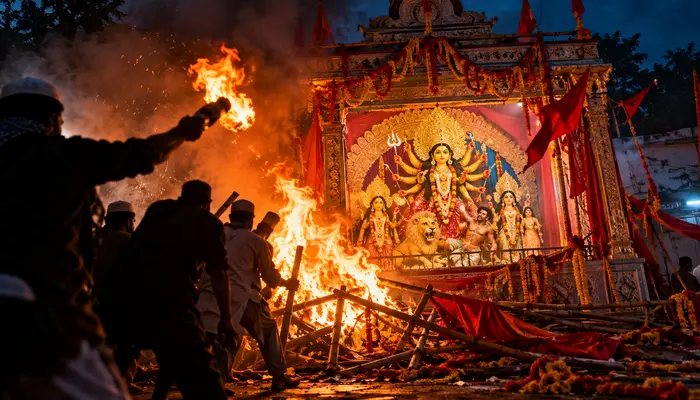
In Pamol village in Goalpokhar, North Dinajpur district, West Bengal, a Durga mandap was targeted in an attempted arson attack by a Muslim mob ahead of the Durga Puja immersion in a Muslim-majority area. The video circulated on social media showed flames outside the Durga mandap, with a group of people gathered around the premises. Heated arguments broke out among those present as tensions mounted. The person recording the footage attributed responsibility to Muslims and affirmed that they were attempting to set the mandap ablaze. As the situation escalated, police arrived to maintain order and prevent further unrest. Pamol village, where the incident occurred, accounts for only about 20 per cent of the Hindu population. The incident called for a thorough investigation to establish the circumstances surrounding the fire and identify those responsible. Authorities were expected to take strict legal action against anyone found involved, while ensuring the security of religious sites and preventing further tensions. Maintaining law and order and preserving communal harmony remained crucial as concerns grew over the incident.
Why it is Hate Crime ?
The primary category selected in this case is: Attack on Hindu religious representation. The subcategory selected is: Violence against religious structures or centres. In Hinduism, a religious structure is also considered divine. Hindus believe that not just the Deity but the religious structure itself is sacred. In this sub-category, we would document attacks against religious structures which are not consecrated temple spaces. Such religious spaces could be temporary in nature – for example – the religious spaces erected specifically for festivals like Durga Puja etc. This category would also document cases of attacks against religious centres. These spaces in their own right may not be ‘sacred’ per se, however, are often spaces where religious gurus live, religious teaching is imparted, or belong to religious institutions. Any attack against religious structures is a result of animosity towards the religion itself, which manifests itself through the religious spaces and therefore, such attacks are considered religiously motivated hate crimes. Religious centres are also manifestations of the religion, its teachings or gurus and therefore, attacks against such centres would be considered religiously motivated hate crimes. This case is a clear example of a religiously driven hate crime, as a Durga mandap was targeted in an attempt to set it ablaze by a Muslim mob ahead of the Durga Puja immersion. Targeting a Hindu religious structure prepared for one of the most significant Hindu festivals demonstrated hostility towards a distinctly Hindu religious celebration. To begin with, the attempt to set a Durga mandap ablaze represented a direct threat to a sacred space associated with Hindu faith, worship and religious identity. Goddess Durga occupies a revered position in Hinduism, symbolising divine feminine power and the triumph of good over evil. The mandap serves as a focal point where devotees gather, offer prayers, and participate in rituals dedicated to the Goddess. An attempt to set such a religious structure on fire therefore threatened more than a physical site; it threatened a space embodying the faith, devotion and collective religious identity of Hindu worshippers. The prospect of a Hindu place of worship being engulfed in flames caused profound distress among devotees and undermined their sense of security in practising their religion. Such a deliberate act constituted a serious assault on the sanctity of a Hindu religious institution. The targeting of a sacred structure associated with Goddess Durga raised grave concerns about hostility towards Hindu religious expression and the protection of Hindu places of worship. The timing of the incident was particularly significant, as it fell ahead of the Durga Puja immersion, one of the most spiritually and culturally significant occasions in the Hindu religious calendar. Durga Puja commemorates Goddess Durga's victory over Mahishasura and celebrates the triumph of righteousness over evil. The immersion ceremony marks the culmination of days of worship, prayer, community participation and religious observance. An attempt to set a Durga mandap ablaze during this period threatened the sanctity and continuity of a celebration central to Hindu religious life. The timing heightened the incident's seriousness because the mandap was part of an active festival rather than an ordinary public structure. Any deliberate attempt to disrupt or destroy such a space because of its Hindu religious significance represented an attack on the community's freedom to celebrate its faith without intimidation. Targeting a religious structure during a major festival risked instilling fear among devotees, disrupting established traditions and turning a period of religious celebration into one of anxiety and insecurity. The circumstances therefore raised serious concerns about the safety of Hindu religious observances and the protection of their sacred spaces. Equally concerning was Pamol village's demographic composition, where Hindus made up only about 20 per cent of the population. In a Muslim-majority locality, the threat to a Durga mandap demonstrated serious concerns about the security of a Hindu religious institution serving a comparatively smaller community. For Hindu residents, the prospect of their place of worship being targeted intensified fears about their ability to preserve religious traditions, conduct festivals and maintain their sacred institutions without intimidation. A religious minority's place of worship is especially important as a centre of collective faith, cultural continuity, and community participation. Any deliberate attack on such a site because of its Hindu identity struck at the community's religious dignity and sense of security. Evidence established that a place of worship had been targeted specifically because it belonged to Hindus. The act represented a grave instance of anti-Hindu hostility and an assault on the community's fundamental freedom to practise its faith. This broader pattern of persecution reflects the systemic hostility faced by Hindus. This sort of attack specifically targeting Hindus stems from a deep-seated animosity Islamists harbour towards the Hindu faith, which is why this case has been categorised as a religiously motivated hate crime in the Hinduphobia Tracker's Database as an instance of religiously motivated hostility directed against Hinduism and the religious identity of the Hindu community. Disclaimer: The Hinduphobia Tracker records incidents based on when an event occurred or when the victim's ordeal began. None of the media sources covering this case has specified the exact date the incident occurred. Therefore, for documentation purposes, we recorded the date as the date the incident was reported in the media: 26 October 2026.


Case Status
Unknown


Perpetrators Details
Perpetrators
Muslim Extremists
Perpetrators Range
Unknown
Perpetrators Gender
unknown
 Sources



