Hindu temple vandalised, idols of Lord Ram, Lakshman and Goddess Sita damaged, blood-like substance splashed inside shrine
 Birbhum district, West Bengal, India
 25 October, 2026
Case Summary
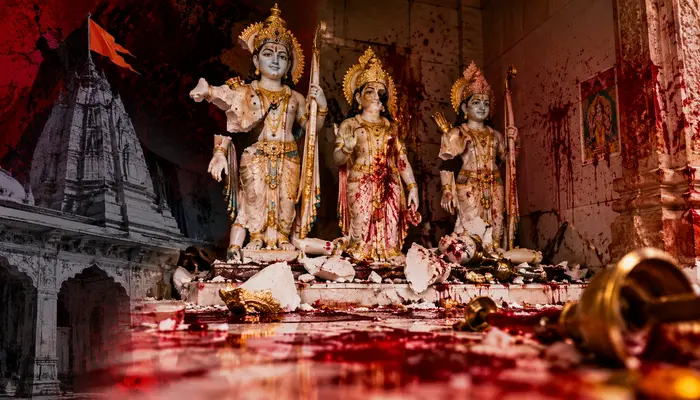
In Chouhatta village, under Labpur Police Station in Birbhum district, West Bengal, a Hindu temple dedicated to Lord Ram and Goddess Sita was vandalised, with the white-marble idols of Lord Ram, Goddess Sita and Lord Lakshman damaged and a blood-like substance splashed inside the shrine. The incident occurred on the night of 26 October 2026 at the temple along the Chouhatta–Sainthia road. The shrine housed white-marble idols of Lord Ram, Goddess Sita, and Lord Lakshman, each about one foot tall, which had been worshipped there for a long time. Residents established the adjacent Hanuman temple. On the morning of 27 October 2026, residents discovered the damaged idols and the substance inside the temple and informed the police. Police personnel from Labpur Police Station reached the spot and initiated an investigation. Labpur Police Station Officer-in-Charge Abdul Gaffar and Nanur Circle Inspector Mithun Bandyopadhyay visited the scene. Birbhum Superintendent of Police Vidit Raj Bandeesh subsequently arrived with a large police contingent, accompanied by Additional Superintendent of Police Abhishek Roy and Bolpur Sub-Divisional Police Officer Arpit R. Parekh. Police cordoned off the temple premises and examined the scene as part of the investigation. A forensic science laboratory (FSL) team was called to collect samples and determine the nature of the blood-like substance found inside the shrine. Investigators began examining the available evidence to establish the circumstances surrounding the damage to the idols, identify those responsible and determine the motive behind the incident. Birbhum Superintendent of Police Vidit Raj Bandeesh assured that police would arrest those responsible and take strict action. Speaking after inspecting the site, he said, “Those who have committed this incident will be arrested soon, and strict action will be taken against them. The forensic team has also been informed. The culprits will not be spared in any way.” Police also said they were working to solve the case as soon as possible and had deployed personnel to monitor the area and maintain order. The incident prompted local Bharatiya Janata Party (BJP) workers and supporters to gather outside the temple and demand action. Local BJP leader Biswajit Mondal described the incident as deeply distressing and said the party would follow up on the matter and provide any assistance the administration requires. He also noted that the police had arrived after receiving information about the incident. Mondal said the police assured local representatives they would arrest those responsible within seven days. However, he cautioned against speculating about the perpetrators' identities before the investigation established the facts. A resident also expressed distress over the damage, stating, “This shouldn't have happened. It's very distressing. Lord Ram and Goddess Sita's idols have been vandalised inside the premises.”
Why it is Hate Crime ?
This case is being added to the tracker under the primary category: Attack on Hindu religious representations. The selected subcategory is Desecration of Hindu religious symbols. Icons and symbols or a religious representation of a spiritual ideal are widely revered in Hinduism. Iconography is of vital significance in the Hindu milieu. It helps connect people’s spiritual beliefs with the real world. Iconography within the Hindu faith takes several shapes and forms. Murtis are of most significance to Hindus, to which daily rituals, prayers and offerings are done. Besides the murtis, there are several other symbols which have deep significance in the Hindu faith – the Om and Swastika for example. Since these Hindu religious symbols hold paramount importance in Hinduism, any desecration of symbols, icons, murtis, religious representations and manifestations, is driven by animosity towards the faith itself which manifests itself through these murtis, icons and symbols. Therefore, any desecration of these Hindu religious symbols and representations is considered religiously motivated hate crimes under this category. The other subcategory selected is: Attack on Temples. In Hinduism, a temple is the abode of the Deity. The Deity in the Temple is consecrated, thereby, making it a real, breathing entity. Hindus believe that not just the Deity but the temple premises itself are sacred to Hindus since Hindus hold the faith that the entire Temple space is an amalgamation of the divine energy of the deity. Given the central significance of Temples in Hindu Dharma, any attack against a Hindu Temple or its peripheral premises is an attack on the faith itself and is born out of animosity towards the faith, of which, the Temple is a central tenet. Any manner of attack against a Temple and/or its premises would therefore be considered a religiously motivated hate crime. In this case, the vandalism of sacred idols of Hindu deities Lord Ram, Goddess Sita and Lord Lakshman, along with the presence of a blood-like substance inside the temple, constitutes a religiously driven hate crime rooted in anti-Hindu hostility. The idols of Lord Ram, Lord Lakshman and Goddess Sita hold profound religious significance in Hinduism. Lord Ram is revered as the seventh incarnation of Lord Vishnu and embodies righteousness, virtue and dharma. At the same time, Lord Lakshman, his younger brother, is venerated for his unwavering devotion, loyalty and sacrifice. Goddess Sita, Lord Ram's consort and an incarnation of Goddess Lakshmi, is worshipped as an embodiment of purity, devotion, courage, and virtue. Together, they hold a central place in Hindu religious beliefs and are revered as symbols of righteousness, familial devotion, and the triumph of good over evil. Their idols serve as sacred symbols of worship in Hindu temples, making their desecration a deeply distressing matter for devotees. To begin with, the destruction of the sacred idols of Lord Ram, Lord Lakshman and Goddess Sita constituted a grave act of desecration against revered figures of Hinduism. The smashing of these idols constituted a serious violation of the sanctity attached to these revered representations and inflicted profound distress upon Hindu devotees. The destruction struck at the heart of a place where these deities had been worshipped for years, turning sacred representations of faith into targets of physical destruction. For the Hindu community, the desecration represented a grave affront to religious reverence, sacred traditions and the right to practise faith without fear of such violations. Compounding the gravity of the incident, a substance resembling blood was also found splashed inside the shrine, adding another disturbing dimension to the desecration of the Hindu place of worship. Hindu temples are sacred spaces for prayer, worship, religious observance, and spiritual devotion, and their sanctity holds profound importance for devotees. The discovery of a blood-like substance scattered inside a shrine where Lord Ram, Goddess Sita and Lord Lakshman were worshipped represented a deeply disturbing violation of the temple's sacred environment. Considered alongside the destruction of the idols, the substance heightened the gravity of the incident and raised serious concerns about the circumstances surrounding the desecration. The combination of desecrated idols of deities and an unidentified substance resembling blood inside the shrine constituted a defilement of a sacred space and a deeply distressing intrusion into a space reserved for religious devotion. This was clearly done with the intent to mock the Hindu faith, underscoring the deep-rooted hatred towards Hinduism in the mind of the perpetrator. Because the fundamental motivation behind this incident is contempt for the Hindu religion, we added this instance to the tracker. It is important to mention here that, though the last update was that the miscreants were unknown, regardless, the action stemmed from hatred against Hinduism and resulted in the desecration of the sacred temple and the idols, and would therefore be considered a religiously motivated hate crime.


Case Status
Complaint filed


Perpetrators Details
Perpetrators
Unknown
Perpetrators Range
Unknown
Perpetrators Gender
unknown
 Sources



