Hindu devotees assaulted by Muslim woman for celebrating Navratri; threatened with death for pursuing legal action
 Satara, Maharashtra, India
 19 October, 2026
Case Summary
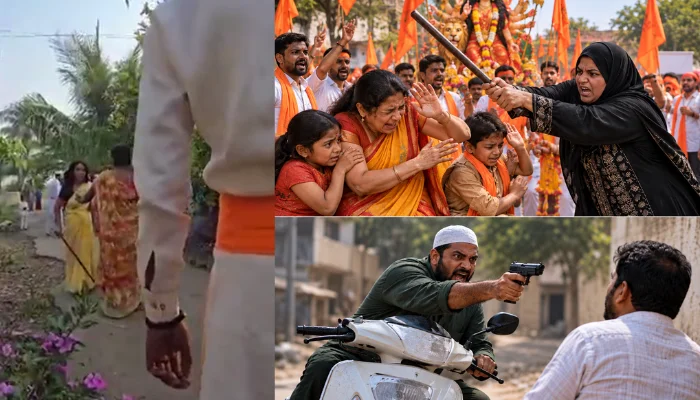
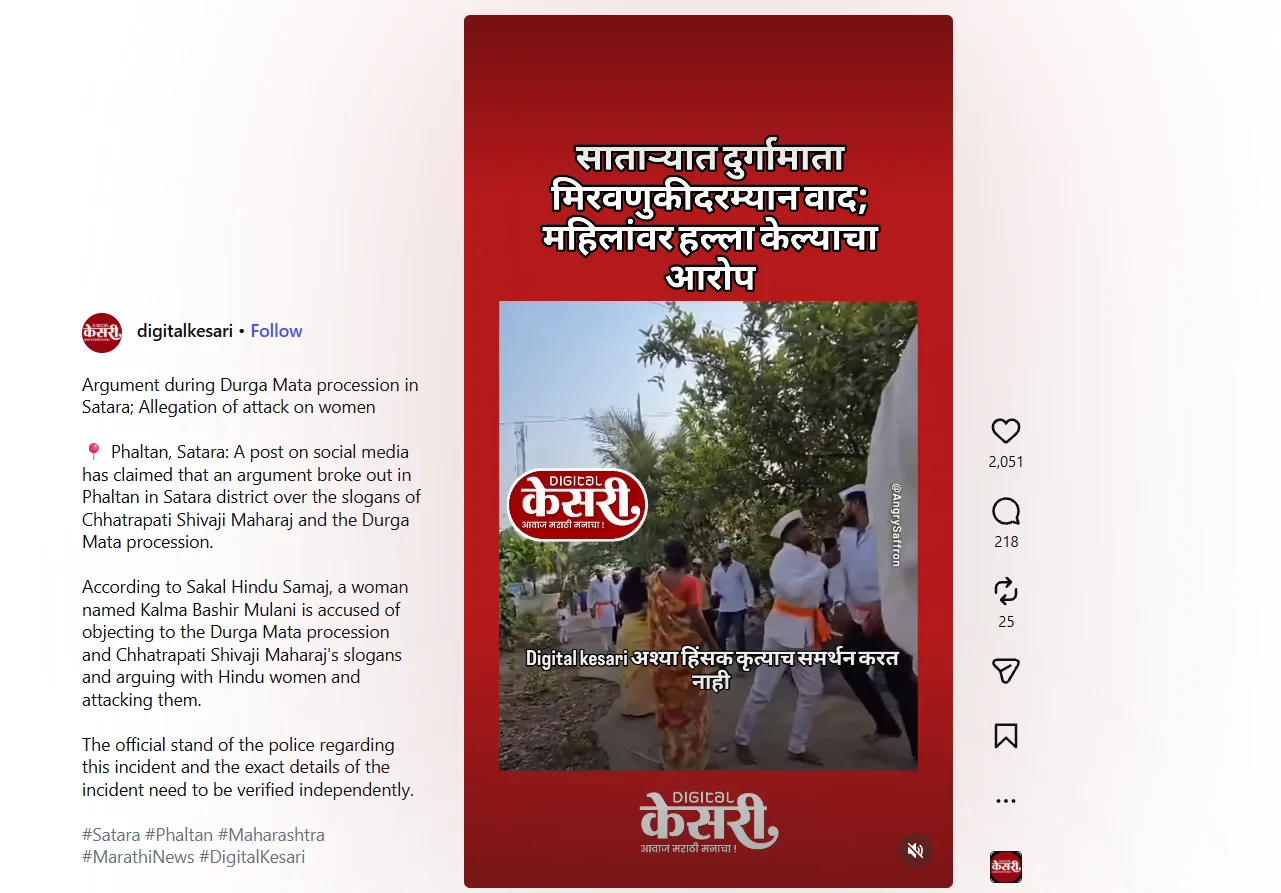
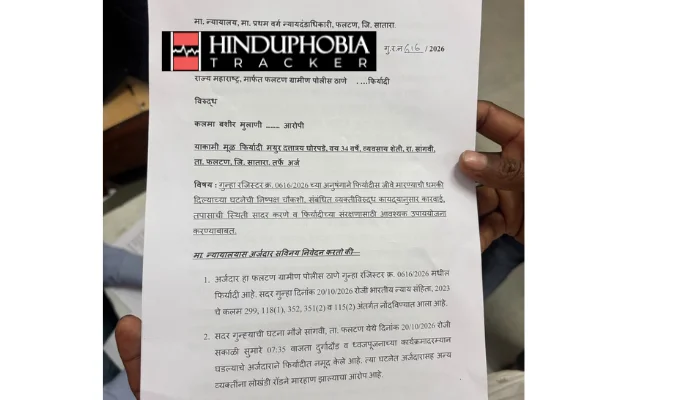
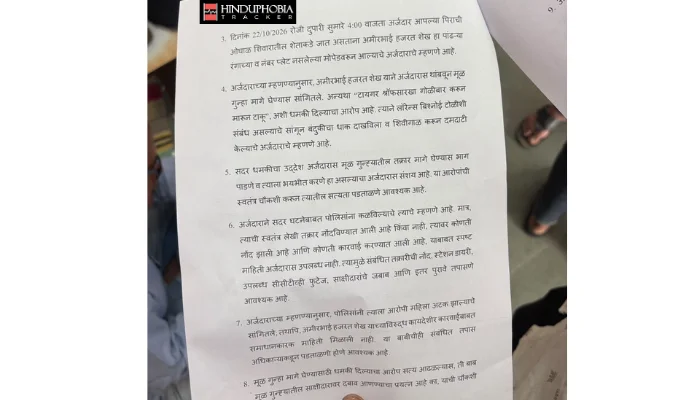
In Sangvi village, Phaltan, Satara, Maharashtra, Hindu devotees participating in a Navratri procession were attacked by a Muslim woman, Kalma Bashir Mulani, for merely chanting Hindu religious slogans. The woman assaulted the participants, including women and children, with a rod. Subsequently, a Hindu devotee, Mayur Dattatray Ghorpade, filed a complaint against the Muslim woman and was threatened with death for pursuing legal action against her. The incident took place on 20 October 2026 at approximately 7.35 am during a Durga Daud procession (Hindu religious procession) and flag-worship programme organised as part of the Navratri festivities. The Muslim woman, identified as Kalma Bashir Mulani, objected to the procession and the religious slogans being raised in praise of Goddess Durga and Chhatrapati Shivaji Maharaj, a revered Hindu king of the Maratha Empire. She then confronted and attacked the Hindu participants with a rod. A video of the incident circulated on social media, prompting users to highlight the attack on Hindu devotees. Sakal Hindu Samaj and other Hindu groups also raised the issue publicly. The Hinduphobia Tracker team contacted Sakal Hindu Samaj and Vishwa Hindu Parishad activists from Satara, who confirmed the incident and stated that a complaint had been filed against the Muslim woman at Phaltan Rural Police Station. According to the activists, the police released Kalma Bashir Mulani by claiming that she was mentally ill. The Hinduphobia Tracker team also spoke to advocate Prashant Nimbalkar, who, at the time of writing this report, practised in Phaltan and at the Kolhapur Bench of the High Court. He confirmed the incident and provided a copy of an application submitted by Ghorpade before the Judicial Magistrate First Class Court in Phaltan on 23 October 2026. According to the application, on 22 October 2026, at approximately 4 pm, a Muslim man identified as Amir Bhai Hazrat Shaikh approached Ghorpade at his farm in Shivratri on a white moped without a number plate. He threatened to shoot Ghorpade “like Tiger Shroff” if he did not withdraw his complaint against Kalma Bashir Mulani. The Muslim man claimed that he had connections with the Lawrence Bishnoi gang (a criminal network associated with organised crime and violent intimidation), brandished a firearm, abused Ghorpade and intimidated him. Ghorpade stated that he had informed the police about the death threat but had not received clear information about the action taken. Fearing for his safety and that of his family, he approached the court seeking an investigation into the threat, appropriate legal action and protection for himself and his family. He also requested an inquiry into whether threats were being used to intimidate other witnesses and obstruct legal proceedings.
Case Images
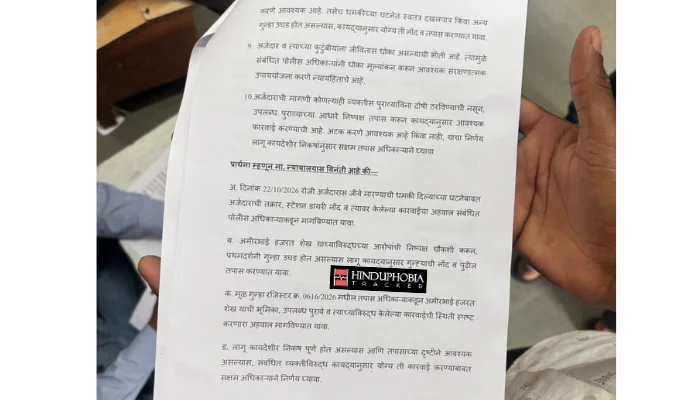
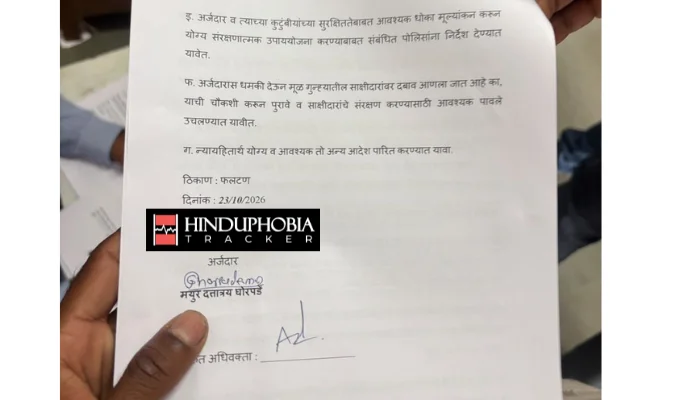
Why it is Hate Crime ?
The first primary category in this case is: Attack not resulting in death. The subcategory selected is: Attacked for Hindu identity. In several cases, Hindus are attacked merely for their Hindu identity without any perceived provocation. A classic example of this category of religiously motivated hate crime is a murder in 2016. 7 ISIS terrorists were convicted for shooting a school principal in Kanpur because they got ‘triggered’ seeing the Kalava on his wrist and tilak that he had put. In this, the Hindu victim had offered no provocation except for his Hindu religious identity. The motivation for the murder was purely religious, driven by religious supremacy. Such cases where Hindus are targeted merely for their religious identity would be documented as a hate crime under this category. The other subcategory selected is: Attack against Hindu devotees. Hindu devotees are a few of the easiest targets of religiously motivated hate crimes because during the festival/procession/puja etc, for non-Hindus it is easy to profile their victims on the basis of religion. Hindu devotees come under attack on several occasions by individual non-Hindus or mobs of non-Hindus owing to their animosity against Hinduism, its symbols and tradition/practices. There are several instances of Hindu devotees being attacked while they worship in temples or temporary religious structures, during religious processions, doing bhajan/kirtan/puja in their own homes, in the residential society etc. These attacks are perpetrated by non-Hindus primarily because of their animosity towards Hindus and their faith. In some cases, the trigger for the violence may be non-religious, however, there are two elements that make these hate crimes. First, the Hindus who come under attack are attacked violently while indulging in religious activity. Whether they are in a place of worship or not is immaterial to the crime. When individuals are attacked while indulging in religious practices, the attack in itself is a hindrance to their freedom to practice religion and therefore constitutes a hate crime. Secondly, religious supremacist doctrines and ideologies deem religious practices of Hindus to be offensive ab initio since they are considered “sinful” by these ideologies, worthy to be annihilated by force or coercion. Driven by these religious supremacist ideologies and doctrines, the attacks against Hindu devotees stem from intrinsic animosity towards Hinduism. In some cases, the trigger for the violence may be non-religious, however, it develops into a religiously motivated crime during the course of the violence. Since these attacks stem from animosity towards Hindus and Hinduism, they are considered religiously motivated hate crimes under this category. The other subcategory selected is: Attack on religious procession. The outward celebration and display of religious symbols in an intrinsic part of Hinduism. Religious processions on various festivals are age-old traditions and a way to manifest faith and form a part of the religious practices of Hindus. On several occasions, such religious processions come under attack by non-Hindu mobs, in a manifestation of their animosity towards Hinduism and their practices. The reasons cited for such violent attacks are many and range from crossing a non-Hindu resident-dominated area to playing loud music, crossing from an area where there is a religious structure of another faith etc. The violent attacks are triggered by the outward display of religiosity by Hindus. The attacks are mainly a manifestation of religious supremacist doctrine which believes that idolatry, essentially the Hindu faith, is one that deserves to be annihilated since the very tenets of Hinduism, its practices and traditions are considered a sin in those doctrines. Since these attacks emanate from intrinsic and doctrinal animosity towards Hindus and Hinduism, it is considered a religiously motivated hate crime under this category. The second primary category selected is: Hate Speech against Hindus. The subcategory selected is: Violent Threats. Violent threats, explicit, implicit or implied, is the most dangerous form of hate speech since it goes beyond discriminatory and prejudicial language to express the intent of causing harm to an individual or a group of people based on their religious identity and faith. There could be several different kinds of threats that are issued to Hindus based on religious animosity. An explicit threat would mean the direct threat of violence towards an individual Hindu, a group of Hindus or Hindus at large. Physical violence, death threats, threats of destruction of property belonging to Hindus and threats of genocide would mean explicit threats against Hindus for their religious identity. Implicit threats may not be a direct threat but implied through the use of symbols of actions – for example – in the Nupur Sharma case, other than explicit threats, there were also implicit threats when Islamists took to the streets to burn and beat her effigies. It implies that they want to do the same to Nupur Sharma – thereby is considered an implicit threat. Violent threats can be delivered in person, through letters, phone calls, graffiti, or increasingly through social media and other online platforms. It would be important to understand that a threat – explicit or implicit, online or offline – to an individual who happens to be a Hindu does not qualify as a religiously motivated threat. Such a threat, while vile and dangerous, could be owing to non-religious reasons and/or personal animosity. To qualify as a religiously motivated threat, it would need to exhibit an indication that the individual is being targeted for religious reasons and/or owing to his/her religious identity as a Hindu. This case is a clear example of a religiously driven hate crime because Hindu devotees were attacked by a Muslim woman for merely chanting Hindu religious slogans during a Navratri procession. Subsequently, when Mayur Dattatray Ghorpade, one of the Hindu victims, pursued legal action against the woman, another Muslim man threatened him with death. The attack on devotees for expressing their faith, followed by threats against a victim seeking justice, highlights the religious hostility surrounding the incident. To understand the severity of the incident, it is important to examine the religious significance of the procession during which the attack took place. Navratri is one of the most significant Hindu festivals, dedicated to the worship of the Divine Mother in her various manifestations, particularly Goddess Durga. Devotees observe the festival through prayers, rituals, fasting, devotional singing and public religious celebrations. Religious processions are among the ways in which devotees express their faith and participate collectively in the festivities. The Durga Daud procession, particularly observed in many parts of India, including Maharashtra, involves Hindu devotees taking to the streets while chanting devotional slogans in praise of Goddess Bhavani, a manifestation of the Divine Mother, and expressing reverence for Chhatrapati Shivaji Maharaj, the revered Hindu Maratha king whose devotion to Goddess Bhavani forms an important part of his religious and cultural legacy. Slogans such as Jai Bhavani are integral to this devotional expression. In this case, the Hindu devotees were participating in such a procession and chanting slogans in praise of Goddess Durga and Chhatrapati Shivaji Maharaj when Kalma Bashir Mulani objected to the procession and attacked the participants with a rod. The attack on Hindu devotees for chanting religious slogans demonstrates hostility towards their religious identity and their right to express their faith publicly. The perpetrator first objected to the Durga Daud procession and then assaulted Hindu devotees for chanting slogans in praise of Goddess Durga and Chhatrapati Shivaji Maharaj. Her objection, followed by violence against participants over their devotional expression, indicates intolerance towards the public expression of Hindu faith. Targeting devotees for practising their religion amounts to hostility towards their religious identity and their right to observe their traditions without fear of violence. The assault also violated the sanctity of the religious procession. A Durga Daud procession is a collective expression of Hindu devotion, bringing devotees together to honour the Divine Mother and celebrate their religious and cultural traditions. By disrupting the procession and attacking its participants, the perpetrator turned an occasion of devotion into one of fear and intimidation. The fact that women and children were also attacked further underscores the severity of the incident. Such violence intimidates not only the immediate victims but also other Hindu devotees, who may fear that participating in public religious celebrations or chanting devotional slogans could expose them to similar attacks. The incident therefore demonstrates hostility towards the public observance of Hindu traditions and undermines the freedom of Hindu devotees to express their faith openly and peacefully. Therefore, this attack on the Hindu devotees makes the incident an example of a religiously driven hate crime. The death threat issued to Mayur Dattatray Ghorpade for pursuing legal action further demonstrates the hostility surrounding the incident. After Ghorpade sought justice for the assault on Hindu devotees, another Muslim man threatened to shoot him if he did not withdraw his complaint. The man also invoked the Lawrence Bishnoi gang, a criminal network associated with organised crime and violent intimidation, adding to the seriousness of the threat. Ghorpade had sought legal recourse rather than retaliating against the Muslim woman who attacked him and other devotees. Threatening a Hindu victim for reporting an assault serves to intimidate him into silence and discourage others from seeking accountability for violence against their community. In this context, the death threat reflects hostility towards a Hindu devotee who sought justice following an attack on Hindu religious observance. Such intimidation compounds the original assault by attempting to deter victims from pursuing legal remedies and reinforces the fear surrounding the public expression of Hindu identity. Another point that needs careful analysis is that the police in this case attempted to whitewash the religiously hostile nature of the crime by claiming that the perpetrator was mentally ill. This is not an isolated incident. In several such cases involving attacks on Hindus for their religious identity, a common narrative used to shield the non-Hindu perpetrator is to attribute the crime to his/her mental illness, claiming that the act was committed because the accused was ‘mentally ill’ or ‘mentally unstable’. The police and media, in many such cases where a crime is committed against Hindus and their faith by a non-Hindu perpetrator, deny that the crime was motivated by religious bias and instead attribute it to the perpetrator’s mental health. Many a time, the police downplay low-level communal crimes because their own jurisdiction and handling of the matter come under scrutiny. The police also often attribute such crimes to the accused’s mental instability to prevent further tensions or a flare-up in the area. However, a police statement cannot be enough to determine whether there is a communal angle present in the crime that has been committed. In fact, to determine whether the crime is communal in nature or not, we need to give emphasis to the ground realities. For example, in the case of Rinku Sharma, the Bajrang Dal activist who was mercilessly stabbed in his house in front of his family members in Delhi’s Mangolpuri area in the year 2021, the leftist media and the leftist ecosystem had tried to peddle that there was no communal angle to the crime. Even the police denied that the crime was communal in nature. However, OpIndia spoke to several people who were on the ground with the family of Rinku Sharma, and they were told that the communal tension in the area was palpable. The family of Rinku Sharma had said that the Muslims of the area held a grudge against Rinku ever since he celebrated the Ram Janmabhoomi verdict. As in the case of Rinku Sharma, incidents in which the police denied a communal angle or the leftist media aggressively promoted the ‘no communal angle’ narrative, despite the ground reality indicating clear religious bias behind the crime, were documented in this tracker. Even in this case, the ground reality needs to be evaluated. The use of the ‘mental illness’ narrative to explain attacks on Hindus for their religious identity raises critical questions. If the perpetrator was indeed mentally unstable, why did she specifically target Hindu devotees participating in the Durga Daud procession for chanting religious slogans? Why did she not direct similar aggression towards non-Hindus or non-religious events? This selective targeting demonstrates how the ‘mental illness’ trope is being used to dismiss the religiously hostile nature of the act. The repeated use of this narrative to downplay crimes against Hindus reflects an attempt to whitewash religious hostility and obscure the religious motivation behind such attacks. In conclusion, considering all aspects of this case, the incident meets the parameters for inclusion as a hate crime and is therefore being added to the Hinduphobia Tracker database. Disclaimer: In this case, despite multiple Hindu devotees being targeted, the total number of participants in the procession has not been specified. The available information identifies Mayur Dattatray Ghorpade as a single Hindu victim. Hence, the victim count has been recorded as one, a conservative estimate for documentation purposes only.
Victim Details
Total Victim
1
Deceased
0
Gender
- Male 1
- Female 0
- Third Gender 0
- Unknown 0
Caste
- SC/ST 0
- OBC 0
- General 0
- Unknown 1
Age Group
- Minor 0
- Adult 1
- Senior Citizen 0
- Unknown 0


Case Status
Perpatrator released by Police


Perpetrators Details
Perpetrators
Muslim Extremists
Perpetrators Range
From 2 To 5
Perpetrators Gender
both
 Sources



