Navratri celebrations targeted: Muslim youth uses fabricated Hindu identity at Garba venue in Vadodara, Gujarat
 Vadodara, Gujarat, India
 14 October, 2026
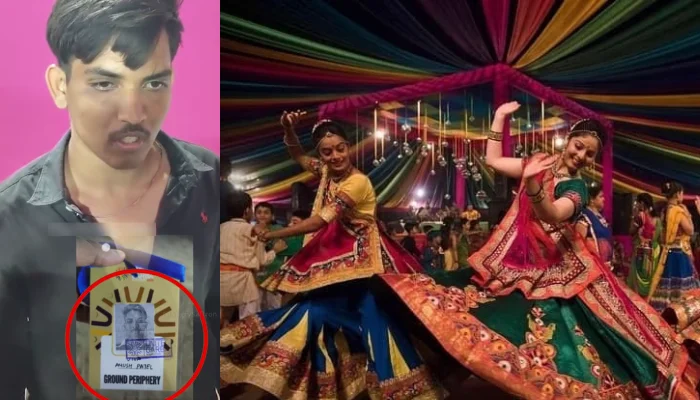
Case Summary
In Vadodara, Gujarat, the sanctity of a Garba celebration was desecrated when a Muslim youth was found working at the United Way Garba venue under a false Hindu name. The accused was identified as Razaq Pathan, who was using an identity card bearing the Hindu name 'Ayush Patel'. The incident triggered outrage among Hindu participants and activists, who questioned how a Muslim youth carrying an identity card under a Hindu name had been employed at a venue hosting Navratri celebrations. The incident came to light on 15 October 2026, when members of the Vishwa Hindu Parishad (VHP) confronted the Muslim youth at the United Way Garba venue in Atladra. A video of the confrontation subsequently went viral on social media, showing the accused acknowledging that he was Muslim and had been working at the venue using an identity card bearing the name Ayush Patel. A copy of the identity card with the name Ayush Patel was also visible in the video. The accused claimed that a person named Vishal, associated with a security agency, had provided him with the identity card and assured him that he would handle the situation. The youth was employed in the pass-scanning section, where staff were responsible for scanning entry passes. According to the VHP, his Aadhaar card bore the name Razaq Pathan, while the identity card used at the venue identified him as Ayush Patel. Following the confrontation, VHP members handed him over to the police. Atladra Police Inspector Parth Pastagiya stated that the accused had been hired through Veda, a security agency responsible for scanning passes. The accused told police that he had submitted the required documents but that the identity card had been issued by the security agency. Police initiated an investigation into the issuance of the card and the circumstances under which he had been employed. Tarak Patel, chairperson of United Way’s resource mobilisation committee, stated that the organisation did not directly employ workers and that the youth might have been engaged through a sub-vendor. The incident occurred after midnight, when most attendees had left the venue. At the time of writing this report, the police were investigating who had issued the identity card and who was responsible for submitting the documents.
Why it is Hate Crime ?
This case is being added to the tracker under the category: Attack on Hindu religious representations. The subcategory selected is: Defiling religious customs. Sanatan Dharma is not a religion of one book, which is to say that while it has religious scriptures that form the central tenets of the faith, there are several traditions followed through thousands of years, mostly passed from generation to generation orally. There are several such customs and traditions that are followed by various Hindus and Hindu sects. Defiling of these traditions and customs is a breach of an individual or group’s religious practices. Such practices can range from dietary restrictions like not eating non-vegetarian food for a certain period of the year, not eating non-vegetarian food at all, not eating beef since the cow is considered holy in Hinduism, the sanctity of religious customs followed in the house (like many ISCKON devotees), etc. Any malicious action leading to the breach of such traditions or defilement of these traditions owing to animosity towards the faith or for the sake of activism stems not only from the lack of faith in the religion itself but also from disregard for the faith of the devotees who follow the customs/traditions and implicit bias against the faith, the tradition itself. Since these specific traditions are central to the faith of the devotees of that specific sect of Hindus, any non-compliance with these traditional rules would be considered a religiously motivated hate crime. The other subcategory selected is: Breaking rules of place of worship. Sanatan Dharma is not a religion of one book, which is to say that while it has religious scriptures that form the central tenets of the faith, there are several traditions followed through thousands of years, mostly passed from generation to generation orally. One of these oral traditions or written traditions is the rules of specific temples. Certain temples have rules which are traditional rules, dependent on the worship of the presiding deities. These rules and traditions have been followed for thousands of years whether they find scriptural mention or not. Such traditions are based on the nature and rules of worship of the presiding deity of that temple. Any non-compliance of these traditions owing to animosity towards the faith or for the sake of activism stems not only from the lack of faith in the presiding deity but also disregard for the faith of the devotees of that deity/temple and implicit bias against the faith, the tradition and the deity itself. Since these specific traditions are central to the faith of the devotees of that specific temple and presiding deity, any non-compliance with these traditional rules would be considered a religiously motivated hate crime. This incident demonstrates religious disregard and the desecration of sacred Hindu customs, as a Muslim youth concealed his religious identity and used an identity card bearing a fabricated Hindu name to work at the United Way Garba venue during Navratri celebrations. By assuming a Hindu identity to gain employment at the venue, the accused concealed his actual religious identity while working at a celebration dedicated to Hindu worship. The use of a fabricated identity to gain access to a religious setting demonstrates disregard for the sentiments of the Hindu devotees celebrating Navratri. Garba is not a party, nightclub or ordinary commercial entertainment event. It is an essentially Hindu devotional tradition centred on the worship of Goddess Amba during Navratri. Hindus celebrate the Divine Mother through devotional dances, prayers and religious observances, with Goddess Amba, Durga and Kali revered in diverse Hindu traditions. Garba is therefore inseparable from the religious beliefs and customs of the Hindu community. Treating this sacred celebration merely as a commercial opportunity for employment and entertainment disregards its devotional purpose and the sanctity Hindus attach to it. The distinction between Hindu and Islamic theology further contextualises the religious nature of the event. Hinduism encompasses traditions of worship involving multiple deities, including Goddess Amba, Durga and Kali, whereas Islam upholds the absolute oneness of Allah and prohibits the worship of other deities. Associating partners with Allah is known as 'shirk' and is considered a grave sin in Islamic theology. These differences do not, by themselves, establish hostility on the part of an individual because of his religious identity. However, in this incident, the accused concealed his Muslim identity and used a fabricated Hindu name to work at a celebration dedicated to the worship of Hindu deities. Rather than approaching the event under his actual identity, he presented himself as a Hindu to gain employment at the venue. This conduct demonstrates disregard for the religious character of the celebration and treats a sacred Hindu observance as though it were merely a commercial event without any religious significance. Religious communities have a legitimate interest in preserving their sacred customs and determining the arrangements under which their religious observances are conducted, subject to applicable law. A sacred religious space is not simply a commercial venue, and its religious character must be respected. Entering a religious setting under a false identity to circumvent the community's expectations constitutes a serious violation of its customs. Similarly, the use of a fabricated Hindu identity at the Garba venue deprived the organisers of the opportunity to make an informed decision about the accused's employment. The central issue is not his religious identity alone, but the deliberate concealment of that identity in a setting devoted to Hindu religious observances. Such deception disregards the sentiments of Hindu devotees and the sanctity of their religious traditions. The security agency's alleged role also forms part of the incident. According to the accused, a person associated with the agency provided him with an identity card bearing the Hindu name Ayush Patel and assured him that he would handle the situation. If these claims are substantiated, the agency's involvement would demonstrate a disregard for Hindu religious sentiments and the sanctity of the Garba celebration. Issuing an identity card under a fabricated Hindu identity for a worker assigned to a Navratri Garba venue would suggest that the event's religious character was treated as inconsequential, as though it were merely a commercial or cultural programme rather than a sacred Hindu celebration. If proven, such conduct would reflect an anti-Hindu bias by facilitating the use of a false identity at an event dedicated to the worship of Goddess Amba, disregarding the religious significance of Garba and the sentiments of the Hindu devotees who gathered to celebrate it. Overall, since this case meets the parameters of a hate crime, it is being added to the hate crime database of the Hinduphobia Tracker.


Case Status
Arrested


Perpetrators Details
Perpetrators
Muslim Extremists
Perpetrators Range
One Person
Perpetrators Gender
male
 Sources



