Hindu homes attacked and looted by Muslim mob over false blasphemy allegations against Hindu youth in Bangladesh
 Rangpur District, Bangladesh
 25 October, 2026
Case Summary
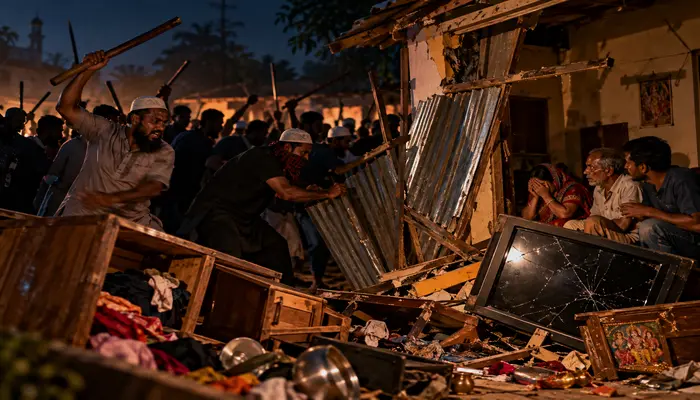
In the Chak Karim Telipara village of Pirganj upazila, Rangpur district, Bangladesh, several Hindu households were attacked by a Muslim mob. The incident occurred following the circulation of an old social media video attributed to 22-year-old Sourav Chandra Mahanta, a Hindu garment worker accused of making objectionable remarks about Allah and the Quran. According to reports, the alleged video was said to have been posted on Facebook around two months earlier, in August 2026, where Sourav Chandra Mahanta was accused of committing blasphemy. After it sparked controversy in Gazipur, Sourav deleted the post, deactivated his Facebook account and returned to his village in Piraganj. About a week later, copies of the content circulated again on social media as short videos and reaction videos, provoking anger among local Muslim residents. This renewed circulation of the content preceded the attack on the Hindu households. At around 8 pm on 26 October 2026, shortly after Maghrib prayers, the Muslim mob attacked three homes belonging to Sourav Chandra Mahanta, Dinesh Chandra Mahanta and Jagadish Chandra Mahanta. The attackers damaged tin fencing, broke two televisions and scattered and damaged household belongings. They also stole three goats, furniture and other valuables. The electricity had gone out around the time of the attack, leaving the victims unable to identify those involved because of the darkness. Some reports stated that the electricity supply had been deliberately cut off during the incident, but the police stated that only that the power went out around the time of the attack and did not conclusively confirm that the attackers had deliberately cut it. Jagadish and Dinesh described the destruction of their property, while local residents reported that some of the attackers had come from outside the village. Before the attack, police had received information that people were preparing to target the households. In response, four plain-clothes police officers and five or six informants were sent to the area to monitor the situation. They left at around 5:30 pm after the situation appeared to have calmed down. The Officer-in-Charge returned after Maghrib prayers, around the time the electricity went out, and the attack took place. Police subsequently arrived at the scene and brought the situation under control. Rangpur Superintendent of Police Mohammad Mozammel Haque visited the affected area, and additional police personnel were deployed to prevent further violence. One report stated that more than 100 police personnel were deployed. The Superintendent of Police said that vandalism and taking the law into one’s own hands would be dealt with through legal action. Police began making inquiries and collecting names to identify those involved, but no case had been filed at the time of reporting.
Why it is Hate Crime ?
This case has been added to the tracker under the primary category of - Attack not resulting in death. Within it, the sub-category selected here is - Attacked over 'Blasphemy'. Blasphemy essentially refers to the desecration of anything which is held sacred/holy to a group of people. However, for religious supremacist groups, the elements of ‘blasphemy’ are ever-changing, shifting and expanding – leading to infringement on the rights of other religious groups, freedom of speech and expression, threats and even physical violence. There are instances where blasphemy is also used as a dog whistle to target Hindus owing to intrinsic animosity towards Hinduism. There are several instances where stating truths as mentioned in the non-Hindu doctrine itself has led to unmitigated violence against Hindus. There have also been instances where non-Hindus have themselves created a ‘blasphemous’ situation, like placing a Quran in a temple, to use it as an excuse to attack Hindus. Essentially, Blasphemy charges are often made up and/or are used to shut down any form of criticism of non-Hindu faiths and as a tool to target Hindus. Any physical violence over Blasphemy charges against Hindus are foundationally based on animosity for Hindus and their faith owing to religious supremacist ideologies, therefore, such attacks would be documented as religious motivated hate crimes under this category. The other sub-category selected here is - Communal clash/attack. Communal clash is a form of collective violence that involves clashes between groups belonging to different religious identities. For a communal clash between Hindus and non-Hindus to qualify as a religiously motivated hate crime, the trigger of the violence itself would have to be anti-Hindu in essence. For example, if there is a Hindu religious procession that comes under attack from a non-Hindu mob and after the initial attack, Hindus retaliate in self-defence, leading to a communal clash between the two religious communities. While at a later stage, both communities are involved in the clash/violence, the initial trigger of the violence was by the non-Hindu mob against the Hindus and therefore, it could safely be termed as an anti-Hindu violence. Further, the trigger would also have to be religiously motivated. In the cited example, the attack by the non-Hindu mob was against religious processions and therefore, can be concluded to be religiously motivated. In some cases, the trigger may be non-religious, however, it develops into religious violence against Hindus at a later stage. In such cases too, the foundational animosity towards Hindus becomes the motivating factor of the crime and therefore, it would be classified as a religiously motivated hate crime against Hindus under this category. This case qualified as a religiously motivated hate crime because multiple Hindu families were subjected to collective intimidation, threats and physical violence after a Hindu youth was accused of insulting Islam. The incident was triggered by the recirculation of content attributed to Sourav Chandra Mahanta, which was described as insulting Allah and the Quran. Rather than allowing the matter to remain a dispute over social media content, a Muslim mob of around 50 to 60 people attacked three Hindu households, damaging property and reportedly stealing livestock, furniture and other valuables. The religious accusation thus became the immediate context for collective violence against Hindu families in the village. The most significant aspect of this case was the escalation from an accusation of religious offence to an attack on the homes of multiple Hindu households. Such actions portray how a blasphemy-style accusation can rapidly escalate into a wider communal threat. This demonstrates how such accusations can place Hindu victims in an immediately vulnerable position by generating collective hostility around them even before the allegation itself has been verified. Sourav had deleted the original post and deactivated his Facebook account after it sparked controversy in Gazipur. However, when copies of the content subsequently circulated on social media, the anger extended beyond Sourav himself and resulted in violence against his family and the wider Hindu community. The attack on three households demonstrated that the consequences were not confined to the individual whose online activity had prompted the controversy. Other members of the Hindu community were also exposed to intimidation and property damage in the course of the retaliatory violence. The fact that the accusation of Sourav committing blasphemy remained unproven is particularly important. A charge of insulting Islam itself has become a tool for targeting a Hindu individual, irrespective of whether the alleged statement was ever made. Once such an allegation circulates publicly, the Hindu victim is stigmatised as someone who has offended Islam, creating pressure, hostility and the possibility of retaliatory action without any established proof of wrongdoing. Blasphemy-related allegations in Muslim-majority countries such as Bangladesh are frequently weaponised to persecute Hindus and other minorities. Such accusations often rely on hearsay, selective interpretation, disputed digital content, or unverified claims, yet they are capable of provoking public outrage, communal mobilisation, and police intervention before any impartial investigation takes place. In many cases, merely being accused becomes sufficient grounds for mob violence, social humiliation, ostracism, arrest, threats of violence, or long-term persecution. The reaction in this case, where mere allegations rapidly triggered public anger and mob mobilisation against the Hindu youth and the wider Hindu community, highlighted the unequal environment in which Hindu minorities are frequently denied the presumption of innocence. Muslim extremist groups have historically exploited blasphemy accusations to intimidate religious minorities, particularly Hindus, silence dissent, and reinforce social control. Hindus in Bangladesh remain especially vulnerable because allegations involving Islam frequently trigger collective outrage and public vigilantism regardless of whether the accusations have been independently verified. Such allegations have repeatedly preceded Muslim mob attacks, destruction of Hindu homes and temples, forced displacement, arrests, and other forms of persecution across Bangladesh. Consequently, accusations of blasphemy against Hindus cannot be viewed in isolation from the broader environment of anti-Hindu hostility in which they occur. Even if Sourav Chandra Mahanta had made objectionable comments about Islam, the appropriate response would have been to report the matter to the police and allow the law to take its course. Any complaint could have been investigated, the authenticity and context of the content established, and appropriate legal action pursued in accordance with the law. Instead, a Muslim mob gathered and resorted to violence against Hindu households, inflicting damage and subjecting families to collective intimidation. Taking offence at religious remarks did not give anyone the right to bypass lawful procedures and punish people through mob violence. The decision to attack Hindu homes rather than pursue legal recourse reflected hostility directed at the wider Hindu community, treating the alleged offence of one individual as grounds for collective punishment. The case therefore reflects the danger of blasphemy accusations being used to incite hostility and collective violence against Hindus. Here, an accusation of insulting Islam escalated into a mob attack on Hindu households, with families suffering intimidation and property damage over a controversy involving one individual. Rather than pursuing legal recourse, the Muslims subjected the wider Hindu community to collective retaliation, disregarding individual responsibility and the safety of innocent families. The religious context of the incident, the targeting of Hindu households and the use of violence in response to an accusation of religious offence make the anti-Hindu dimension central to this case. It has consequently been included in the Hinduphobia Tracker as a religiously motivated hate crime.


Case Status
Unknown


Perpetrators Details
Perpetrators
Muslim Extremists
Perpetrators Range
From 10 to 100
Perpetrators Gender
unknown
 Sources



