Hindu deities denigrated in Hinduphobic Instagram posts, branded 'paedophiles', 'perverts', 'lustful' and 'characterless'
 India
 14 January, 2024
Case Summary
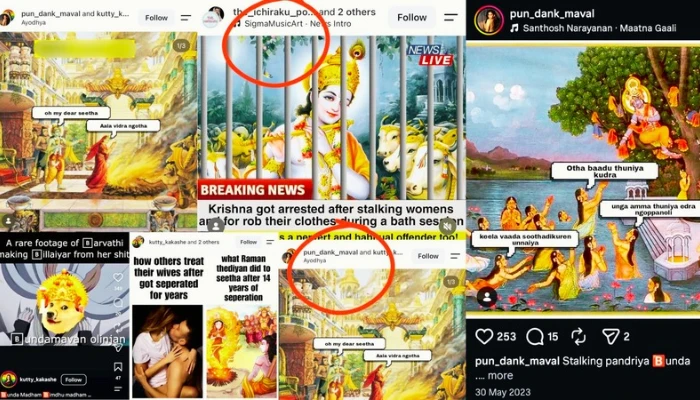
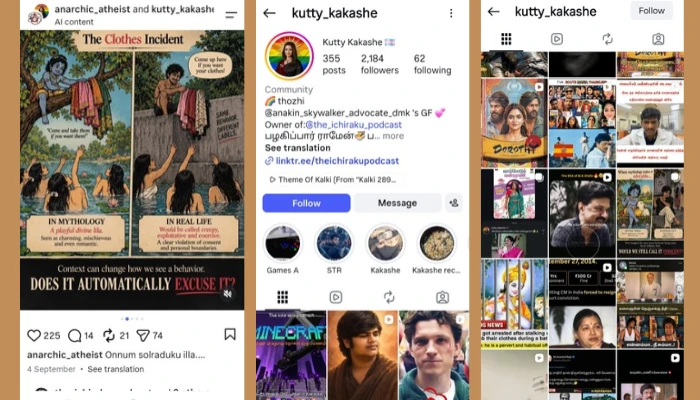
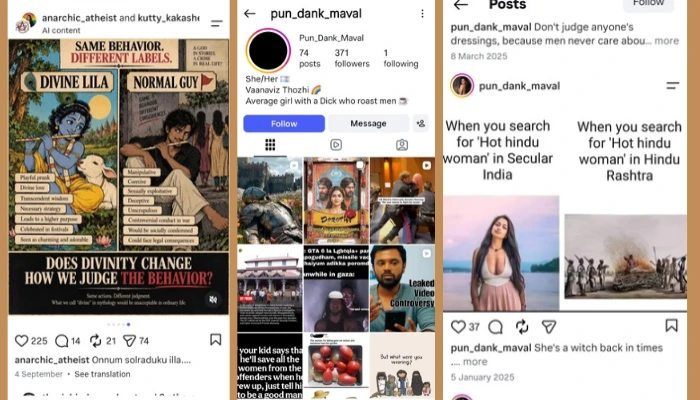
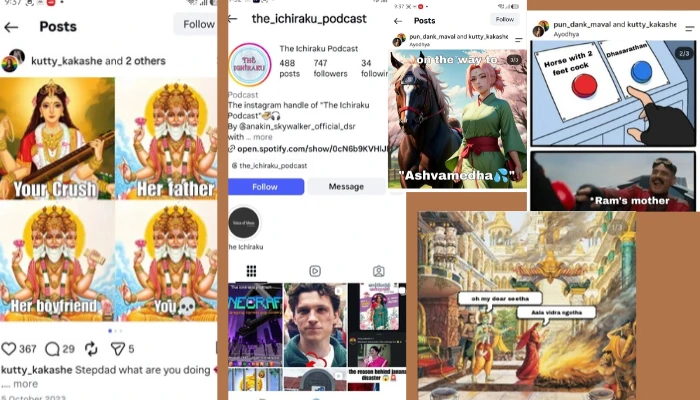
Hindu deities and sacred religious narratives were mocked through obscene depictions, sexually explicit references and vulgar remarks in the Tamil language circulated by several Instagram accounts, including kutty_kakashe, pun_dank_maval and the_ichiraku_podcast. The posts ridiculed Lord Krishna, Goddess Parvati, Lord Ganesha, Lord Rama and Goddess Sita, using sexualised mockery and derogatory language to denigrate Hindu religious beliefs and offend Hindu religious sentiments. The Hinduphobia Tracker team investigated the matter further and examined the Instagram accounts individually. The account kutty_kakashe had 355 posts and 2,184 followers, and its owner also maintained another account, the_ichiraku_podcast, which had 488 posts and 747 followers. The third account, pun_dank_maval, had 74 posts and 371 followers. All three accounts mentioned “Thozhi”, meaning “female friend”. The examination revealed repeated instances of content denigrating Hindu deities and distorting sacred Hindu religious narratives. The posts included a depiction of Lord Brahma portraying him as a paedophile who maintained a relationship with his daughter, Goddess Saraswati. Other posts mocked Lord Rama’s mother through sexually derogatory references. Some ridiculed the Hindu tradition of Jauhar, while others portrayed Lord Krishna as characterless. The content also mocked the Ashwamedha ritual and denigrated revered Hindu women featured in sacred scriptures. The account kutty_kakashe shared a post featuring a fabricated television news graphic depicting Lord Krishna as having been arrested for stalking women and stealing their clothes while they bathed. The graphic included a fictional victim’s statement describing him as a “pervert and habitual offender”. The accompanying vulgar Tamil dialogue turned a Hindu religious narrative into an obscene meme. The same account shared an obscene depiction of Goddess Parvati creating Lord Ganesha. The post contained vulgar references to Hindu religious identity and derogatory language targeting Hindus. In another post, kutty_kakashe circulated a meme targeting the Ramayana. It juxtaposed how husbands treat their wives after years of separation with how Lord Rama treated Goddess Sita following their 14-year separation. The accompanying dialogue used vulgar language to ridicule Lord Rama and Ayodhya. The account pun_dank_maval shared a post containing sexually explicit Tamil insults in dialogue bubbles, with captions featuring abusive language. The account the_ichiraku_podcast was also identified among accounts circulating content that mocked Hindu deities, religious figures, and sacred narratives. The posts used Instagram meme formats, dialogue bubbles, music overlays and engagement-driven captions. Some attracted hundreds of likes, comments, shares or bookmarks. Through repeated sexualised depictions, vulgar dialogue and derogatory references, the accounts circulated content mocking Hindu deities and distorting sacred Hindu religious narratives.
Case Images
Why it is Hate Crime ?
This case is being added to the tracker under the primary category: Hate Speech against Hindus. The subcategory selected is: Anti-Hindu slurs, mocking faith. Anti-Hindu slurs and the deliberate mocking of the Hindu faith owing to religious animosity involve the use of derogatory terms, stereotypes, or offensive references to religious practices, symbols, or figures. One of the common anti-Hindu slurs used against Hindus is “cow-worshipper” and “cow piss drinker”. The intention of using this term is to demean and mock Hindus as a group and their religious beliefs, since Hindus consider the cow holy. Additionally, some symbols and the slurs attached to them have a historical context that exacerbates the insult, hate, stereotyping, dehumanisation and oppression against Hindus. Cow worship has been used for centuries to denigrate Hindus, insult their faith and oppress Hindus specifically as a religious group. There has been overwhelming documentation about how cow slaughter has been used to persecute Hindus, with cow meat being thrown in temples and places of worship. There has also been overwhelming documentation that cow meat (beef) has been force-fed to Hindus to either forcefully convert them to Islam or denigrate their faith. Apart from cow worship, the Swastika – which holds deep religious significance for the Hindus – has also been misinterpreted and distorted to be used as a slur against Hindus. Similarly, the worship of the Shivling has been used by supremacist ideologies and religions to denigrate Hindus owing to religious animosity. Such slurs and denigration stem from inherent animosity and hate towards Hindus and their faith; therefore, it is categorised as hate speech targeted at Hindus specifically owing to their religious identity. The other sub-category selected is: Subversion of scriptures. Subverting the religious scriptures of Hindus has particularly devastating consequences. Subversion of the scriptures of Hindus is often done to justify or promote hatred, discrimination, or violence against specific individuals or groups of Hindus. Religious scriptures are often nuanced, and those who harbour religious animosity towards Hindus often misquote or misrepresent the scripture to legitimise their animosity and hate towards the faith and its adherents. Any such misquoting of scriptures or subversion to justify hate, violence and discrimination against Hindus owing to religious animosity is hate speech and is categorised as such. The other primary category added to the tracker is: Attack on Hindu religious representations. The subcategory selected is: Iconoclastic representation of Hindu Gods/Goddesses. An icon is a symbol of someone or something that is revered, or a religious representation of a spiritual ideal. Iconography is of vital significance in the Hindu milieu. It connects people’s spiritual beliefs to the real world. Iconography within the Hindu faith takes many forms. Murtis are of most significance to Hindus, to which daily rituals, prayers and offerings are done. Besides the murtis, there are several other symbols which have deep significance in the Hindu faith – the Om and Swastika, for example. Any iconoclastic representation of these symbols, images and murtis is an affront to the religious beliefs and faith of the Hindu community itself since the symbols and icons are deeply religious in nature. In this sub-category of crime, we would record hate crimes and iconoclastic representations, in words, art, or any other form of representation of symbols that hold religious significance for the Hindu community. Since these symbols, icons and murtis are central to the Hindu faith, any iconoclastic representation of these symbols is born out of animosity towards the faith itself, manifesting itself through these symbols; therefore, these representations would be considered religiously motivated hate crimes. This case was included in the Hinduphobia Tracker because blasphemous, sexually explicit and derogatory posts were used to ridicule Hindu deities and undermine the sanctity of Hindu religious beliefs. By turning revered deities and sacred narratives into material for vulgar mockery, these accounts directly denigrated Hindu religious figures and traditions. The social media posts went beyond ordinary criticism or disagreement with religious beliefs. They used obscene depictions, vulgar language and distorted religious narratives to portray Hindu deities as sexually depraved, ridiculed sacred traditions and demeaned the faith of Hindus. The repeated use of Hindu religious figures and scriptural narratives as material for sexualised mockery established a pattern of religious denigration. In Hindu Dharma, deities are revered for their divine attributes, spiritual significance and role in upholding Dharma. Lord Brahma is associated with creation; Goddess Saraswati is revered as the goddess of knowledge, wisdom, and learning; Lord Krishna is worshipped as an incarnation of Lord Vishnu who restores Dharma; and Lord Rama is revered as Maryada Purushottam, the ideal of righteousness, duty, and moral conduct. Devotees also worship Goddess Parvati as the divine mother and revere Lord Ganesha as the remover of obstacles and the deity of auspicious beginnings. These figures occupy central places in Hindu worship, philosophy, scriptures and devotional traditions. Their portrayal in sexually degrading and obscene forms therefore does not merely ridicule individual characters; it directs contempt towards figures who hold profound religious significance for Hindus. Further, the depiction of Lord Brahma as a paedophile who maintained a relationship with his daughter, Goddess Saraswati, used a sexually degrading characterisation to mock revered Hindu figures. Rather than presenting these deities within their religious and scriptural contexts, the content reduced them to vulgar allegations and used the resulting portrayal to ridicule Hindu beliefs. Similarly, the obscene depiction of Goddess Parvati creating Lord Ganesha used a sacred narrative of divine motherhood as material for vulgar references to Hindu religious identity. Such representations displaced the religious significance of the deities with sexualised mockery, turning sacred figures into objects of ridicule. Furthermore, the treatment of Lord Krishna was rooted in sexual denigration of a revered Hindu deity. By associating him with sexual misconduct and presenting him as morally depraved, the posts inverted the religious understanding of Krishna and sought to replace devotion and reverence with ridicule. The fabricated news format was used to lend the derogatory portrayal a veneer of familiarity while ridiculing a sacred figure and insulting the religious sentiments of Hindu devotees. Such portrayals demean Hindu devotees by treating their object of worship as a legitimate target for sexual humiliation and normalising contempt for their religious beliefs. The ridicule directed at Lord Rama and the Ramayana similarly attacked the religious and moral foundations of Hindu belief. Lord Rama is highly revered as Maryada Purushottam, the ideal of righteousness and adherence to Dharma, while the Ramayana conveys enduring spiritual and ethical teachings. Recasting these sacred narratives through vulgarity and sexual insinuations was a form of scriptural distortion that displaced their religious meaning with degrading caricatures. This undermined the dignity of revered figures and trivialised the values Hindus derive from their scriptures. More importantly, such content encouraged audiences to view Hindu sacred traditions with contempt rather than understanding, making the denigration of Hindu faith appear acceptable under the guise of humour. The mockery of Jauhar trivialised a historical tradition associated with Rajput women choosing self-immolation to avoid capture during invasions. By reducing the extreme circumstances of warfare, captivity and dishonour to vulgar ridicule, the posts stripped the tradition of its historical context and demeaned the memory of women associated with it. This turned a painful part of Hindu historical heritage into a vehicle for contempt. Similarly, mocking the Ashwamedha ritual without regard for its Vedic and religious significance reduced a sacred Hindu tradition to an object of derision. Such portrayals demean Hindu religious heritage and encourage audiences to dismiss sacred practices through ridicule rather than understand their significance. As a whole, these posts reflected a deliberate pattern of presenting Hindu Dharma through vulgarity, sexual insinuations and degrading caricatures. Hindu Gods and Goddesses, sacred scriptures, religious rituals and revered women were repeatedly stripped of their religious and historical significance and subjected to obscene mockery. This was not simply poor or inaccurate representation of Hinduism. It reflected hostility towards Hindu religious figures and traditions by portraying what Hindus hold sacred as sexually depraved, morally contemptible or worthy of ridicule. Such treatment demeans Hindu Dharma and disregards the profound spiritual, ethical and cultural significance these beliefs hold for devotees. Such recurring derogatory statements reveal a consistent disregard for Hindu cultural and religious values. In fact, this behaviour underscores a deliberate effort to belittle and disrespect the Hindu faith, highlighting the religiously motivated nature of these actions and, as such, this incident is being categorised as a religiously motivated hate crime against Hindus. Disclaimer: The Hinduphobia Tracker records incident dates based on when an incident occurred, not when the media reported it. In this case, the earliest identified date of circulation of the posts, 15 January 2024, was recorded as the indicative incident date for documentation purposes. The number of perpetrators was recorded as two (2), as three Instagram accounts were identified, of which two were operated by the same person. This is an indicative figure based on the accounts identified and does not represent the total number of individuals involved, which may be higher.


Case Status
Unknown


Perpetrators Details
Perpetrators
Others
Perpetrators Range
From 2 To 5
Perpetrators Gender
female
 Sources



