Durga Visarjan disrupted in Nepal; five held for communal provocation and fake posts
 Lumbini Zone, Nepal
 24 October, 2026
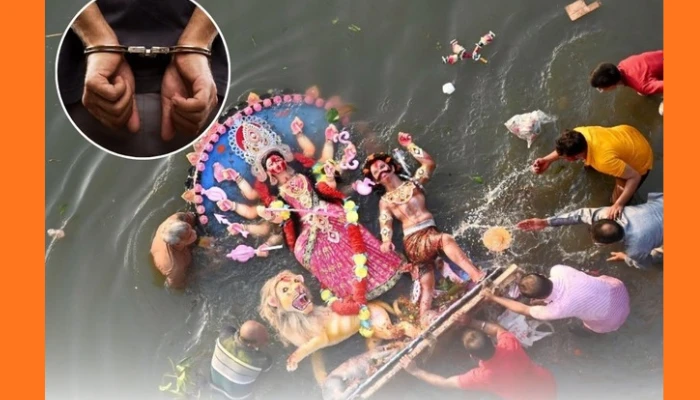
Case Summary
In Kapilvastu, Nepal, a Hindu religious Durga idol immersion was disrupted by three miscreants in Krishnanagar Municipality-2. Two other individuals spread online hatred and misleading content against Hindus. Police arrested all five. According to the District Police Office, Kapilvastu, police received a complaint about activities that disrupted religious and communal harmony at various locations along the route during the immersion of the idol of Goddess Durga in Krishnanagar Municipality-2. Following the complaint, police identified the accused through photographs and videos circulating on social media and arrested them. The three accused involved in disrupting religious and communal harmony during the immersion were identified as Vikas Yadav, 23, Gandhi Chauhan, 18, and Sunil Chauhan, 18, all residents of Semra in Krishnanagar Municipality-1. Aryan Mishra, 19, a resident of Madarniya in the same municipality, was arrested for recording a video of the incident and spreading misleading information on social media. Hari Narayan Pal, 26, a resident of Ramnagar (Kaptanganj) in Krishnanagar Municipality-11, was arrested for posting content on Facebook that disturbed religious and communal harmony. Deputy Superintendent of Police Ripendra Kumar Singh said that police were conducting further investigation into the activities of all five accused in accordance with the law. He appealed to the public to refrain from activities that disturbed religious and communal harmony and from spreading misleading information on social media.
Why it is Hate Crime ?
This case is being added to the tracker under the first primary category: Attack not resulting in death. The subcategory selected is: Attack on Hindu religious procession. The outward celebration and display of religious symbols in an intrinsic part of Hinduism. Religious processions on various festivals are age-old traditions and a way to manifest faith and form a part of the religious practices of Hindus. On several occasions, such religious processions come under attack by non-Hindu mobs, in a manifestation of their animosity towards Hinduism and their practices. The reasons cited for such violent attacks are many and range from crossing a non-Hindu resident-dominated area to playing loud music, crossing from an area where there is a religious structure of another faith etc. The violent attacks are triggered by the outward display of religiosity by Hindus. The attacks are mainly a manifestation of religious supremacist doctrine which believes that idolatry, essentially the Hindu faith, is one that deserves to be annihilated since the very tenets of Hinduism, its practices and traditions are considered a sin in those doctrines. Since these attacks emanate from intrinsic and doctrinal animosity towards Hindus and Hinduism, it is considered a religiously motivated hate crime under this category. The second primary category selected is: Hate Speech against Hindus. The subcategory selected is: Anti-Hindu slurs, mocking faith. Anti-Hindu slurs and the deliberate mocking of the Hindu faith owing to religious animosity involve the use of derogatory terms, stereotypes, or offensive references to religious practices, symbols, or figures. One of the common anti-Hindu slurs used against Hindus is “cow-worshipper” and “cow piss drinker”. The intention of using this term is to demean and mock Hindus as a group and their religious beliefs, since Hindus consider the cow holy. Additionally, some symbols and the slurs attached to them have a historical context that exacerbates the insult, hate, stereotyping, dehumanisation and oppression against Hindus. Cow worship has been used for centuries to denigrate Hindus, insult their faith and oppress Hindus specifically as a religious group. There has been overwhelming documentation about how cow slaughter has been used to persecute Hindus, with cow meat being thrown in temples and places of worship. There has also been overwhelming documentation that cow meat (beef) has been force-fed to Hindus to either forcefully convert them to Islam or denigrate their faith. Apart from cow worship, the Swastika – which holds deep religious significance for the Hindus – has also been misinterpreted and distorted to be used as a slur against Hindus. Similarly, the worship of the Shivling has been used by supremacist ideologies and religions to denigrate Hindus owing to religious animosity. Such slurs and denigration stem from inherent animosity and hate towards Hindus and their faith; therefore, it is categorised as hate speech targeted at Hindus specifically owing to their religious identity. This case reflected hostility towards Hindu religious practices and the public expression of Hindu faith, as a Durga idol immersion procession was disrupted and misleading content targeting religious and communal harmony was circulated online. The immersion of Goddess Durga’s idol marks the conclusion of Durga Puja celebrations and holds deep religious significance for Hindu devotees. Goddess Durga is revered as the embodiment of divine feminine power and the force that destroys evil. The festival involves prayers, rituals and community celebrations through which devotees express their reverence for the Goddess. The immersion procession forms an integral part of these observances and represents an important expression of collective Hindu faith. Disrupting such a procession interferes with the peaceful observance of religious traditions and undermines the sanctity of a sacred occasion. Hindu religious processions are an important manifestation of religious identity, enabling devotees to practise their faith publicly and preserve traditions across generations. Targeting these observances for disruption infringes upon the community’s ability to express its religious beliefs without hostility or interference. Such acts also create an atmosphere of intimidation around Hindu religious celebrations, undermining the security and dignity with which devotees should be able to participate in their faith. Further, the dissemination of misleading content and material that disturbed religious and communal harmony intensified hostility surrounding religious events. Social media content that misrepresented such incidents distorted public understanding, aggravated communal tensions and directed hostility towards religious communities. When Hindu religious observances became the subject of such online activity, the consequences extended beyond the immediate event, affecting communal relations and the freedom of Hindus to express their faith peacefully. The disruption of religious observances, coupled with the spread of misleading online content, therefore represented a threat to both Hindu religious expression and communal harmony. The deliberate targeting of a sacred Hindu festival and the dissemination of misleading content surrounding the incident underscores the profound animosity the accused harboured towards the Hindu faith, which is why this incident warrants inclusion in the Hinduphobia Tracker. Disclaimer: The Hinduphobia Tracker records incidents based on when an event occurred or when the victim's ordeal began. The report does not specify the exact date the accused posted the offensive content. Therefore, for documentation purposes, we recorded the date as when the incident was reported in the media: 25 October 2026.


Case Status
Arrested


Perpetrators Details
Perpetrators
Others
Perpetrators Range
From 5 to 10
Perpetrators Gender
male
 Sources



