Hindu deities denigrated in AI-generated video by Muslim man depicting Hindu goddess embracing Islam before Islamic cleric
 Pilibhit, Uttar Pradesh, India
 23 October, 2026
Case Summary
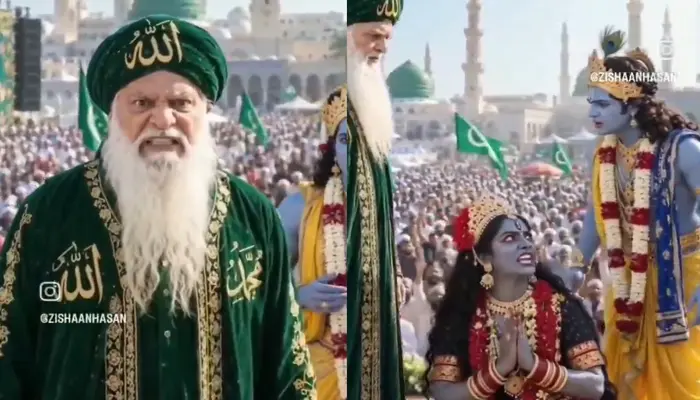
Hindu sentiments were hurt after an objectionable AI-generated video was uploaded on social media by a Muslim man named Zishan Hussain, depicting a Hindu goddess kneeling before an Islamic cleric and declaring her faith in Allah. The incident came to light after the objectionable video went viral on social media, prompting police action. In the video, the goddess recited “La ilaha illallah Muhammadur Rasulullah” while kneeling before the cleric and said, “Me allah me iman rakhne lgi hoon. Sabse bada mera allah hai" (I am beginning to believe in Allah. Allah is the greatest). Lord Krishna was depicted standing beside them, questioned her actions, asking, 'What are you doing?'. However, the goddess continued to kneel before the cleric and reiterated her faith in Allah. Lord Krishna then challenged the cleric, saying he would summon God. The cleric responded dismissively, challenging Krishna to call whomever he wanted. The goddess continued kneeling before the cleric and reiterated that she would believe in Allah. Towards the end, the cleric urged viewers to like and follow the video, promising to reveal what happened in the next video, while repeatedly invoking Allah and declaring “Allahu Akbar” The portrayal of a Hindu goddess renouncing her religious faith and affirming allegiance to Allah while kneeling before an Islamic cleric, alongside the cleric’s confrontational exchange with Lord Krishna, presented Hindu deities in a religiously disparaging context. According to the Pilibhit Police, a written complaint was received at Pooranpur Police Station regarding the incident. A case was registered under the relevant legal provisions, and Hussain was arrested. The police also stated that necessary preventive action had been taken.
Why it is Hate Crime ?
This case has been added to the tracker under the primary category of - Attack on Hindu religious representations. Within it, the sub-category selected here is - Iconoclastic representation of Hindu Gods/Goddesses. An icon is a symbol of someone or something that is revered, or a religious representation of a spiritual ideal. Iconography is of vital significance in the Hindu milieu. It helps connect people’s spiritual beliefs with the real world. Iconography within the Hindu faith takes several shapes and forms. Murtis are of most significance to Hindus, to which daily rituals, prayers and offerings are done. Besides the murtis, there are several other symbols which have deep significance in the Hindu faith – the Om and Swastika for example. Any iconoclastic representation of these symbols, images and murtis is an affront to the religious beliefs and faith of the Hindu community itself since the symbols and icons are deeply religious in nature. In this sub-category of crime, we would record hate crimes and iconoclastic representations, in words, art, or any other form of representations of symbols that hold religious significance for the Hindu community. Since these symbols, icons and murtis are central to the Hindu faith, any iconoclastic representation of these symbols is born out of animosity towards the faith itself, manifesting itself through these symbols and therefore, these representations would be considered religiously motivated hate crimes. The other primary category selected here is - Hate speech against Hindus. Within it, the sub-category selected here is - Anti-Hindu slurs, mocking faith. Anti-Hindu slurs and the deliberate mocking of the Hindu faith owing to religious animosity involve the usage of derogatory terms, stereotypes, or offensive references to religious practices, symbols, or figures. One of the common anti-Hindu slurs used against Hindus is “cow-worshipper” and “cow piss drinker”. The intention of using this term is to demean and mock Hindus as a group and their religious beliefs since Hindus consider the cow holy. Additionally, some symbols and the slurs attached to them have a historical context that exacerbates the insult, hate, stereotyping, dehumanisation and oppression against Hindus. Cow worship has been used for centuries to denigrate Hindus, insult their faith and oppress Hindus specifically as a religious group. There has been overwhelming documentation about how cow slaughter has been used to persecute Hindus with cow meat being thrown in temples and places of worship. There has also been overwhelming documentation where cow meat (beef) has been force-fed to Hindus to either forcefully convert them to Islam or denigrate their faith. Apart from cow worship, the Swastika – which holds deep religious significance for the Hindus – has also been misinterpreted and distorted to use as a slur against Hindus. Similarly, the worship of the Shivling has been used by supremacist ideologies and religions to denigrate Hindus owing to religious animosity. Such slurs and denigration stem out of inherent animosity and hate towards Hindus and their faith, therefore, it is categorised as hate speech targeted at Hindus specifically owing to their religious identity. This case has been added to the tracker because the video went beyond the expression of religious beliefs or the promotion of one faith over another. It used revered Hindu deities as subjects of an explicitly disparaging religious narrative in which Hindu faith was presented as something to be abandoned in favour of Islam. Hindu deities occupy a central and deeply revered place in Hindu religious life, serving as objects of worship and embodiments of divine power, wisdom, protection, and spiritual guidance. Lord Krishna, worshipped as an incarnation of Lord Vishnu, holds particular significance for millions of Hindus, with his teachings in the Bhagavad Gita forming an essential part of Hindu spiritual and philosophical traditions. Hindu goddesses are similarly venerated as manifestations of divine feminine power and are integral to the faith and devotional practices of countless devotees. The dignity and sanctity of these deities are therefore fundamental to Hindu religious sentiments, and portraying them in a manner that ridicules their beliefs or undermines their revered status constitutes a serious affront to the faith and traditions of Hindu devotees. The use of AI-generated imagery to construct a narrative that Hindu gods are accepting was extremely derogatory in nature. By placing Hindu deities within a fabricated religious encounter and assigning them dialogue that depicted the abandonment of their faith, the Muslim accused used the recognisable identities of sacred Hindu figures to produce content capable of offending Hindu devotees. The objectionable element lay in the deliberate narrative framing: Hindu religious identity was portrayed as being rejected, while the Islamic cleric was positioned as the dominant figure in the encounter. This made the content more than a general religious disagreement or an expression of personal conversion. It turned Hindu sacred figures into instruments of religious disparagement, with the potential to ridicule Hindu beliefs and hurt the sentiments of devotees. The video was constructed to portray Hindu deities as accepting Islam and abandoning their own faith, presenting this supposed conversion as a rejection of Hinduism in favour of Islam. This was extremely derogatory because it appropriated the identities of revered Hindu deities and attributed to them a religious allegiance that undermined their sacred status within Hinduism. By depicting a Hindu goddess submitting to an Islamic cleric and affirming faith in Allah, while Lord Krishna was challenged and dismissed by the cleric, the video established a narrative of Islamic religious supremacy over Hinduism. It sought to portray Hindu religious figures as subordinate to Islamic authority, reducing revered Hindu deities to instruments for disparaging Hindu beliefs and elevating another religion at their expense The fact that the video was AI-generated further underscores the deliberate construction of this disparaging narrative, as its creator used artificial intelligence to fabricate a scenario in which Hindu deities were portrayed as abandoning their faith. The creation and dissemination of such content constituted a deliberate effort to demean Hindu religious beliefs, reflecting religious animosity through the calculated use of AI-generated imagery to portray Hindu deities as subordinate to Islamic religious authority. Such a portrayal constituted a direct affront to Hindu religious sentiments and demeaned the faith and traditions of Hindu devotees. The video was an outright denigration of Hindu religious beliefs, using the humiliation of revered Hindu deities to construct a narrative of religious subordination. This was not merely a religious disagreement but a deeply derogatory portrayal that placed Hindu deities in positions of submission and inferiority to an Islamic religious authority. By scripting this encounter and disseminating it on social media, the Muslim accused turned sacred Hindu figures into instruments of religious humiliation, directly insulting the faith of millions of devotees who worship them. The deliberate degradation of Hindu deities and the portrayal of the Hindu faith as something to be renounced constituted a direct affront to Hindu religious sentiments and established the incident as targeted religious disparagement against Hindus.


Case Status
Arrested


Perpetrators Details
Perpetrators
Muslim Extremists
Perpetrators Range
One Person
Perpetrators Gender
male
 Sources



