Hindu students barred from reciting morning praying as it invoked names of Hindu deities, teachers threatened with false case for opposing
 Tikamgarh, Madhya Pradesh, India
 15 October, 2026
Case Summary
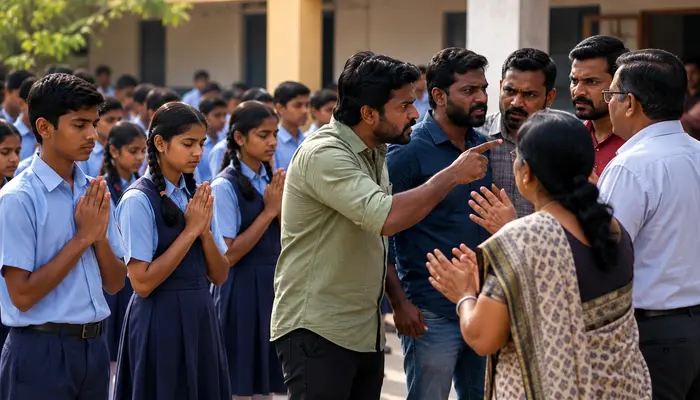
In Amarpur village in the Badagaon area of Tikamgarh district, Madhya Pradesh, authorities stopped Hindu students from reciting their morning prayers at Government High School because the prayers invoked the names of Hindu deities, including Lord Ram. The four men who arrived at the school objected to the prayers mentioning Hindu gods, demanded that the assembly stop, and argued that the school was providing religious instruction. The incident took place on the morning of 16 October 2026, when students were attending their regular morning assembly. The four men were identified as Ajay Ahirwar, Rohit Ahirwar, Heera Ahirwar, and Suresh Ahirwar, residents of the village. The teachers attempted to reason with them, but the men did not allow the prayers to continue. People present at the scene recorded the confrontation, and the video later went viral on social media. After the incident, the school principal submitted written complaints to the District Education Officer and the local police, saying the four men intimidated students and teachers and obstructed government work. The teachers also reported the matter to senior officials in the police and education departments. After the teachers intervened to address the disruption, the men threatened them with a false case under the Scheduled Castes and Scheduled Tribes (Prevention of Atrocities) Act. During the proceedings, the men also abused police personnel. District Collector Vivek Shrotriya took the matter seriously and directed the relevant officials to act immediately. Police arrested the four men and later remanded them to judicial custody by the court of the local Sub-Divisional Magistrate (SDM).
Why it is Hate Crime ?
The primary category selected in this case is: Attack not resulting in death. The subcategory selected is: Attacked for Hindu identity. In several cases, Hindus are attacked merely for their Hindu identity without any perceived provocation. A classic example of this category of religiously motivated hate crime is a murder in 2016. 7 ISIS terrorists were convicted for shooting a school principal in Kanpur because they got ‘triggered’ seeing the Kalava on his wrist and tilak that he had put. In this, the Hindu victim had offered no provocation except for his Hindu religious identity. The motivation for the murder was purely religious, driven by religious supremacy. Such cases where Hindus are targeted merely for their religious identity would be documented as a hate crime under this category. The other subcategory selected is: Attacked for opposing radicals or trying to save victim. In several cases, Hindus are attacked for opposing religiously motivated crimes being committed against a fellow Hindu or simply for voicing an opinion opposing radical elements, who either have in the past or continue to persecute Hindus. In such cases, the initial attack against the victim, against which the Hindu was trying to defend the victim, would also need to be classified as a religiously motivated hate crime. Since the initial crime itself was religiously motivated and the subsequent crime of attempting to save the victim or speaking against the radical elements ends up inviting a violent attack, it would also be classified as a religiously motivated hate crime under this category. Distinct elements in this particular case demonstrate that the crime was committed while harbouring a bias against the Hindu faith. The incident reflects hostility towards Hindu religious expression, as students were stopped from reciting prayers invoking Hindu deities during their morning assembly. The objection was specifically to the mention of Hindu gods, with the men insisting that the school stop the prayers on the grounds that it was imparting religious instruction. This raises a serious question: why should the mere invocation of Hindu deities be treated as objectionable, particularly when the students were participating in a familiar morning practice? The fact that this happened in India, or Hindustan, is also significant. Hindus form the majority of the population, and Hindu traditions are deeply rooted in the country's cultural and civilisational heritage. Morning assemblies and prayers are a familiar part of school life, and many educational settings include prayers invoking Hindu deities. Against this backdrop, objecting to prayers because they mention Bhagwan Ram and demanding that they be stopped reflects an intolerance towards the expression of Hindu faith. The fact that the school was a government institution does not, by itself, mean that any prayer invoking Hindu deities amounts to formal religious instruction. Every individual has the right to practise and express their faith without intimidation. Hindu students should not be made to feel that invoking their deities is unacceptable or that their religious traditions must be suppressed to avoid confrontation. When prayers are singled out specifically because they invoke Hindu gods, it raises concerns about discriminatory interference with the religious expression of Hindu students. The subsequent conduct makes the incident even more serious. When teachers intervened to address the disruption, the men reportedly threatened them with a false case under the SC/ST (Prevention of Atrocities) Act and also abused police personnel. Such intimidation goes beyond objecting to a school assembly; it tries to pressure those responsible for maintaining order and allowing school activities to continue without interference. The incident has therefore been included in the Hinduphobia Tracker as a religiously motivated hate crime. The objection targeted prayers invoking Hindu deities, and the men sought to stop the students from continuing them. Hindu students should not have to face intimidation for invoking their own gods in Hindustan. When the mention of Hindu deities becomes a reason to disrupt a school assembly and threaten those who intervene, it reflects a troubling hostility towards Hindu beliefs and the freedom to express them.


Case Status
Arrested


Perpetrators Details
Perpetrators
Others
Perpetrators Range
From 2 To 5
Perpetrators Gender
both
 Sources



