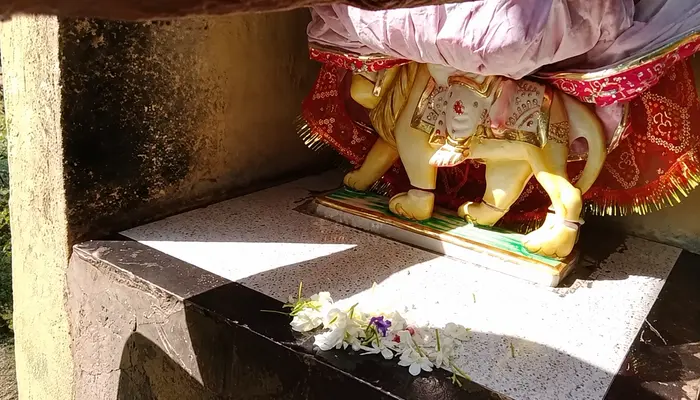
Sacred idol of goddess Durga desecrated, legs of her divine lion mount severed a day after Navratri in Alwar, Rajasthan
 Alwar, Rajasthan, India
 19 October, 2026
Case Summary
In Preet Vihar, Alwar, Rajasthan, an idol of Goddess Durga was desecrated and the legs of her divine lion mount were severed on 20 October 2026, just a day after Navratri. The temple was situated within a park in a residential colony under the jurisdiction of the North East Boundary (NEB) Police Station in Alwar city. The matter came to light on 23 October 2026 after a complaint, prompting a police team and representatives of Hindu organisations to reach the location. Residents expressed concern about the temple's safety and the condition of the surrounding park. They voiced dissatisfaction with the police and administration over the continuing anti-Hindu activities in the area and demanded the prompt identification and arrest of those responsible for damaging the idol. Residents described persistent anti-social activities in Preet Vihar Park and near the shops surrounding it. They stated that groups regularly gathered there until late at night to play cards illegally and consume alcohol. They also reported that passers-by, women and children faced inappropriate and obscene remarks from people frequenting the area, making it difficult for residents to visit the park and move through the surrounding area comfortably. Following the complaint, Vijendra Khandelwal, the district minister of the Vishva Hindu Parishad (VHP), arrived at the site with other VHP workers and inspected the location. The organisation's representatives demanded stronger security arrangements at the temple, regular police patrolling in the area and strict legal action against those responsible for damaging the idol. Residents and VHP members also voiced their anger towards the police and administration over the persistent problems in the park and called for the perpetrators to be arrested promptly. Meanwhile, personnel from the North East Boundary (NEB) Police Station assessed the situation and began investigating the matter. Police officials stated that the investigation was underway and that people considered suspicious in the surrounding area were being questioned.
Why it is Hate Crime ?
The primary category selected in this case is: Attack on Hindu religious representations. The subcategory selected is: Desecration of Hindu religious symbols. Icons and symbols or a religious representation of a spiritual ideal are widely revered in Hinduism. Iconography is of vital significance in the Hindu milieu. It helps connect people’s spiritual beliefs with the real world. Iconography within the Hindu faith takes several shapes and forms. Murtis are of most significance to Hindus, to which daily rituals, prayers and offerings are done. Besides the murtis, there are several other symbols which have deep significance in the Hindu faith – the Om and Swastika for example. Since these Hindu religious symbols hold paramount importance in Hinduism, any desecration of symbols, icons, murtis, religious representations and manifestations, is driven by animosity towards the faith itself which manifests itself through these murtis, icons and symbols. Therefore, any desecration of these Hindu religious symbols and representations is considered religiously motivated hate crimes under this category. This case was a clear example of a religiously driven hate crime, as a sacred idol of Goddess Durga was desecrated and the legs of her divine lion mount were severed inside a Hindu temple, just a day after Navratri. This act directly targeted religious symbols central to Hindu worship and hurt the religious sentiments of the Hindu community. Navratri is one of the most sacred Hindu festivals, celebrating Goddess Durga’s divine power and her triumph over evil. Idols of Hindu deities are sacred representations of the divine and serve as focal points for worship, devotion and religious rituals. Idols of Goddess Durga hold particular religious significance during Navratri, as they form an integral part of the community’s prayers, worship and religious observances. Their desecration therefore constitutes an affront to the faith, devotion and religious traditions of Hindu worshippers. The desecration of the idol of Goddess Durga constituted a direct affront to Hindu religious faith, sacred traditions and the devotion of Hindu worshippers. Desecrating a sacred idol constitutes a grave violation of the sanctity accorded to one of Hinduism’s most revered deities. It disrespects the religious sentiments of devotees, attacks a sacred symbol of their faith and demonstrates contempt for the traditions through which Hindus express their devotion. The destruction of a divine image therefore represents more than physical damage; it strikes at a deeply cherished expression of Hindu religious identity and undermines the reverence that sacred representations of the goddess command within the community. Moreover, the severing of the legs of Goddess Durga’s lion mount constituted a further violation of Hindu religious iconography and the sacred symbolism associated with the goddess. In Hinduism, the lion serves as Goddess Durga’s vahana, or divine mount, and represents courage, strength, authority and the power to overcome evil. Its association with the goddess reinforces her identity as a formidable protector who confronts destructive forces and restores righteousness. The lion is therefore not an incidental decoration but an integral element of the goddess’s sacred representation. Severing its legs disfigures this religious imagery and damages a symbol intrinsically connected with Durga’s divine power. Such destruction demonstrates profound disrespect for Hindu sacred iconography and the religious meanings embodied in the goddess’s image. For Hindu devotees, the damage to the lion compounds the desecration of the idol itself, turning the destruction of a sacred representation into an attack on multiple elements of an image central to their worship. It affronts the devotion of Hindus who revere Goddess Durga as a symbol of invincible strength, divine protection and the destruction of evil. The fact that the desecration of sacred Hindu imagery occurred immediately after Navratri compounded the religious gravity of the act by striking at Hindu worship in a place and period of profound spiritual significance. Desecrating an idol in this setting violates that sanctity and strikes at the heart of the religious observances associated with Goddess Durga. The timing, just after Navratri, further connects the act to a period devoted specifically to the goddess’s worship. Such desecration represents a profound insult to their faith, their sacred traditions and the religious sentiments of the wider Hindu community. It disrespects a place dedicated to worship and violates the reverence that Hindu religious symbols and spaces command. Some may argue that the perpetrator carried out the act under the influence of alcohol, given the complaints of alcohol consumption and anti-social activities in the surrounding park. However, intoxication does not justify the desecration of sacred Hindu religious imagery or negate the religious significance of the offence. The act involved the desecration of the idol of Goddess Durga and the severing of the legs of her divine lion mount inside a Hindu temple. If the act was solely due to intoxication, the perpetrator could have targeted any non-religious property or non-Hindu religious sites such as a mosque, church or gurudwara. The selective targeting of a Hindu deity's idol demonstrates that the act was directed to hurt the religious sentiments of the Hindu community. This overall showcases his inherent hostility towards Hinduism and its adherents. Accordingly, this case has been documented in the Hinduphobia Tracker's Hate Crime Database as an instance of religiously motivated hostility directed against Hinduism and the religious identity of the Hindu community.


Case Status
Complaint filed


Perpetrators Details
Perpetrators
Unknown
Perpetrators Range
Unknown
Perpetrators Gender
unknown
 Sources



