Goddess Durga immersion procession deliberately obstructed, idol broken and Hindu devotees attacked by Muslims in Thakurgaon, Bangladesh
 Thakurgaon District, Bangladesh
 22 October, 2026
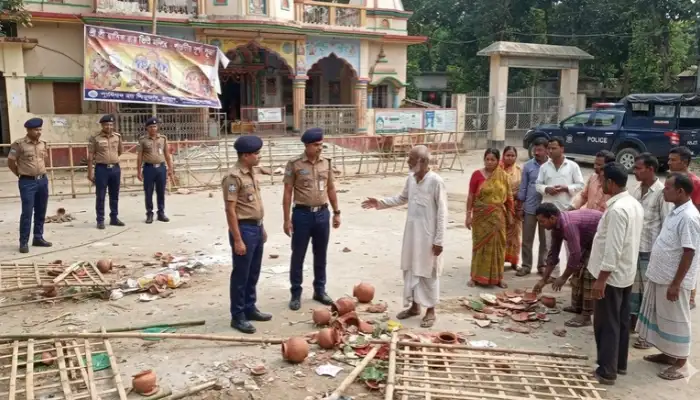
Case Summary
In Ruhiya, Thakurgaon district, Bangladesh, Hindu devotees, including Taposh, a devotee participating in a Durga idol immersion procession, were attacked by Muslim men led by local Bangladesh Nationalist Party (BNP) leader Shukur Ali. He obstructed the procession and deliberately stepped in front of the men carrying the Durga idol, causing them to trip and fall. The fall resulted in the breaking of the Durga idol, disrupting the sacred immersion ritual and hurting the religious sentiments of the Hindu devotees. Hindu members of the procession were also beaten during the incident. The deliberate obstruction of the procession and the resulting damage to the sacred idol caused distress among the Hindu community. The victim, Taposh, expressed fear for the safety of Hindus in Bangladesh, stating that it had become unsafe for them to live in the country following such incidents. The attack left Hindu devotees facing not only the disruption of an important religious observance but also concerns about their security and ability to practise their faith without intimidation or violence.
Why it is Hate Crime ?
The primary category selected for this case is: Attack on Hindu religious representations. The subcategory selected is: Defiling religious customs. Sanatan Dharma is not a religion of one book, which is to say that while it has religious scriptures that form the central tenets of the faith, there are several traditions followed through thousands of years, mostly passed from generation to generation orally. There are several such customs and traditions that are followed by various Hindus and Hindu sects. Defiling these traditions and customs is a breach of an individual or group’s religious practices. Such practices can range from dietary restrictions like not eating non-vegetarian food for a certain period of the year, not eating non-vegetarian food at all, not eating beef since the cow is considered holy in Hinduism, the sanctity of religious customs followed in the house (like many ISKCON devotees), etc. Any malicious action leading to the breach of such traditions or defilement of these traditions owing to animosity towards the faith or for the sake of activism stems not only from the lack of faith in the religion itself but also from disregard for the faith of the devotees who follow the customs/traditions and implicit bias against the faith and the tradition itself. Since these specific traditions are central to the faith of the devotees of that specific sect of Hindus, any non-compliance with these traditional rules would be considered a religiously motivated hate crime. The other subcategory selected is: Desecration of Hindu religious symbols. Icons and symbols, or a religious representation of a spiritual ideal, are widely revered in Hinduism. Iconography is of vital significance in the Hindu milieu. It helps connect people’s spiritual beliefs with the real world. Iconography within the Hindu faith takes several shapes and forms. Murtis are of the most significance to Hindus, to which daily rituals, prayers and offerings are done. Besides the murtis, there are several other symbols which have deep significance in the Hindu faith – the Om and Swastika, for example. Since these Hindu religious symbols hold paramount importance in Hinduism, any desecration of symbols, icons, murtis, religious representations and manifestations is driven by animosity towards the faith itself, which manifests itself through these murtis, icons and symbols. Therefore, any desecration of these Hindu religious symbols and representations is considered religiously motivated hate crimes under this category. The second category selected is: Attack not resulting in death, and within this, the subcategory selected is: Attack against Hindu devotees. Hindu devotees are a few of the easiest targets of religiously motivated hate crimes because during the festival/procession/puja etc, for non-Hindus it is easy to profile their victims on the basis of religion. Hindu devotees come under attack on several occasions by individual non-Hindus or mobs of non-Hindus owing to their animosity against Hinduism, its symbols and tradition/practices. There are several instances of Hindu devotees being attacked while they worship in temples or temporary religious structures, during religious processions, doing bhajan/kirtan/puja in their own homes, in the residential society etc. These attacks are perpetrated by non-Hindus primarily because of their animosity towards Hindus and their faith. In some cases, the trigger for the violence may be non-religious, however, there are two elements that make these hate crimes. First, the Hindus who come under attack are attacked violently while indulging in religious activity. Whether they are in a place of worship or not is immaterial to the crime. When individuals are attacked while indulging in religious practices, the attack in itself is a hindrance to their freedom to practice religion and therefore constitutes a hate crime. Secondly, religious supremacist doctrines and ideologies deem religious practices of Hindus to be offensive ab initio since they are considered “sinful” by these ideologies, worthy to be annihilated by force or coercion. Driven by these religious supremacist ideologies and doctrines, the attacks against Hindu devotees stem from intrinsic animosity towards Hinduism. In some cases, the trigger for the violence may be non-religious, however, it develops into a religiously motivated crime during the course of the violence. Since these attacks stem from animosity towards Hindus and Hinduism, they are considered religiously motivated hate crimes under this category. The hate crime aspect of this incident lay in the deliberate obstruction of a Hindu religious ritual and the damage caused to a sacred Hindu idol. The immersion of the Durga idol was an important part of Durga Puja, marking the festival's conclusion. By obstructing the procession and interfering with the ritual, the perpetrators prevented Hindu devotees from carrying out an important religious custom. This directly affected their ability to practise their faith and showed disregard for the religious traditions they followed. In Hindu Dharma, religious customs are passed down through generations and hold deep meaning for devotees. Durga Puja honours Maa Durga, who represents divine power, protection and the triumph of good over evil. The immersion of her idol forms a meaningful part of the festival and carries religious and emotional significance for worshippers. Deliberately interfering with this practice disrupted a sacred observance and disrespected the beliefs of the Hindu community. This conduct fell under Attack on Hindu Religious Representations — Defiling Religious Customs because it interfered with a religious tradition central to the devotees’ worship. Hindu idols are sacred representations of deities and occupy an important place in Hindu worship. Devotees offer prayers and perform rituals before these representations as expressions of their faith and devotion. The breaking of the Durga idol therefore went beyond damage to a physical object; it damaged a sacred representation of Maa Durga. The deliberate act that caused the idol to break desecrated a Hindu religious symbol and deeply affected the devotees who had gathered to perform the immersion. The physical assault on Hindu devotees added to the seriousness of the incident. The violence occurred alongside the obstruction of their religious procession, leaving members of the Hindu community facing both physical harm and interference with their religious practices. The victim also expressed fear for the safety of Hindus in Bangladesh and described the country as unsafe for them to live in. The incident consequently affected not only the religious observance itself but also the community’s sense of security while practising its faith. The deliberate interference with the immersion ritual and the resulting destruction of the Durga idol demonstrated hostility towards Hindu religious customs and sacred representations. The incident therefore fell under attack on Hindu religious representations, defiling religious customs and desecration of Hindu religious symbols, as it involved both the disruption of an important Hindu ritual and the breaking of a sacred representation of Maa Durga. Disclaimer: The number of victims is recorded as five, two women and three men, based on the individuals visible in the victims’ statement video.
Victim Details
Total Victim
5
Deceased
0
Gender
- Male 3
- Female 2
- Third Gender 0
- Unknown 0
Caste
- SC/ST 0
- OBC 0
- General 0
- Unknown 5
Age Group
- Minor 0
- Adult 5
- Senior Citizen 0
- Unknown 0


Case Status
Unknown


Perpetrators Details
Perpetrators
Muslim Extremists
Perpetrators Range
One Person
Perpetrators Gender
male
 Sources



