Dussehra procession organised by RSS obstructed and stone-pelted by Muslim mob for passing in front of mosque in Jalgaon, Maharashtra
 Jalgaon, Maharashtra, India
 24 October, 2026
Case Summary
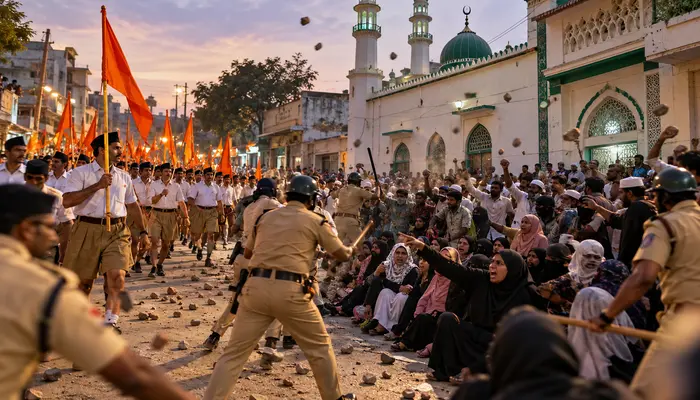
In Kingaon village, Jalgaon, Maharashtra, a Dussehra procession organised by the Rashtriya Swayamsevak Sangh (RSS), a revered Hindu organisation, was targeted by a Muslim mob. Muslims pelted stones at the procession solely because it was passing in front of a mosque. Hindu participants who had taken part in the religious procession were also subjected to physical assault by the Muslim mob. According to media reports, the RSS was preparing to conduct its annual route march on the occasion of Dussehra along a pre-approved route on Sunday, 25 October 2026. However, a group of Muslims objected to the procession passing in front of a mosque. The protest escalated when Muslim women sat on the road outside the mosque to obstruct the procession, with Muslim men bringing them to the front and seating them on the road as part of the protest. The confrontation intensified when members of the Muslim mob pelted stones at the procession and its Hindu participants, triggering further clashes between the two groups and creating panic and chaos in the area. People gathered on the road amid the escalating tension. Police personnel present at the scene attempted to reason with the protesting Muslim group and defuse the situation. Superintendent of Police Shreekant Dhivare later stated that the police had attempted to negotiate with Muslims for approximately two to two-and-a-half hours and had made several requests to persuade them to allow the Dussehra procession to proceed. He confirmed that the police had granted permission for the route march in accordance with the law and the Constitution, adding that no group had the right to prevent a procession from proceeding along its authorised route. However, as the confrontation escalated and the protesting Muslim group remained uncooperative, the police resorted to a mild lathi-charge to disperse the crowd and restore order. The incident created an atmosphere of panic and commotion, prompting the police to intensify their efforts to bring the situation under control. Following the stone-pelting and the deteriorating situation, senior police officials rushed to the village. A large police contingent, led by Superintendent of Police Shreekant Dhivare and Additional Superintendent of Police Sandeep Gavit, reached the spot. Divisional Police Officer Anil Badgujar and other senior officials also arrived to oversee the situation. Following police intervention, the situation was brought under control, and the RSS route march was completed peacefully under heavy security cover. Superintendent of Police Shreekant Dhivare stated that the situation had returned to normal and that a large police force remained deployed in Kingaon to prevent further untoward incidents. He also confirmed that the police had arrested several people whom he described as anti-social elements, although their number and identities were not specified. Authorities urged citizens not to believe rumours and appealed to residents to cooperate in maintaining peace and communal harmony. Further details regarding the identities of those arrested, the possibility of additional arrests, and whether anyone sustained injuries remained unavailable at the time of writing this report.
Why it is Hate Crime ?
This case is being added to the tracker under the primary category: Attack not resulting in death. The subcategory selected is: Attack on religious procession. The outward celebration and display of religious symbols in an intrinsic part of Hinduism. Religious processions on various festivals are age-old traditions and a way to manifest faith and form a part of the religious practices of Hindus. On several occasions, such religious processions come under attack by non-Hindu mobs, in a manifestation of their animosity towards Hinduism and their practices. The reasons cited for such violent attacks are many and range from crossing a non-Hindu resident-dominated area to playing loud music, crossing from an area where there is a religious structure of another faith etc. The violent attacks are triggered by the outward display of religiosity by Hindus. The attacks are mainly a manifestation of religious supremacist doctrine which believes that idolatry, essentially the Hindu faith, is one that deserves to be annihilated since the very tenets of Hinduism, its practices and traditions are considered a sin in those doctrines. Since these attacks emanate from intrinsic and doctrinal animosity towards Hindus and Hinduism, it is considered a religiously motivated hate crime under this category. The other subcategory selected is: Attack against Hindu devotees. Hindu devotees are a few of the easiest targets of religiously motivated hate crimes because during the festival/procession/puja etc, for non-Hindus it is easy to profile their victims on the basis of religion. Hindu devotees come under attack on several occasions by individual non-Hindus or mobs of non-Hindus owing to their animosity against Hinduism, its symbols and tradition/practices. There are several instances of Hindu devotees being attacked while they worship in temples or temporary religious structures, during religious processions, doing bhajan/kirtan/puja in their own homes, in the residential society etc. These attacks are perpetrated by non-Hindus primarily because of their animosity towards Hindus and their faith. In some cases, the trigger for the violence may be non-religious, however, there are two elements that make these hate crimes. First, the Hindus who come under attack are attacked violently while indulging in religious activity. Whether they are in a place of worship or not is immaterial to the crime. When individuals are attacked while indulging in religious practices, the attack in itself is a hindrance to their freedom to practice religion and therefore constitutes a hate crime. Secondly, religious supremacist doctrines and ideologies deem religious practices of Hindus to be offensive ab initio since they are considered “sinful” by these ideologies, worthy to be annihilated by force or coercion. Driven by these religious supremacist ideologies and doctrines, the attacks against Hindu devotees stem from intrinsic animosity towards Hinduism. In some cases, the trigger for the violence may be non-religious, however, it develops into a religiously motivated crime during the course of the violence. Since these attacks stem from animosity towards Hindus and Hinduism, they are considered religiously motivated hate crimes under this category. The other subcategory selected is: Attacked for supporting/being part of perceived Hindu party/org or working for Hindu community. In several cases, Hindus are attacked specifically or tangentially for their association with parties or organisations perceived to be pro-Hindu and/or for working in favour of the Hindu community. One of the classic cases was the attack against a Bharatiya Janata Party Yuva Morcha (BJYM) worker Praveen Nettaru. Nettaru was attacked and hacked to death for his association with Hindu organizations and his work for the Hindu community. He was murdered by PFI, a terror organization which aimed to commit a genocide of Hindus, target Hindu leaders specifically and turn India into an Islamic Nation. In such cases, it is possible that the immediate trigger for the violence is non-religious – either according to the perpetrator or the police. However, there are surrounding circumstances from which the conclusion can be reached that the victim was attacked for his association with a Hindu organization. In a similar case, Rinku Sharma was attacked by radicals. He was a member of Bajrang Dal and regularly worked for the Hindu community. While the police cited a different non-religious trigger for the attack, it is true that he was associated to a Hindu organization and the family of Rinku Sharma specifically attributed his gruesome murder to him working for Bajrang Dal and raising Jai Shree Ram slogans. Such cases are intrinsically driven by religious hate and would therefore be documented as a hate crime under this category. The other subcategory selected is: Attacked for crossing 'Muslim area'. One of the reasons that Hindus get attacked unprovoked specifically by Islamists is for crossing ‘Muslim areas’. Essentially, Muslim mobs often attack Hindus crossing or present in certain areas which have a majority Muslim population. It has often been cited as one of the reasons to blame Hindus for attacks against themselves, signalling that Hindus displaying religious symbols, taking our religious processions or crossing any area which is dominated by Muslim residents is a provocation in and of itself. These areas are mostly ghettoized areas where mobs mobilize quickly to attack Hindus for a variety of reasons like playing music during a religious procession, crossing a mosque, wearing a tilak or any other religious symbol in a Muslim-dominated area, praying at a local temple in that area etc. There have been cases where the few local Hindus of that area have been attacked on their way to the Temple for prayers as well, simply because the area is considered a Muslim-dominated area. Several times, it is entirely possible that the immediate trigger for the violence against Hindus was non-religious in nature, however, the violence became religiously motivated in nature because the area was Muslim dominated and the residents on the whole harboured animosity towards Hindus, evidenced from the actions of the mob, the slogans, and the nature of the attack. Such crimes are motivated by the religious identity of the victims and are therefore classified as hate crimes under this category. The other subcategory selected in this case is: Communal Clash/Attack. Communal clash is a form of collective violence that involves clashes between groups belonging to different religious identities. For a communal clash between Hindus and non-Hindus to qualify as a religiously motivated hate crime, the trigger of the violence itself would have to be anti-Hindu in essence. For example, if there is a Hindu religious procession that comes under attack from a non-Hindu mob and after the initial attack, Hindus retaliate in self-defence, leading to a communal clash between the two religious communities. While at a later stage, both communities are involved in the clash/violence, the initial trigger of the violence was by the non-Hindu mob against the Hindus and therefore, it could safely be termed as an anti-Hindu violence. Further, the trigger would also have to be religiously motivated. In the cited example, the attack by the non-Hindu mob was against religious processions and therefore, can be concluded to be religiously motivated. In some cases, the trigger may be non-religious, however, it develops into religious violence against Hindus at a later stage. In such cases too, the foundational animosity towards Hindus becomes the motivating factor of the crime and therefore, it would be classified as a religiously motivated hate crime against Hindus under this category. In the present case, a Hindu procession organised by the Rashtriya Swayamsevak Sangh (RSS) to celebrate Dussehra was obstructed and targeted with stone-pelting by a Muslim mob. Hindu devotees participating in the procession were attacked merely because the procession was passing along its pre-approved route in front of a mosque. The objection to the procession's passage, followed by violence against its Hindu participants, established the religious context of the offence and demonstrated hostility towards the public expression of Hindu faith. Dussehra is an important Hindu festival celebrating the victory of good over evil. It commemorates Bhagwan Ram's victory over Ravan and, in several Hindu traditions, Maa Durga's triumph over Mahishasura. The festival is observed through prayers, rituals, community gatherings and religious processions. The RSS organises annual marches on Dussehra as part of its religious and cultural observances, bringing Hindu community members together to commemorate the festival and affirm their religious identity. These processions constitute a form of Hindu religious and cultural expression. In this case, the procession was passing peacefully along a route approved by the authorities when it encountered opposition from Muslims because it was passing in front of a mosque. The decision to obstruct the Hindu procession and resort to violence against its participants interfered with their freedom to express their faith publicly and demonstrated hostility towards a peaceful Hindu religious observance. The stone-pelting directed at Hindu devotees further demonstrated the religious hostility underlying the incident. The participants were taking part in a peaceful procession along an authorised route and had not initiated violence or engaged in any provocative conduct against Muslims. Nevertheless, they were targeted with violence merely for participating in a Hindu religious observance. Such attacks on Hindu processions and devotees serve to intimidate the Hindu community, undermine its sense of security and instil fear among those wishing to participate in public religious activities. Resorting to violence against Hindus exercising their right to practise and publicly express their faith demonstrates hostility towards their religious identity and seeks to discourage the open observance of Hindu festivals. The targeting of Hindu devotees by Muslims for their participation in a peaceful religious procession further underscores the religiously motivated nature of the offence. The immediate religious marker in this case was the objection raised by Muslims to the Hindu procession passing in front of a mosque. Despite following its authorised route and proceeding peacefully, the RSS-led procession was subjected to stone-pelting, demonstrating hostility towards the public expression of Hindu religious and cultural identity. The incident also showcased a repeated pattern of territorial dominance exhibited by members of the Muslim community. The incident occurred near a mosque, and it is crucial to note that Muslims often consider areas near mosques, dargahs, or places where their community is in the majority as "Muslim areas". This reveals a disturbing sense of Islamic supremacy among the attackers, who viewed the area near the mosque as an exclusive zone where non-Muslims, particularly Hindus, were unwelcome. This sense of entitlement and superiority reflects deep-seated prejudice and an attempt to assert religious dominance over public spaces. The assault on the Hindu participants reflected this exclusionary mindset, whereby members of the Muslim community sought to dictate who could move freely through an area on the basis of religious identity. Such conduct illustrates a mindset rooted in exclusion, intolerance and religious animosity, making this case an example of violence motivated by religious hostility and territorial dominance. Such incidents of territorial dominance and attacks on Hindus for passing through areas considered “Muslim areas” are not new, but reflect a recurring pattern of hostility towards Hindus and their religious processions. The Hinduphobia Tracker has documented 166 such cases in which Hindu individuals and processions were targeted for passing through areas near mosques, dargahs or localities where Muslims constituted a majority or a significant proportion of the population. Seven of these cases resulted in the deaths of Hindus, highlighting the grave consequences of this pattern of religious hostility and exclusionary territorial control. Furthremore, the RSS's role as the organiser added an important ideological dimension to the incident. The RSS is a prominent Hindu organisation that advocates Hindu interests, promotes Hindu cultural identity and represents a broader pro-Hindu civilisational movement. The RSS has long faced ideological opposition and animosity from the Muslim community because of its pro-Hindu ideology (Hindutva) and its advocacy of Hindu interests. This hostility towards the organisation can extend to its activities, public events and members. In the present case, the targeting of an RSS-led Dussehra procession demonstrated hostility not only towards a Hindu religious observance but also towards an organisation associated with the assertion and protection of Hindu interests. The opposition to the procession and the stone-pelting directed at its Hindu participants reflected animosity towards the public expression of Hindu identity represented by the RSS. Targeting a procession organised by a pro-Hindu organisation also intimidates those who participate in its activities and seeks to disrupt the collective expression of Hindu religious and cultural identity. The incident therefore illustrated the intersection of religious and ideological hostility, with both the Hindu festival and the organisation leading its observance becoming targets of the religiously driven violence. The incident subsequently escalated into a communal clash between the Hindu procession participants and members of the Muslim community. However, the involvement of two groups did not, in itself, establish equal responsibility for the violence. The sequence of events remained crucial: the confrontation began with opposition to the Hindu procession passing along its authorised route in front of a mosque, followed by stone-pelting directed at the procession and its participants. Any subsequent response by Hindu participants must therefore be assessed in the context of the initial aggression. Since they acted in retaliation and self-defence, their actions cannot automatically be equated with the initial attack or treated as evidence of equivalent culpability. The escalation demonstrated how religiously motivated aggression against a Hindu procession can develop into a wider communal confrontation, threatening communal harmony. Responsibility must be assessed according to the actions of each group, rather than attributing equal blame simply because the confrontation eventually involved both sides. The initial targeting of the Hindu procession remained central to understanding the religious hostility that triggered the incident, making this incident an example of a religiously motivated crime. Overall, since this case met the parameters of a religiously motivated offence, it is being added to the Hinduphobia Tracker's hate crime database.


Case Status
Arrested


Perpetrators Details
Perpetrators
Muslim Extremists
Perpetrators Range
Unknown
Perpetrators Gender
both
 Sources



