Tribal Hindu families targeted for conversion to Christianity under the guise of prayer meeting in Korba, Chhattisgarh
 Korba, Chhattisgarh, India
 24 October, 2026
Case Summary
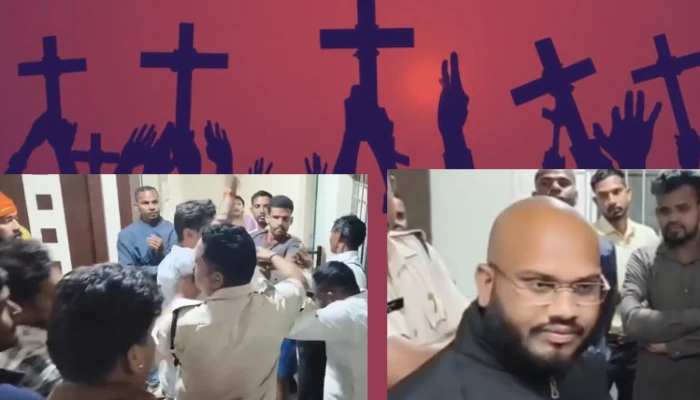
In Korba, Chhattisgarh, around 40 Hindu tribal families were targeted for conversion to Christianity under the guise of a prayer meeting held at Hotel Star Inn. Bajrang Dal workers reached the hotel after receiving information about the gathering, following which a confrontation broke out and some individuals engaged in physical violence. According to reports, the incident took place at Hotel Star Inn in the Transport Nagar area of Korba district on Sunday, 25 October, 2026. About 15 rooms were booked for around 40 people who arrived from Lafaa, Pali, and Katghora. The bookings were made in the name of John Masih, and around 10 tribal Hindu families were among those staying at the hotel. After receiving information about the prayer meeting, Bajrang Dal workers reached the hotel. The situation escalated into a confrontation, during which some individuals engaged in physical violence. Videos of the incident subsequently circulated on social media. Bajrang Dal chief Rana Mukherjee stated that Christian missionaries were offering inducements to encourage people to convert to Christianity. He also stated that conversion activities were taking place through the Indian Prayer Church (IPC) in the Manikpur area. Following the incident, CSP Prateek Chaturvedi arrived at the hotel with a police team and questioned those present. Police began investigating the circumstances surrounding the prayer meeting, the room bookings, and the identities of the people staying at the hotel. Questions also arose over reports that some guests had been accommodated without identity documents. The police investigation was underway when this report was written.
Why it is Hate Crime ?
The primary category selected in this case is: Predatory Proselytisation. The subcategory selected is: Conversion/attempts to convert by inducement. Predatory Proselytisation is not just limited to threats, harassment, force and violence, but it also has contours of stealth. In several cases, the Hindu victim is exploited to convert, with non-Hindus taking advantage of their poverty. In such cases, the Hindu victim who is suffering financially is offered monetary benefits, including lucrative offers for jobs, health treatment, education, etc., to induce the victim to change his/her religion. In such cases, the religious identity of the victim and the aim to disenfranchise him from his faith form the heart of the crime. Also, taking advantage of and exploiting an individual’s economic vulnerabilities is widely acknowledged as exploitation, forms of which are often penalised by law. Such cases therefore are considered religiously motivated hate crimes since the victim’s religious identity forms the very heart of the crime itself. The other subcategory selected is: Proselytisation by grooming, brainwashing, manipulation or subtle indoctrination, with the tertiary category being: Pattern of targeting Hindus. Religious brainwashing essentially means the often subtle and forcible indoctrination to induce someone to give up their religious beliefs to accept contrasting regimented ideas. Religious grooming or brainwashing also involves propaganda and manipulation. It involves the systematic effort, driven by religious malice and indoctrination, to persuade “non-believers’ to accept allegiance, command, or doctrine to and of a contrasting faith. Cases of such grooming or brainwashing are far more nuanced than direct threats, coercion, inducement and violence. In such cases, it is often seen that there is repeated, subtle and continual manipulation of the victim to induce disaffection towards their own faith and acceptance of the contrasting faith of the perpetrator. While subtle indoctrination is widely acknowledged as predatory, an element which is often understated in such conversions or in the attempts at such conversion is the role of loyalty and trust which might develop between the perpetrator and the victim. Fiduciary relationships are often abused to affect such religious conversion. For example, an educator transmitting religious doctrine of a competing faith to a Hindu student. The Hindu student is likely to accept what the teacher is transmitting owing to the existence of the fiduciary relationship. The exploitation of the fiduciary relationship to religiously indoctrinate victims would also be included in this category. Since the underlying animosity towards the victim’s faith forms the basis of predatory proselytisation, such cases are considered religiously motivated hate crimes. In this case, the prayer meeting was directed at Hindus and tribals specifically, which demonstrated that their religious identity was the reason they were selected as targets. The use of Christian religious practices during the gathering, along with inducements to encourage conversion, indicated that the meeting was not a passive social gathering but an effort to convert Hindu attendees. When the practices of one faith are used to deliberately target and manipulate members of another, with the clear intention of securing a change of religion, it constitutes a direct assault on the religious identity of those targeted. The conduct also reflected a broader religious objective of reducing adherence to Hinduism and increasing adherence to Christianity. The intended outcome was not religious coexistence or mutual understanding, but replacing one religious identity with another. By encouraging Hindus and tribals to leave their faith in return for inducements, the organisers treated Hindu religious affiliation as something to be discarded and replaced. The success of the entire effort depended on abandoning Hindu beliefs and practices, revealing a clear and deliberate religious motive. Around 15 rooms were booked at Hotel Star Inn for approximately 40 people who arrived from Lafaa, Pali, and Katghora, indicating planning and coordination rather than a spontaneous gathering. The Christian faith, by its very theological foundations, places a strong emphasis on proselytisation. In pursuit of conversion objectives, Christian evangelists often employ unethical means, ranging from psychological pressure and misinformation to inducements such as money or jobs. In such cases, Christian missionary groups often target and brainwash socially and economically vulnerable Hindus to further their agenda of religious conversions. This form of coercion strips Hindus of their agency and dignity and enforces forced conversions. These are not random or isolated incidents, but rather premeditated efforts to undermine the Hindu faith, persuade Hindus to discard their own faith, and convert to Christianity. Such acts were deeply rooted in religious animosity towards Hindu victims, and thus, this case was added to the tracker. This case was therefore recorded in the Hinduphobia Tracker because the perpetrator targeted Hindu individuals on account of their Hindu identity, employed inducements to weaken their attachment to their faith, and organised a gathering to achieve religious conversion. Disclaimer: Media reports state that approximately 40 people were staying at Hotel Star Inn in Korba, Chhattisgarh, where a prayer meeting took place amid allegations of attempts to convert Hindus to Christianity through inducements. The reports also state that around 10 Hindu families were among those staying at the hotel. However, they do not provide an exact count of Hindu participants or a gender-wise or age-wise breakdown. For documentation purposes, the Hinduphobia Tracker has recorded the reported figure of 40 participants as the victim count. The exact number of Hindu individuals targeted for conversion may be higher. The perpetrator count was kept at one (1) because the report named only one perpetrator, John Masih. This figure was kept for documentation purposes and may not reflect the actual number of perpetrators
Victim Details
Total Victim
40
Deceased
0
Gender
- Male 0
- Female 0
- Third Gender 0
- Unknown 40
Caste
- SC/ST 0
- OBC 0
- General 0
- Unknown 40
Age Group
- Minor 0
- Adult 0
- Senior Citizen 0
- Unknown 40


Case Status
Unknown


Perpetrators Details
Perpetrators
Christian Extremists
Perpetrators Range
One Person
Perpetrators Gender
male
 Sources



