Hindu woman deceived into marriage and forced to convert by Christian man hiding his religious identity; Hindu deities insulted during baptism ceremony
 Ludhiana, Punjab, India
 1 September, 2026

Case Summary
In m Ludhiana, Punjab, a Hindu woman named Kritika Verma was deceived into relationship and marriage by a Christian man named Karanvir Sidhu, who hid his religious identity and claimed to be a Jat Sikh. After the marriage, the Karanvir's father refused to accept the marriage claiming he will only accept the marriage if the Hindu woman converted to Christianity. Furthermore, during the religious conversion ceremony, insulting remarks were also made against Hindu gods and goddesses. Kritika Verma married Karanvir Sidhu on 2 September 2026 at Shani Shiv Temple in Sant Vihar, Ludhiana, according to Hindu customs and rituals. According to her father, Vipin Kumar Verma, Kritika and Karanvir were both motorcycle enthusiasts and met through their shared interest in biking. Karanvir developed feelings for Kritika and began visiting the Apple Store where she worked under various pretexts. He subsequently expressed his feelings for her, and the two entered into a relationship. The victim's father stated that Karanvir introduced himself to Kritika as Karanvir Singh Sidhu and presented himself as a Jat Sikh, and Kritika believed his account of his religious identity. She later introduced him to her mother on her mother's birthday, when Karanvir proposed marriage. After Kritika's family made enquiries about him and her brother confirmed that he knew Karanvir, the relationship progressed towards marriage. The wedding took place on 2 September 2026 at Shani Shiv Temple in Sant Vihar, Ludhiana, according to Hindu religious customs. Vipin Kumar stated that Karanvir's family did not attend the wedding because his grandmother had died, although his elder brother was present. Subsequently, the victim went to her marital home on 5 October 2026. Upon arriving at the marital home, Kritika discovered a large hall on the ground floor that had been converted into a church. It was revealed that Karanvir's family had already converted to Christianity, a fact that had not been disclosed to Kritika before the marriage. Furthermore, Karanvir's father, Jatinder Singh Sidhu, refused to accept the marriage unless Kritika converted to Christianity. Kritika initially resisted but eventually agreed because she feared that the marriage would be rejected. Subsequently, Jatinder switched off her mobile phone at night and took her to a swimming pool on the third floor of the house, where she was made to sit in the water and immerse herself as part of a religious conversion ritual. During the incident, Jatinder touched her head, back and body inappropriately and recorded a video. The victim's father further stated that insulting and derogatory remarks were made about Hindu gods and goddesses during the incident. Following the conversion ritual, Kritika was sent back to her parental home that night and told that she would be taken back the following day for a marriage ceremony according to Christian religious customs. Karanvir subsequently took Kritika away and arranged a second marriage ceremony according to Christian customs. After this ceremony, Jatinder stated that he had separated his son from the family and would provide the couple with only a room, without other household belongings, after which Kritika and Karanvir began living together separately from his family. The relationship subsequently deteriorated, with frequent arguments between Kritika and Karanvir. Karanvir's and his family demanded ₹10 lakh in dowry and eventually forced the victim out of the marital home when she failed to pay the amount. Kritika then shifted to a rented accommodation in Joginder Nagar, Haibowal, Ludhiana, where Karanvir continued to visit and physically assault her. During this period, Kritika discovered a tattoo on Karanvir's chest bearing the name Nannu, along with the date 16 October 2021, which marked the date on which they first met. Karanvir acknowledged that Nannu was another woman with whom he had been involved and told Kritika that he did not love her. The dispute escalated on 19 October 2026, when Karanvir and members of his family arrived at the victim's father Vipin Kumar's residence in Ludhiana. According to the complaint, they threatened the victim's family and attempted to take Kritika away, leading to a violent confrontation. Vipin Kumar sustained a nasal bone fracture during the altercation. Following his complaint, Haibowal police registered a case against Karanvir Sidhu, his parents Jatinder and Minni Sidhu, a relative named Vikramjit Singh, a lawyer identified as Munish Kumar, and four unidentified individuals. The charges included rioting, wrongful restraint, voluntarily causing hurt and deliberate acts intended to outrage religious feelings under the Bharatiya Nyaya Sanhita. The complaint also covered the reported forced religious conversion, dowry harassment, threats and other forms of mistreatment. Vipin Kumar further stated that his daughter's in-laws had arranged the marriage as part of a planned scheme to convert a Hindu woman to Christianity and had received a substantial sum of money from a Christian missionary. He also described the subsequent physical and mental harassment as an attempt to extract a further ₹10 lakh in dowry.
Case Images
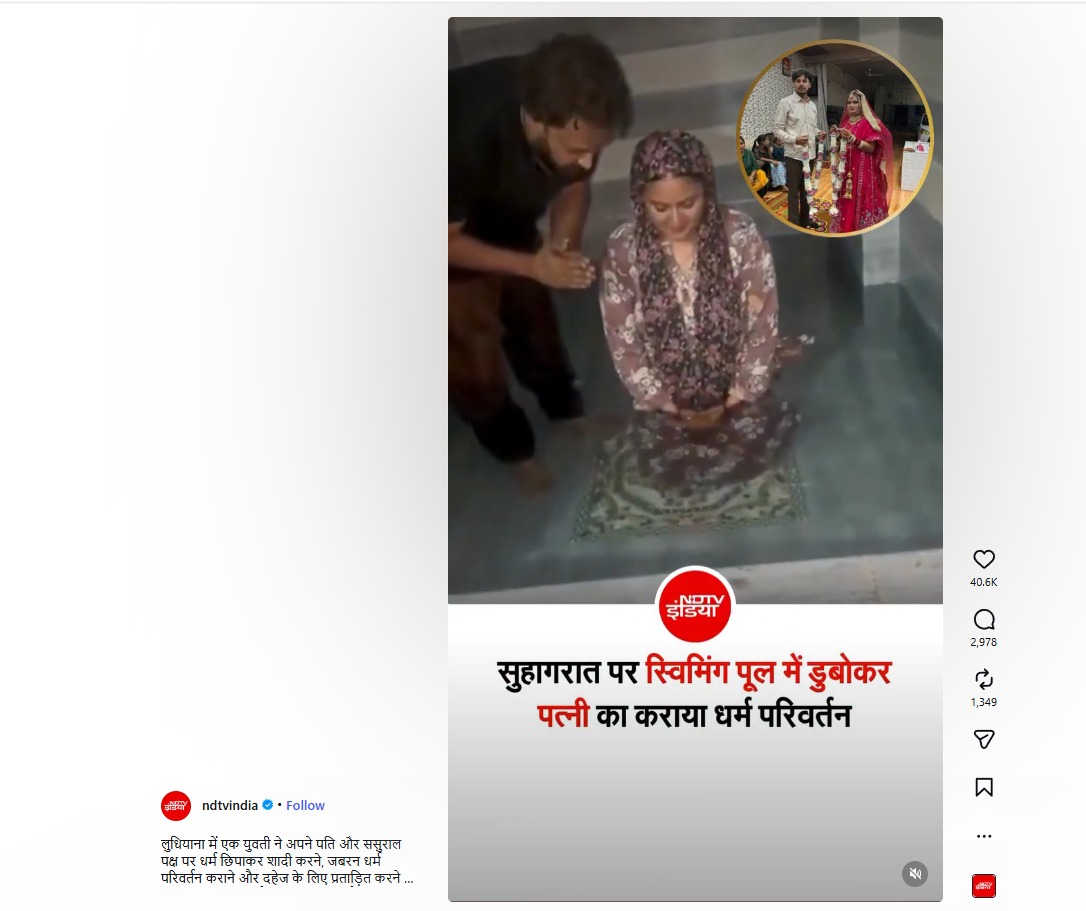
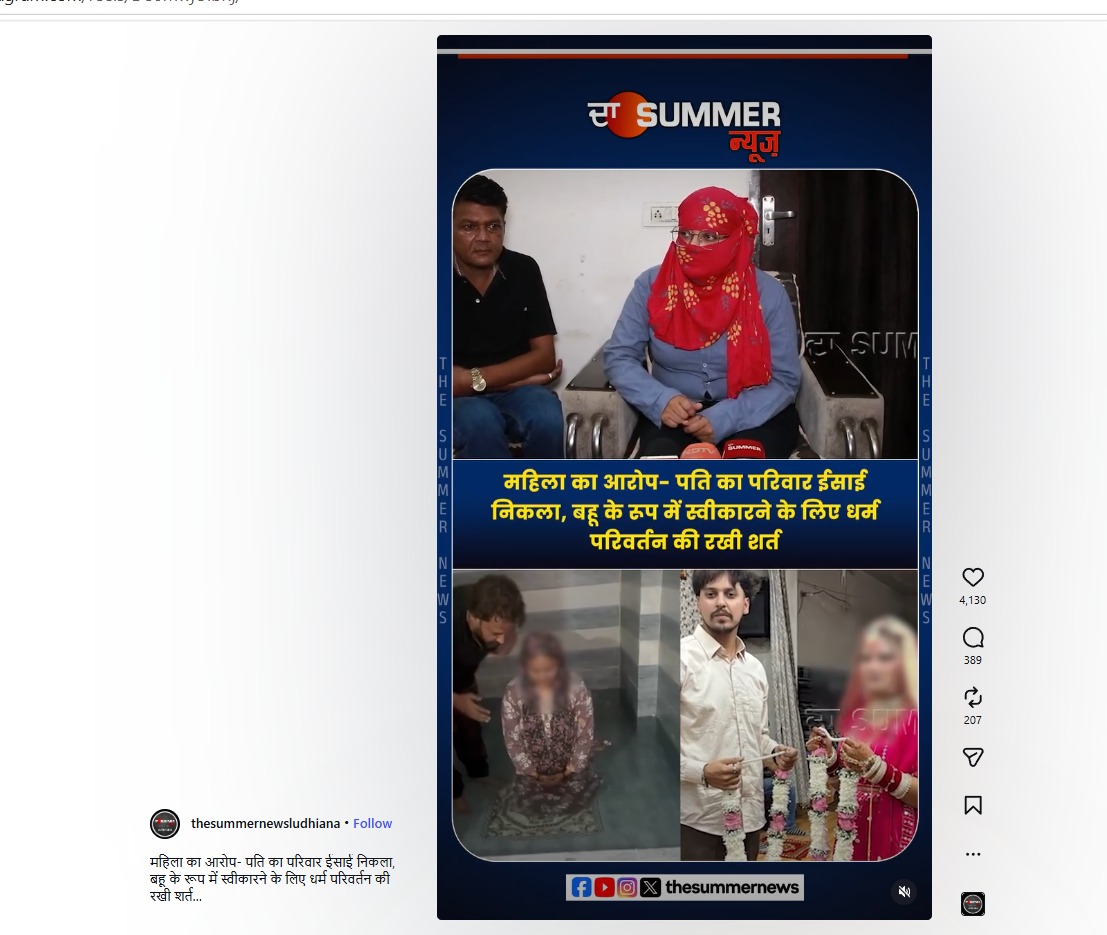
Why it is Hate Crime ?
This case has been added to the tracker under the primary category of - Crimes against women in relationships and other sexual crimes. Within it, the sub-category selected here is - Man pretends to be Hindu, with the tertiary category being - Marries as per Hindu rituals. When a non-Hindu man pretends to be a Hindu to deceive a Hindu woman into a relationship, the act is seen as triggered by malafide intentions. In some cases, the woman eventually accepts the man’s original religious identity and converts after the man’s identity is revealed. These cases could be argued as cases of religious brainwashing and a result of the pressure a woman feels after getting into a relationship with a man. The woman, it can be argued, also changed her religious identity because of the stigma she believes she might face if she chooses to walk out of a deceptive relationship. However, for the purpose of documenting hate crimes, the cases in this subcategory are limited to those where there is explicit violence aimed at religious conversion against the wishes of the victim (force-feeding beef, blackmailing with intimate videos, rape on refusal to convert, etc), or if the woman herself complains of the man’s religious deception. In such cases, it is established that the deception of the non-Hindu man had a specific aim of religious conversion or targeting of the victim due to her Hindu religious identity, therefore, making it a religiously motivated hate crime. The other sub-category selected here is - Forced conversion after marriage. In such cases, a non-Hindu man marries a Hindu woman, and the force/pressure to convert to any Abrahamic faith, like Islam, begins after marriage. In such cases, typically, two patterns emerge. First, when the relationship is consensual, and the religious identity of the perpetrator is known to the Hindu woman in the relationship. The marriage could be under the Special Marriages Act, where neither parties are required to convert their religion for the marriage to be considered legitimate. While the victim in such cases enters matrimony assuming that religious identity is not a barrier, the non-Hindu man starts to pressure the woman to convert her religion after marriage. The second is when the woman gets into a marriage with the man, pretending to share her faith. Later, when the truth is revealed, the man starts pressuring the woman to convert her religion and give up her religious identity. In both situations, there is application of force by the perpetrator, including the denial of the woman’s religious rights. Some of the means by which the woman is forced/pressured to convert include force-feeding beef, being forced to read the Kalma, being forced to wear a hijab, forced to undergo Halala, etc. There are several instances where, after marriage, the woman voluntarily converts to Islam. Such cases are often argued to be a result of religious brainwashing, however, for the purpose of documenting religiously motivated hate crimes, in the absence of the victim complaining of forced conversion, such cases do not form a part of the database. The other primary category selected here is - Predatory Proselytisation. Within it, the sub-category selected here is - Attempting to convert/converting by denigrating Hinduism. In several cases, Hindus are converted or an attempt is made to convert Hindus by denigrating their faith, Hinduism. In such cases, the Hindus associate with the non-Hindu perpetrators often by choice and then, the attempt to convert them by insulting their faith, showing the faith down etc begins. An example of this would be a non-Hindu gathering where the Hindus are attending the gathering of their own free will. However, once they attend the gathering, there is an explicit attempt to convert them by abusing their faith and hailing the faith of the perpetrator. The denigration of the Hindu faith is often based on misrepresentation of the Hindu faith, its doctrine and scriptures and insult to espoused traditions if not blatant lies about Hindu beliefs and ways. Such conversions or attempts at conversions are driven by animosity towards the Hindu faith and are therefore documented as religiously motivated hate crimes. The case was classified as a hate crime because the conduct went beyond a marital dispute and involved the deliberate concealment of religious identity, pressure on a Hindu woman to abandon her faith, and disparagement of Hindu religious beliefs. The central aspect of hate crime was the use of marriage as a means of bringing a Hindu woman into a Christian household without disclosing the family's religious affiliation beforehand. By misrepresenting his religious background, Karanveer exploited Kritika’s trust and prevented her from making an informed decision about the relationship. The deception became particularly significant when his family’s Christian faith was revealed after the marriage and his father demanded that she convert to Christianity before accepting the marriage. This deliberate concealment of religious identity, followed by pressure to abandon her faith, indicated a targeted disregard for the victim’s Hindu identity and religious beliefs. Karanveer’s decision to marry Kritika according to Hindu rituals was significant in the context of his misrepresentation of his religious identity. He presented himself as a Jat Sikh and participated in a Hindu wedding ceremony, reinforcing Kritika’s belief that her faith would be respected within the marriage. By concealing his family’s Christian affiliation and observing Hindu wedding customs, he created an impression of mutual respect for her religious beliefs and gained her trust. After the marriage, however, his father demanded that Kritika convert to Christianity before the family would accept the marriage, exposing the deception behind this apparent respect for her faith. The insistence that Kritika convert to Christianity before her marriage by her father-in-law was particularly relevant to the question of religious targeting. The demand placed the acceptance of her marriage and her position within her new family on the condition that she abandon her existing faith. This was not merely a disagreement over religious practices between spouses or relatives. Rather, the ultimatum placed pressure on a Hindu woman to change her religious affiliation as a prerequisite for acceptance within the household. Her initial resistance, followed by her eventual agreement because she feared that the marriage would be rejected, further indicated the coercive circumstances in which the conversion took place. Pressuring a Hindu individual to discard her religious faith and embrace another was a direct attack on her religious identity and dignity. It was not a matter of personal choice; it was coercion rooted in hostility towards the victim's Hindu identity. Such an attempt reflects religious animosity because the act was not simply about personal differences but about erasing the victim’s Hindu faith, making it a religiously motivated crime. The derogatory remarks about Hindu gods and goddesses made during the baptism ceremony further demonstrated that the incident was rooted in hostility towards Hindu religious beliefs. Such conduct went beyond religious debate or proselytisation, as the remarks were directed at the core beliefs of the Hindu faith in the context of pressuring a Hindu woman to embrace Christianity. Such denigration undermined the dignity of her existing religious identity and reinforced the pressure to abandon her faith. By disparaging Hindu deities during the baptism ceremony intended to convert her, the Jatinder connected the conversion process with disrespect towards the religion she had previously followed. This demonstrated hostility towards Hindu religious beliefs and strengthened the religious dimension of the case. This fosters an environment of hostility and disrespect towards the Hindu community and Hindu deities. These acts of insulting Hinduism stem from Christian theology, which harbours disdain and hatred for polytheistic faiths, and which categorises Hindus as ‘polytheists’, thereby fostering hatred against them. Such actions make the religiously motivated nature of the crime even more evident. Additionally, Kritika’s father stated that the marriage had been arranged as part of a planned scheme to convert a Hindu woman to Christianity, for which the family received a substantial sum of money from a Christian missionary. This indicated the religious profiling and deliberate targeting of a Hindu woman for religious conversion through deception and manipulation. When individuals or groups focus their efforts on converting members of a particular religion, in this case, Hindus, then it demonstrates a fundamental disregard for the Hindu faith. Conversion, especially when not based on personal conviction but rather on external persuasion or pressure, is not simply about sharing a different belief system. It is an attempt to undermine the values, traditions, and identity of the Hindu community. Taken together, the concealment of religious identity, coercion to convert to Christianity, derogatory remarks about Hindu deities and the financial motive for the conversion demonstrated a pattern of religiously motivated targeting against a Hindu woman. This systematic attempt to erode the religious foundation of individuals and replace it with allegiance to another faith reflects deep religious malice and animus against the Hindu identity. Because the core motivation of the act stems from hostility toward the victim’s religion, it meets the threshold of a hate crime. Hence, categorised as a hate crime in the database. Disclaimer: It is important to clarify that none of the media sources covering this case have specified the exact date when the victim's ordeal began. The earliest date mentioned is 2 September 2026 when the couple got married. Since Hinduphobia Tracker records the incident based on when the victim’s ordeal began and not when it was reported, we have considered the date of the incident as 2 September 2026, though the media reported the incident later.
Victim Details
Total Victim
1
Deceased
0
Gender
- Male 0
- Female 1
- Third Gender 0
- Unknown 0
Caste
- SC/ST 0
- OBC 0
- General 1
- Unknown 0
Age Group
- Minor 0
- Adult 1
- Senior Citizen 0
- Unknown 0


Case Status
Complaint registered


Perpetrators Details
Perpetrators
Christian Extremists
Perpetrators Range
From 5 to 10
Perpetrators Gender
both
 Sources



