Ancient Hindu temple desecrated, sacred Hanuman idol smashed and burned in Morena, Madhya Pradesh
 Morena, Madhya Pradesh, India
 22 October, 2026
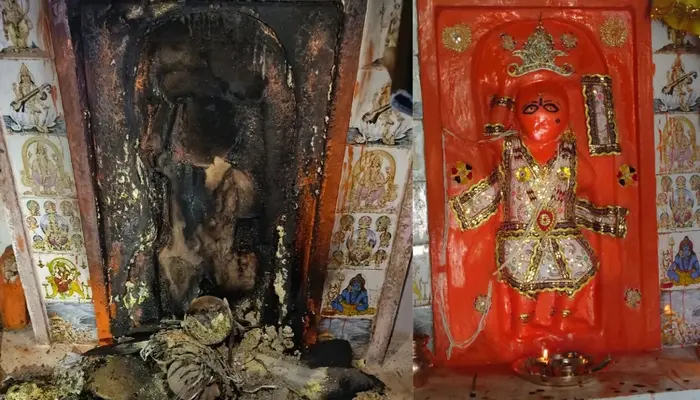
Case Summary
In Dhorota village, in the Porsa area of Morena district, Madhya Pradesh, a 200-year-old Hindu temple, the Pilua Wale Hanuman Temple, was desecrated when the sacred idol of Lord Hanuman was smashed and set on fire. The idol, installed in the temple’s sanctum sanctorum, was severely damaged and scorched, while the fire blackened the inner shrine's walls and damaged the items used for worship. On the afternoon of 23 October 2026, the idol was deliberately smashed, and electrical wires and other items used for worship were placed in front of the damaged statue and set alight. The incident came to light that evening when villagers visited the temple to light lamps and offer prayers. Upon entering the sanctum sanctorum, they found the broken idol and evidence of burning around it. The extent of the damage angered and distressed the residents. As news of the incident spread, hundreds of villagers gathered at the temple premises. They subsequently assembled and went to Porsa police station, where more than 200 villagers surrounded the police station and demanded action against the person responsible for damaging the idol and setting the fire. Their protest centred on seeking appropriate police action in response to the destruction at the temple. Following questioning, the police apprehended a 45-year-old resident of Dhorota village in connection with the incident. The police stated that he had broken the idol during the afternoon and then placed electrical wires and other worship materials in front of the damaged statue before setting them on fire. The individual was identified as Omprakash Sharma, who was claimed to be mentally ill. Village elder Ramroop stated that the Pilua Wale Hanuman Temple was more than 200 years old and served as an important religious centre for Dhorota and seven surrounding villages. Worshippers from these villages visited the temple to offer prayers and perform religious rituals. The damage to the idol and the fire inside the sanctum sanctorum affected a place of longstanding religious significance to the local Hindu community. Jaideep Bhadoria, the station in-charge of Porsa police station, said the police were taking action against the accused. Police continued their investigation after his apprehension.
Why it is Hate Crime ?
The primary category selected in this case is: Attack on Hindu religious representations. The subcategory selected is: Desecration of Hindu religious symbol. Icons and symbols or a religious representation of a spiritual ideal are widely revered in Hinduism. Iconography is of vital significance in the Hindu milieu. It helps connect people’s spiritual beliefs with the real world. Iconography within the Hindu faith takes several shapes and forms. Murtis are of most significance to Hindus, to which daily rituals, prayers and offerings are done. Besides the murtis, there are several other symbols which have deep significance in the Hindu faith – the Om and Swastika for example. Since these Hindu religious symbols hold paramount importance in Hinduism, any desecration of symbols, icons, murtis, religious representations and manifestations, is driven by animosity towards the faith itself which manifests itself through these murtis, icons and symbols. Therefore, any desecration of these Hindu religious symbols and representations is considered religiously motivated hate crimes under this category. The other subcategory selected is: Attack on Temples. In Hinduism, a temple is the abode of the Deity. The Deity in the Temple is consecrated, thereby, making it a real, breathing entity. Hindus believe that not just the Deity but the temple premises itself are sacred to Hindus since Hindus hold the faith that the entire Temple space is an amalgamation of the divine energy of the deity. Given the central significance of Temples in Hindu Dharma, any attack against a Hindu Temple or its peripheral premises is an attack on the faith itself and is born out of animosity towards the faith, of which, the Temple is a central tenet. Any manner of attack against a Temple and/or its premises would therefore be considered a religiously motivated hate crime. This incident was a clear example of a religiously motivated hate crime, as a more than 200-year-old Hindu temple was vandalised, the sacred idol of Lord Hanuman was smashed and burned, and items used for worship were set alight. A Hindu temple is a deeply revered place of worship where devotees believe the divine presence resides. It is not merely a physical structure but a sacred space dedicated to prayer, ritual, and communion with the divine. In Hindu tradition, consecrated idols (murtis) are sacred embodiments of the deity’s presence, serving as the focal point of worship and devotion rather than ordinary objects. Lord Hanuman is one of Hinduism’s most venerated deities, worshipped as the embodiment of devotion, strength, courage, loyalty, and divine protection. The deliberate desecration of his idol at the more than 200-year-old Pilua Wale Hanuman Temple, including the smashing of the idol and setting it on fire, was therefore not simply an act of property damage but an attack on a sacred religious symbol held in profound reverence by millions of Hindus. Such an act violates the sanctity of a consecrated place of worship, deeply wounds the religious sentiments of devotees, and damages a sacred symbol through which the Hindu faith is expressed. Moreover, the act was carried out despite the understanding that temples are sacred spaces and centres of worship for Hindus and that such attacks not only cause physical destruction but also deeply wound the spiritual and cultural fabric of the Hindu community, as temples symbolise their faith and collective identity. The deliberate targeting of these revered spaces underscores the profound animosity the accused harboured towards the Hindu faith, which is why this case has been categorised as a religiously motivated hate crime.


Case Status
Arrested


Perpetrators Details
Perpetrators
Others
Perpetrators Range
One Person
Perpetrators Gender
male
 Sources



