Hindu organisation targeted with fake news falsely accusing it of killing Muslims and inciting communal violence in Noida
 India
 23 October, 2026
Case Summary
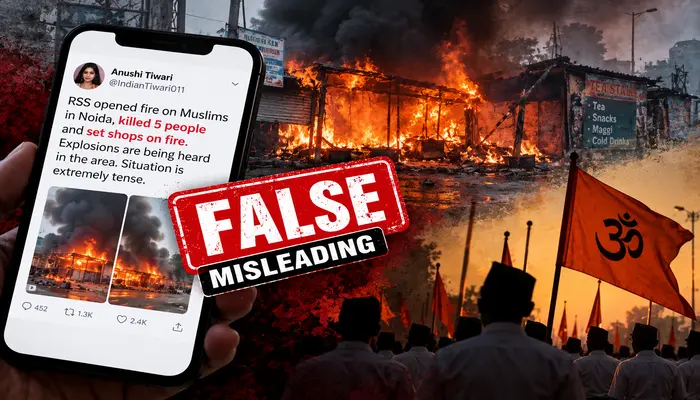
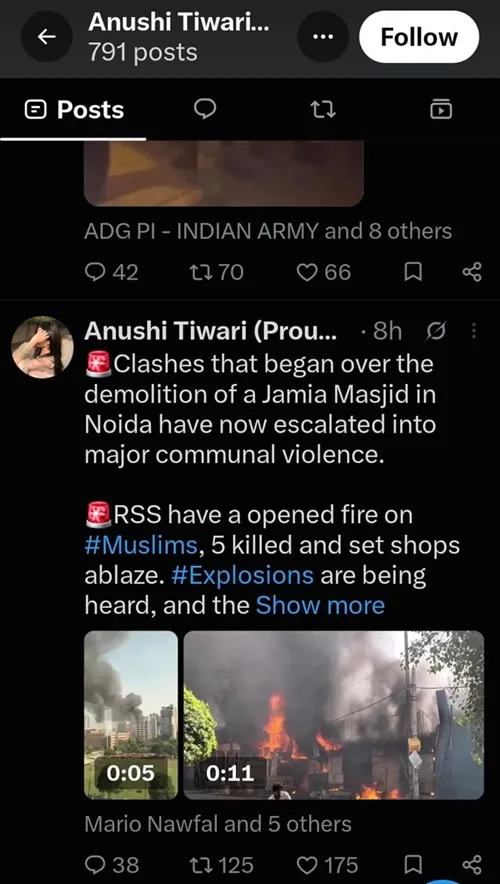
The Rashtriya Swayamsevak Sangh (RSS), a Hindu organisation, was targeted through a misleading social media post that falsely accused it of perpetrating communal violence against Muslims in Noida following a fire at tea and snack shops. A social media user, Anushi Tiwari, operating under the ID Indian Tiwari011, shared two videos showing a fire at shops in the Sector 125 area of Noida, Uttar Pradesh. She falsely attempted to link the incident to claiming it to be communal violence following the demolition of a Jama Masjid in Noida. The post stated that the RSS had opened fire on Muslims, killed five people and set shops on fire. It further claimed that explosions were being heard in the area and that the situation was extremely tense. The videos showed a fire at tea and snack shops within the jurisdiction of Sector 126 police station. Noida Police took cognisance of the post and clarified that reports of vandalism and clashes in connection with the fire were completely false. The police stated that the social media account had spread misleading information capable of disturbing communal harmony and registered a case against the person responsible at Sector 126 police station. As of the date of writing this report, the account has been withheld in response to legal demands.
Case Images
Why it is Hate Crime ?
This case has been added to the tracker under the primary category of - Hate speech against Hindus. Within it, the sub-category selected here is - Anti Hindu subversion and prejudice, with the tertiary category being - Anti-Hindu fake news. Hate speech is defined as any speech, gesture, conduct, writing, or display that is prejudicial against a specific individual and/or group of people, which is leading to or may lead to violence, prejudicial action or hate against that individual and/or group. Media plays a specific and overarching reach in perpetuating prejudicial attitudes towards a community owing to unfair, untrue coverage and/or misrepresentation/misinterpretation, selective coverage and/or omission of facts of/pertaining to issues affecting a specific religious group. This type of bias can dehumanise the victim group, making it easier for others to justify harmful actions against them, which aligns with the objectives of hate speech laws aimed at preventing such harm. It is often observed that the media takes a prejudicial stand against the Hindu community driven by their need to shield the aggressor community which happens to be a numeric minority, however, is the one perpetrating violence against Hindus. For example, the media is often quick to contextualise religiously motivated crimes against Hindus, omit or misrepresent facts that point towards religiously motivated hate crimes, justify and/or downplay religiously motivated hate crimes or simply present fake news to stereotype Hindus. Such media bias leads to the denial of persecution and is often used to dehumanise Hindus, leading to justification for violence against them. For example, the media covered several fake allegations of Hindus targeting Muslims and forcing them to chant Jai Shree Ram. Most of these cases were proved false and fabricated after police investigation. These fake news reports were subsequently never retracted or clarified. Such fake news led to the justification of violence and dehumanisation of Hindus based on the argument that since Hindus targeted Muslims and forced them to chant Jai Shree Ram, the dehumanisation of Hindus and violence against them was par for the course and merely a retaliation. Such media bias leads to prejudicial portrayal of Hindus and offers a justification for violence against them and therefore, is considered hate speech under this category. This case has been added to the tracker because the Rashtriya Swayamsevak Sangh (RSS), a Hindu organisation, was deliberately targeted with anti-Hindu fake news that falsely portrayed it as perpetrating communal violence against Muslims. The Rashtriya Swayamsevak Sangh (RSS) was specifically named in a social media post that attributed killings and arson to the organisation and presented an ordinary fire incident as evidence of communal violence. This went beyond the circulation of inaccurate information about a fire. By claiming it perpetrated communal violence against a religious community, the post created a false narrative of Hindu-perpetrated violence against Muslims. Such framing risked portraying the Hindu organisation and its associated cause as a threat to Muslims, while encouraging communal suspicion and hostility towards its members and supporters. The RSS is a Hindu organisation founded in 1925 that works towards Hindu unity, cultural preservation and the advancement of Hindu interests. It has played a prominent role in organising Hindu society and promoting Hindu cultural and national identity. Given its explicit association with Hindu identity and its work for the Hindu cause, falsely attributing communal killings and violence to the organisation carried a religious dimension. The post did not merely name an unrelated individual or make a generic accusation of criminal conduct; it implicated a prominent Hindu organisation in supposed violence against Muslims, placing the organisation within a fabricated communal conflict. This association was significant because it could influence how audiences perceived the organisation and the wider Hindu community with which it was identified. The false narrative also had the potential to aggravate religious divisions by presenting the incident as an instance of Muslims being attacked by a Hindu organisation. By invoking a supposed confrontation over a mosque and alleging that Muslims had been killed, the post placed the fire within a specifically religious framework rather than reporting it as a local incident. This framing risked provoking anger, fear and resentment along religious lines, while encouraging viewers to interpret an unrelated fire through the lens of Hindu-Muslim conflict. The targeting of the RSS was therefore connected to its Hindu identity and its perceived role in representing Hindu interests, rather than being limited to criticism of its general activities. Such fabricated narratives can also incite hostility and provoke violence against the RSS, its members and supporters, as well as the wider Hindu community, by portraying them as perpetrators of religious violence. By spreading false accounts of communal attacks, such misinformation can fuel resentment, deepen religious divisions and expose Hindus to hostility or retaliatory violence. Targeting a Hindu organisation with fabricated news can damage its reputation, incite hostility towards its members and supporters, and expose the wider Hindu community to threats or retaliatory violence. Such misinformation can also deepen social divisions and create an atmosphere of suspicion towards those associated with the Hindu cause.


Case Status
Complaint filed


Perpetrators Details
Perpetrators
Others
Perpetrators Range
One Person
Perpetrators Gender
female
 Sources



