Hindu temple land encroached, boundary wall demolished and temple committee members threatened amid dispute with Muslim man in Noakhali, Bangladesh
 Noakhali District, Bangladesh
 21 October, 2026
Case Summary
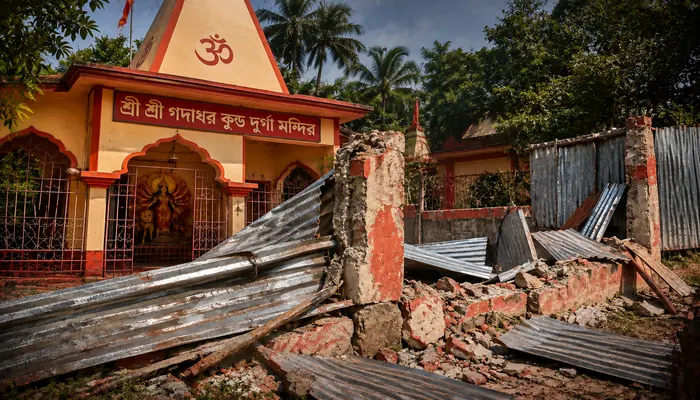
On 22 October 2026, the boundary wall of the Sri Sri Gadadhar Kund Durga Temple in the Sonaimuri municipal area of Noakhali district, Bangladesh, was vandalised due to the ongoing temple dispute with a Muslim man named Rawnak Hasan Rizvi. According to temple committee president Dipankar Chakraborty, a group of miscreants arrived at the temple and demolished its boundary wall, which was made of tin sheets and cement pillars. The incident took place amid a longstanding dispute over the temple's boundaries with Rawnak Hasan Rizvi, headmaster of Sonaimuri Model Government Primary School. Chakraborty stated that the school authorities had encroached upon the temple land and constructed rooms and toilets on temple land. Hridoy Haran Vaishnav, the temple committee's joint general secretary, also stated that the school authorities had encroached on temple land and were conspiring against the temple. He further reported that committee members had been receiving regular threats, leaving them fearful for their lives and safety. The vandalism caused panic and insecurity among the local Hindu community. Following the incident, personnel from Sonaimuri Police Station visited the site, and Officer-in-Charge Kabir Hossain stated that efforts were underway to identify and arrest those responsible. Nasrin Akhter, Sonaimuri Upazila Executive Officer and municipal administrator, stated that legal action would be taken following an investigation. Rizvi could not be reached for comment.
Why it is Hate Crime ?
The primary category for this case is: Attack on Hindu religious representations. The subcategory for this case is: Encroachment or illicit takeover of temple land/land near temple. In Hinduism, a temple is the abode of the Deity. The Deity in the Temple is consecrated, thereby making it a real, breathing entity. Hindus believe that not just the Deity but the temple premises itself are sacred to Hindus since Hindus hold the faith that the entire Temple space is an amalgamation of the divine energy of the deity. Not only the Temple but the Temple premises in their entirety are considered sacred by Hindus. In several cases, the premises of the Temple and/or religious centre are illicitly taken over by institutions belonging to other faiths – like the Waqf board or the Church. Other times, the temple property, land or the property of religious centres are illicitly encroached upon by non-Hindu groups. Any illicit takeover or encroachment is a crime ab initio; however, when non-Hindu groups illicitly take over or encroach upon the sacred land of Hindus, it is an affront to the Hindu community and is therefore classified as a religiously motivated hate crime under this category. The other sub-category selected here is - Attack on temples. In Hinduism, a temple is the abode of the Deity. The Deity in the Temple is consecrated, thereby, making it a real, breathing entity. Hindus believe that not just the Deity but the temple premises itself are sacred to Hindus since Hindus hold the faith that the entire Temple space is an amalgamation of the divine energy of the deity. Given the central significance of Temples in Hindu Dharma, any attack against a Hindu Temple or its peripheral premises is an attack on the faith itself and is born out of animosity towards the faith, of which, the Temple is a central tenet. Any manner of attack against a Temple and/or its premises would therefore be considered a religiously motivated hate crime. This case was significant because the vandalism targeted the boundary of a Hindu place of worship and interfered with the physical space through which the local Hindu community maintained and protected its religious institution. The Sri Sri Gadadhar Kund Durga Temple was not merely a parcel of disputed land. It was a sacred space dedicated to the worship of Goddess Durga, and its premises formed part of the religious environment in which devotees practised their faith. The destruction of the temple's boundary therefore had implications beyond physical property damage, as it affected the community's ability to safeguard a place of Hindu worship and preserve its religious character. In Hindu Dharma, a temple is a sacred space associated with the presence of the deity, where devotees offer prayers, perform rituals and participate in religious observances. The sanctity of a temple is not confined to its principal structure or inner shrine. Its surrounding premises and boundaries also serve to protect the place of worship, distinguish its grounds from neighbouring properties and preserve the space required for religious activities. The deliberate destruction of a temple boundary consequently interferes with the physical protection of a sacred Hindu institution. In this case, the demolition of the boundary wall compromised the temple's ability to maintain a clearly defined and protected religious space, making the incident significant from the perspective of the security of Hindu religious representations. The dispute over the temple land highlighted the vulnerability of the Hindu religious institution. Temple committee representatives stated that Rawnak Hasan Rizvi, the Muslim headmaster of Sonaimuri Model Government Primary School, had been involved in a longstanding dispute over the temple's boundaries. The encroachment threatened the Hindu community's control over property attached to its place of worship. Temple land was integral to preserving the sanctity, integrity and continued functioning of the religious institution. Encroachment upon such land undermined the community's ability to protect its sacred premises and maintain them for religious purposes. The demolition of the temple's boundary wall further compromised the security of the Hindu religious site. Rather than resolving the dispute through lawful means, the perpetrators physically damaged a boundary protecting the temple premises. Any genuine disagreement over land ownership or boundaries could have been addressed through the appropriate legal and administrative channels. Destroying the boundary wall instead interfered with the temple's physical integrity and left its premises more vulnerable to further encroachment. The dispute over temple land did not justify vandalising a Hindu place of worship or undermining the community's ability to safeguard its religious property. The threats against temple committee members further intensified concerns about the security of the Hindu community. These threats targeted individuals responsible for protecting and managing the temple, placing additional pressure on the community as it sought to safeguard its religious property. The combination of encroachment on Hindu temple land, the demolition of the boundary wall and threats against committee members raised serious concerns about the Hindu community's ability to protect its place of worship without intimidation. Taken together, the encroachment on Hindu temple land, the demolition of the boundary wall of the Sri Sri Gadadhar Kund Durga Temple, and the threats against temple committee members constituted interference with a Hindu religious institution and undermined the local Hindu community's ability to protect its sacred place of worship. The destruction of the boundary compromised the security of the temple premises, while the intimidation of committee members intensified fear and insecurity among local Hindus.


Case Status
Complaint filed


Perpetrators Details
Perpetrators
Muslim Extremists
Perpetrators Range
One Person
Perpetrators Gender
male
 Sources



