Hindu temple targeted; Muslim man throws brick at idol of Lord Hanuman and hurls abuses against Hinduism
 Ludhiana, Punjab, India
 20 October, 2026
Case Summary
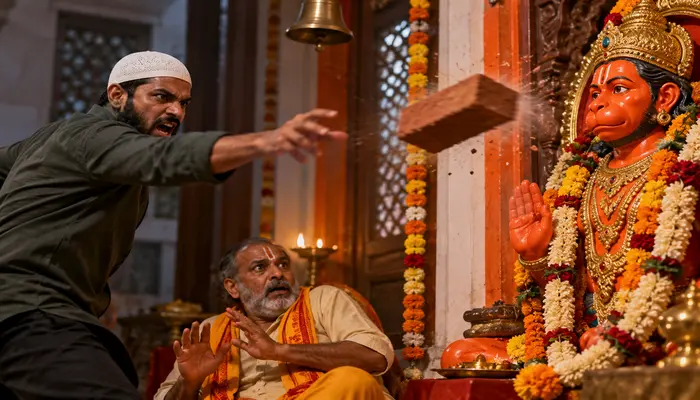
In Ludhiana, Punjab, Shri Sankat Mochan Hanuman Temple was targeted when a Muslim man named Mohammad Yahya Khan threw a brick at the sacred idol of Lord Hanuman and hurled abuses against the Hindu faith According to the temple priest, Shashikant, the incident occurred on 21 October 2026 after he had performed the evening aarti and was reciting religious scriptures while seated in front of the idol of Lord Hanuman. During this time, the accused entered the temple premises holding half a brick and threw it towards the idol of Hanuman ji. The brick narrowly missed the idol and landed in front of the priest. Khan then hurled abuses against Hinduism and fled the scene. Shashikant informed the police and identified Khan to the authorities. Based on the priest's complaint, police at Division No. 2 Police Station registered an FIR against Khan under Sections 298 and 299 of the Indian Penal Code for offences relating to religious sentiments. The police subsequently arrested him. ACP Anil Bhanot stated that Khan had previously been arrested for breaking the windscreen of a parked vehicle by throwing a brick and had been released on bail shortly before the temple incident.
Why it is Hate Crime ?
This case has been added to the tracker under the primary category of - Attack on Hindu religious representation. Within it, the sub-category selected is - Desecration of Hindu religious symbol. Icons and symbols or a religious representation of a spiritual ideal are widely revered in Hinduism. Iconography is of vital significance in the Hindu milieu. It helps connect people’s spiritual beliefs with the real world. Iconography within the Hindu faith takes several shapes and forms. Murtis are of most significance to Hindus, to which daily rituals, prayers and offerings are done. Besides the murtis, there are several other symbols which have deep significance in the Hindu faith – the Om and Swastika for example. Since these Hindu religious symbols hold paramount importance in Hinduism, any desecration of symbols, icons, murtis, religious representations and manifestations, is driven by animosity towards the faith itself which manifests itself through these murtis, icons and symbols. Therefore, any desecration of these Hindu religious symbols and representations is considered religiously motivated hate crimes under this category. The other sub-category selected here is - Attack on temples. In Hinduism, a temple is the abode of the Deity. The Deity in the Temple is consecrated, thereby, making it a real, breathing entity. Hindus believe that not just the Deity but the temple premises itself are sacred to Hindus since Hindus hold the faith that the entire Temple space is an amalgamation of the divine energy of the deity. Given the central significance of Temples in Hindu Dharma, any attack against a Hindu Temple or its peripheral premises is an attack on the faith itself and is born out of animosity towards the faith, of which, the Temple is a central tenet. Any manner of attack against a Temple and/or its premises would therefore be considered a religiously motivated hate crime. The second primary category selected here - Hate speech against Hindus. Within it, the sub-category selected here is - Anti-Hindu slurs, mocking faith. Anti-Hindu slurs and the deliberate mocking of the Hindu faith owing to religious animosity involve the usage of derogatory terms, stereotypes, or offensive references to religious practices, symbols, or figures. One of the common anti-Hindu slurs used against Hindus is “cow-worshipper” and “cow piss drinker”. The intention of using this term is to demean and mock Hindus as a group and their religious beliefs since Hindus consider the cow holy. Additionally, some symbols and the slurs attached to them have a historical context that exacerbates the insult, hate, stereotyping, dehumanisation and oppression against Hindus. Cow worship has been used for centuries to denigrate Hindus, insult their faith and oppress Hindus specifically as a religious group. There has been overwhelming documentation about how cow slaughter has been used to persecute Hindus with cow meat being thrown in temples and places of worship. There has also been overwhelming documentation where cow meat (beef) has been force-fed to Hindus to either forcefully convert them to Islam or denigrate their faith. Apart from cow worship, the Swastika – which holds deep religious significance for the Hindus – has also been misinterpreted and distorted to use as a slur against Hindus. Similarly, the worship of the Shivling has been used by supremacist ideologies and religions to denigrate Hindus owing to religious animosity. Such slurs and denigration stem out of inherent animosity and hate towards Hindus and their faith, therefore, it is categorised as hate speech targeted at Hindus specifically owing to their religious identity. The incident constituted a hate crime because the accused's actions specifically targeted a sacred object of Hindu worship and were accompanied by verbal abuse directed against Hinduism. The hate crime aspect stemmed from the deliberate targeting of a Hindu religious symbol and the accompanying expression of hostility towards Hinduism. Lord Hanuman is a revered Hindu deity, and an attempt to damage his idol in a temple went beyond ordinary vandalism because the object targeted held specific religious significance for Hindu devotees. In Hindu traditions, consecrated murtis (sacred images or representations of deities) serve as focal points for worship, prayer and ritual offerings, enabling devotees to express their reverence and devotion. Such images are not treated merely as decorative objects; their religious significance derives from the traditions, rituals and devotional practices associated with them. Attempting to attack or damage a sacred idol therefore carried significance beyond the physical impairment of the object, as it affected an item associated with religious observance and the spiritual lives of worshippers. Thus, throwing a brick at the idol, with the intention of damaging or desecrating it, therefore represented an attack on a sacred symbol of Hindu faith. The religious significance of the target distinguished the incident from ordinary property damage or indiscriminate vandalism. The accused's verbal abuse against Hinduism further established the religious dimension of the offence. The remarks were directed against the Hindu religion itself, rather than being confined to a personal disagreement with the priest or another individual. Although the accused's remarks were not made publicly, the combination of an act directed at a Hindu deity's idol and derogatory language against Hinduism demonstrated hostility towards Hindu religious beliefs and their expression. These circumstances provided a specific connection between the accused's conduct and the religious identity represented by the temple and its sacred object. The incident also targeted the sanctity of a Hindu place of worship. Temples serve as spaces where devotees express their faith, perform rituals and maintain their connection with their deities. An act intended to desecrate a deity's idol within such a space undermines the religious security of the community that worships there. The brick landing in front of the priest, who was engaged in religious observance, further placed the act within the immediate context of Hindu worship. Such conduct had implications beyond the physical object itself, as it threatened the ability of worshippers to practise their faith in an environment free from deliberate religious hostility. Taken together, the attempt to damage a sacred Hindu idol and the accompanying verbal abuse against Hinduism established a clear religious dimension to the incident. The accused's actions reflected hostility towards Hindu religious beliefs and their sacred symbols, making the incident more than an act of ordinary vandalism. The targeting of Hindu religious expression supported its classification as a hate crime that undermined the community's right to practise its faith without deliberate desecration or religious hostility.


Case Status
Arrested


Perpetrators Details
Perpetrators
Muslim Extremists
Perpetrators Range
One Person
Perpetrators Gender
male
 Sources



