Hindu sentiments outraged as Muslim woman chants “Allahu Akbar” during Navratri garba event in Gujarat
 Gujarat, India
 21 October, 2026
Case Summary
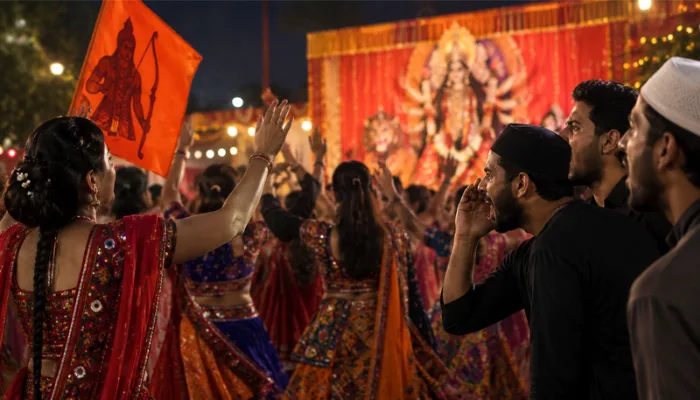
In Gujarat, a Navratri Garba event was disrupted when a Muslim woman identified as Sara Pathan chanted “Allahu Akbar” during a bhajan programme. In a viral video, Sara was seen looking into her phone’s camera and chanting the Islamic slogan in response to a bhajan featuring the line, “Mere Bharat ka bachcha bachcha Jai Jai Shri Ram bolega” (Every child of my Bharat will chant Jai Jai Shri Ram). As the bhajan played, Sara responded with “Allah Hu Akbar bolega,” replacing the original refrain invoking Bhagwan Shri Ram with an Islamic slogan. When the performers encouraged the audience to chant “Jai Shri Ram,” she again responded by chanting “Allahu Akbar” instead. The incident took place during Navratri, a Hindu festival dedicated to the worship of the Goddess, at an event centred on Garba and Hindu devotional music. Sara’s repeated chanting of an Islamic slogan in direct response to the bhajan and the performers’ calls to chant “Jai Shri Ram” disrupted the devotional atmosphere and turned a celebration of Hindu faith into a scene of religious provocation. This was not an isolated incident. The Hinduphobia Tracker has documented 24 incidents in which Muslims have defiled the sacred Garba event, including six incidents recorded during this year’s Garba celebrations alone. The recurrence of such incidents raises serious concerns about the targeting and disruption of Hindu religious celebrations.
Why it is Hate Crime ?
The primary category selected for this case is: "Attack on Hindu religious representation." The subcategory selected is: Abrahamic religious chanting outside Hindu religious places and/or during Hindu activities. In Hinduism, a temple is the abode of the Deity. The Deity in the Temple is consecrated, thereby making it a real, breathing entity. Hindus believe that not only the Deity but also the temple premises are sacred, since they hold that the entire Temple space is an amalgamation of the deity's divine energy. Similarly, religious activities hold deep significance for Hindus, as they are intricately connected to their spiritual, cultural, and social lives. These practices encompass rituals, festivals, prayers, and pilgrimages that celebrate and honour various deities, fostering a sense of spiritual connection, community, and cultural continuity. Given the central significance of Temples and religious activities in Hindu Dharma, any aggressive Abrahamic chanting outside Temples or during religious activities negates the divinity of the religious space because the chanting itself negates the existence of any God other than the God of the Abrahamic faith. Such chanting is specifically done to negate the faith of Hindus, establish religious supremacy, intimidate the devotees and mock the faith. Besides temples, such Abrahamic chanting outside any Hindu place of worship or religious structure or during any religious activity, has the same effect. Since such acts are rooted in an inherent religious supremacist mentality driven by religious animosity, such crimes would be considered religiously motivated hate crimes under this category. The other subcategory selected is: Defiling religious customs. Sanatan Dharma is not a religion of one book, which is to say that while it has religious scriptures that form the central tenets of the faith, there are several traditions followed through thousands of years, mostly passed from generation to generation orally. There are several such customs and traditions that are followed by various Hindus and Hindu sects. Defiling these traditions and customs is a breach of an individual or group’s religious practices. Such practices can range from dietary restrictions like not eating non-vegetarian food for a certain period of the year, not eating non-vegetarian food at all, not eating beef since the cow is considered holy in Hinduism, the sanctity of religious customs followed in the house (like many ISCKON devotees), etc. Any malicious action leading to the breach of such traditions or defilement of these traditions owing to animosity towards the faith or for the sake of activism stems not only from the lack of faith in the religion itself but also from disregard for the faith of the devotees who follow the customs/traditions and implicit bias against the faith and the tradition itself. Since these specific traditions are central to the faith of the devotees of that specific sect of Hindus, any non-compliance with these traditional rules would be considered a religiously motivated hate crime. The incident constitutes an attack on Hindu religious representation because Hindu devotional expression was mocked through the deliberate use of a contrasting religious slogan during a Hindu religious celebration. Bhagwan Shri Ram, revered as the seventh avatar of Bhagwan Vishnu and an embodiment of righteousness and dharma, holds a central place in Hindu Dharma. Chanting “Jai Shri Ram” expresses devotion to Bhagwan Shri Ram and is an important expression of Hindu religious identity. Mockingly countering this invocation disrespects the faith and devotion it represents. Navratri is a major Hindu festival dedicated to the worship of the Divine Goddess, while Garba is a significant religious event which is performed to venerate Goddess Durga. Bhajans and collective chanting during these celebrations are not merely entertainment; they are integral expressions of Hindu worship and religious customs. Deliberately turning devotional singing into an occasion for mockery disrupts the sanctity of the celebration and disregards the religious sentiments of Hindu devotees. “Allahu Akbar” expresses Islamic faith. The phrase itself is not inherently offensive. Its significance in this incident arises from its mocking use in response to a Hindu bhajan and the artists’ calls for the audience to chant “Jai Shri Ram”. Rather than being an independent expression of Islamic devotion, its use in this context served as a counter-slogan to Hindu devotional expression, turning a religious celebration into an occasion for provocation. Because the act deliberately mocks devotional practices central to the celebration and shows disregard for the customs through which Hindus express their faith, this incident warrants inclusion in the tracker. Disclaimer: The available sources do not specify the exact date the incident occurred. The tracker records incident dates based on when the crime occurred, not when it was reported or published. In this case, we used 22 October 2026 as the indicative incident date for documentation purposes only.


Case Status
Unknown


Perpetrators Details
Perpetrators
Muslim Extremists
Perpetrators Range
One Person
Perpetrators Gender
female
 Sources



