Hindu woman brainwashed into adopting Islamic practices and pressured for conversion by Muslim man; attempts suicide due to threats and blackmail
 Thanjavur, Tamil Nadu, India
 16 October, 2022
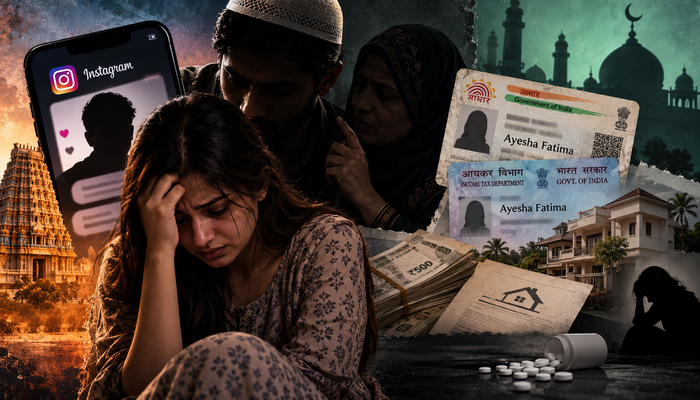
Case Summary
In Mannargudi in Thanjavur district, Tamil Nadu, a 23-year-old Hindu woman was lured into a relationship and pressured for conversion by a Muslim man named K.A. Shahid Mufazal Ali. She was brainwashed into adopting Islamic religious practices; her Hindu beliefs were disrespected, and she was encouraged to pray and learn Quranic verses. They also tried to change her name to Ayesha Fatima. She was threatened, blackmailed and harassed to a point that she attempted suicide. The victim narrated her ordeal at a press conference held by Sri Sri Chendalankara Shenbaga Mannar Jeeyar, popularly known as Mannargudi Jeeyar, on 17 October 2026, where she said that she met the accused, Shahid, on Instagram and their friendship gradually developed into a romantic relationship over four years. When she expressed concern that her Hindu background could lead her family to oppose the relationship, Shahid assured her that he would marry her with her family's consent When her mother discovered the relationship, she reportedly beat her. The victim said she subsequently confided in Shahid's mother, Rasheeda Banu, who advised her to secretly take money and jewellery from her home and move to Shahid's family's residence. However, the Hindu woman refused to run away and insisted that Shahid's family approach her mother directly. The victim's mother later met the accused's family, and Shahid reportedly drove her to his house in Pallapatti, Aravakurichi taluk, Karur district. The house was a large, bungalow-like residence. When the victim's mother questioned the Shahid family's apparent wealth, Rasheeda Banu assured her that they were very well off and that she should not worry about arranging the documents or the marriage. Rasheeda Banu also said her elder son, who lived in Mumbai, had four Aadhaar cards: two with Hindu names and two with Muslim names. She also promised to arrange fake Aadhaar and PAN cards in the name of “Ayesha Fatima” and solemnise the victim's marriage to Shahid through their Jamaath. Once they gained the victim's trust, Shahid and his mother, K.A. Rasheeda Banu, encouraged her to adopt Islamic religious practices, told her that Allah was the only true God, and instructed her to pray five times a day and learn Quranic verses. The victim was taught Islamic recitations to recite while bathing and drinking water. While recalling all this, the victim said she began following these practices and felt that she was being made to forget her Hindu identity. The victim further stated that Shahid’s family encouraged her mother to sell their property in Mannargudi and buy land near their residence in Pallapatti, Karur district, where they could build a house and rent it out. They proposed buying a plot of about 1,500 square feet near their residence in the victim's name, building a house, and renting it out. According to her, this was a deliberate attempt aimed at establishing her as someone belonging to Pallapatti and facilitating her relocation there under the proposed Muslim identity. The Hindu woman also stated that Shahid’s family obtained ₹7 lakh from her mother under the pretext of a business arrangement that never materialised, along with another payment of ₹60,000 connected with a vehicle. When she and her family sought to recover the money, they locked her inside and denied ever receiving it. They threatened to create and circulate vulgar or compromising videos depicting her bathing or sleeping, or to portray her falsely as having had sexual relations with Shahid. They also threatened to approach her mother’s workplace to jeopardise her job and warned her of retaliation if she contacted the police or the media. Invoking her alleged connections and influence, Rasheeda Banu told the victim that neither the local police nor reporters would help her, and cited the influence of a politician named Shahul Hameed. The victim clarified that she did not know who Shahul Hameed was and understood the reference to his name as part of the threat being made against her. She also stated that she had retained audio recordings of some of these conversations. The victim stated that the religious coercion, financial dispute, threats and fear of public humiliation severely affected her mental health. She said she was afraid that reporting the matter would prompt Shahid's family to circulate the material they had threatened to create or distribute. She initially did not disclose the full extent of the threats to her mother because of this fear. She eventually told her mother that she needed psychological help. Her family took her to a doctor, Dr Venkatesan, in Thanjavur, where she was prescribed sleeping tablets. She subsequently attempted suicide by consuming 60 sleeping tablets and was admitted to Mannargudi Government Hospital, where she spent five days in the intensive care unit. She stated that the police had primarily treated the matter as a financial dispute and had not adequately investigated the threats, religious coercion and identity-related circumstances. She specifically maintained that her suicide attempt was not simply about recovering the money, but resulted from the threats, pressure to change her religion and identity, fear of public humiliation, and concern that her mother's reputation and livelihood would be damaged. She also referred to audio recordings that she said documented conversations about changing her name, arranging identity documents, property transactions and threats against her and her mother, and expressed her willingness to submit them for investigation. The victim also spoke about other women whom she believed Shahid and people associated with him had approached through social media. She stated that Shahid had previously approached other Hindu women and that some Instagram accounts initially used Hindu names before being renamed with Muslim names. She referred to an earlier incident involving another woman whose name and mother's name she said she knew, as well as an incident in which a woman's photographs were posted on Instagram. The victim additionally stated that Shahid was using and selling ganja. She also said she had seen WhatsApp conversations on his phone, which she later understood differently. During the press conference, Mannargudi Jeeyar described the matter as “love jihad” and called for a wider investigation into the circumstances surrounding the case.
Why it is Hate Crime ?
This case has been added to the tracker under the primary category of - Crimes against women in relationships and other sexual crimes. Within it, the sub-category selected is - Forced conversion before marriage. In such cases, a non-Hindu man is in a relationship with a Hindu woman when the pressure to convert her religion begins to manifest. In such cases, typically, two patterns emerge. First, when the relationship is consensual, and the religious identity of the perpetrator is known to the Hindu woman in the relationship, however, at some point during the relationship, the non-Hindu man starts to force the victim to convert her religion and give up her Hindu religious identity. The second is when the woman gets into a marriage with the man pretending to share her faith. Later, when the truth is revealed, the man starts pressuring the woman to convert her religion and give up her religious identity. In both the situations, the methods used to force the victim to convert her religion often revolve around force-feeding beef, forcing her to wear hijab, forcing her to read the Kalma or even pressurizing the victim to do ‘Nikah’, which is marriage under Islamic law, with a prerequisite being conversion to Islam. Cases where a Hindu woman consensually converts to Islam in a relationship will be left out of the hate crime database, even though it could be argued in several cases that the conversion was a result of religious brainwashing. The other subcategory selected here is: Brainwashed and/or groomed, with the tertiary category being - Victim says she was brainwashed/groomed and Pattern of targeting Hindus. In our database, we have not added incidents where women have converted to another religion of their free will and no allegations of forced/involuntary conversion have been made. However, there are certain cases of conversion where the consent itself is a result of the brainwashing or grooming of a minor by the non-Hindu perpetrator trying to victimise a woman for her Hindu religious identity. The phenomenon of grooming points to non-Hindu perpetrators identifying their Hindu victims’ vulnerabilities and exploiting them over months and sometimes years, to extract the supposed ‘consent’ in order to convert their religion. In most cases of grooming, the victims are minors or the grooming started when the victim was a minor. In other cases of grooming, the non-Hindu perpetrator brainwashes and grooms a minor victim to extract their trust and then proceeds to rape them repeatedly with the intent of converting them to their faith. It is pertinent to understand here that when the victim is a minor, the ‘consent’ to convert or enter into a romantic relationship with an adult itself is redundant – addressed by POCSO. While every case of conversion of a minor and incidents of establishing a physical relationship with a minor by an adult is a crime, for the purpose of this database, a case would be considered a hate crime only if there is a distinct religious angle to the grooming. For example, in the UK, if a Hindu minor is targeted by Pakistani grooming gangs, it would be considered a hate crime because the victims are specifically targeted owing to their non-Muslim religious identity with the perpetrators being Muslim. In other cases, if a Hindu minor is brainwashed into entering a physical relationship with the non-Hindu adult perpetrator and the family alleges grooming/brainwashing of the minor to convert her religion, it would form a part of this database. If the victim is a Hindu adult, the case would form a part of this database only if the victim herself says that she was brainwashed/groomed to convert her religion. However, if the victim is deceased (murdered or otherwise), the case would form a part of this database if her family/friends provided testimony that the victim was brainwashed/groomed to convert her religion. Since these crimes have a distinct religious angle where the victim is being targeted owing to her Hindu religious identity, these cases are considered a hate crime. The other sub-category selected here is - Assault or threat upon refusal to convert. When Hindu women are in a relationship with non-Hindu men, there are cases where the woman faces threats or assault after she refuses to convert and change her religious identity owing to pressure/force by the non-Hindu man. Such relationships may be consensual with the religious identity of the non-Hindu man known to the victim. Somewhere along the relationship, the non-Hindu man starts pressurizing the Hindu woman to convert to Islam and upon her refusal, assaults or threatens the victim. Such cases are driven by specific religious motivations and against the religious identity of the victim and are therefore qualified as hate crimes. Cases where the Hindu woman converts to Islam and does not file a complaint about the force or threat, are not considered a part of the hate tracker, even though, it may be argued that the woman was brainwashed or threatened to convert to Islam. The case qualifies as a hate crime because the victim’s Hindu religious identity was central to the coercion she faced. The pressure to abandon Hinduism, adopt Islamic religious practices and take a Muslim name went beyond a dispute arising from a romantic relationship. The proposed change of identity from her Hindu name to “Ayesha Fatima”, alongside the stated plan to arrange new identity documents and solemnise the marriage through the Jamaath, demonstrated a deliberate attempt to replace her existing religious identity with a Muslim one. The significance of this conduct lies in the direction of the pressure: her Hindu background was treated as something to be discarded before she could become part of Shahid’s family. These circumstances distinguish the case from an ordinary interfaith relationship or a financial dispute. Pressuring a Hindu individual to discard her religious faith and embrace another was a direct attack on her religious identity and dignity. It was not a matter of personal choice; it was coercion rooted in hostility towards the victim's Hindu identity. Such an attempt reflects religious animosity because the act was not simply about personal differences but about erasing the victim’s Hindu faith, making it a religiously motivated crime. The proposed name change from her Hindu identity to “Ayesha Fatima”, essentially a Muslim name, was a significant part of the religious coercion described in this case. It represented an attempt to erase her existing Hindu identity and replace it with a Muslim identity. In the context of pressure to abandon Hinduism, adopt Islamic religious practices, and learn Quranic verses, the proposed name change was not a neutral expression of personal preference but part of a process aimed at reshaping her religious identity and drawing her toward Islam. The coordinated nature of these efforts indicated religious animosity towards her existing Hindu identity and an attempt to undermine her religious affiliation through sustained psychological influence and coercion. The instructions to pray five times a day, learn Quranic verses and follow Islamic religious practices were significant because they sought to gradually reshape the victim’s religious beliefs and familiarise her with Islamic teachings. This sustained exposure to Islamic practices, alongside the denigration of her existing Hindu beliefs, functioned as a means of influencing her religious outlook and making her more susceptible to conversion. Rather than constituting an isolated difference in religious practice, these actions formed part of the broader pressure to distance her from Hinduism and replace her existing religious identity with an Islamic one. Furthermore, the assertion that Allah was the only true God was significant because it presented Islam as the sole valid religious path and implicitly rejected the legitimacy of other religious beliefs, including the victim’s Hindu faith. In the context of the sustained pressure to adopt Islamic practices and abandon her existing religious identity, this messaging undermined the religious beliefs she had grown up with and encouraged her to regard Islam as superior to her inherited faith. Such religious messaging, combined with the efforts to familiarise her with Islamic prayers and Quranic teachings, formed part of the broader attempt to shift her religious allegiance away from Hinduism. The threats of fabricating compromising videos, damaging the victim’s reputation and jeopardising her mother’s employment served to intimidate her into silence and discourage resistance. The threat of retaliation if she approached the police or media further restricted her ability to seek protection. These actions were significant in the context of the pressure to abandon Hinduism, as they created an atmosphere of fear around her refusal to comply with the proposed change in her religious identity. This coercive atmosphere reinforced the religious dimension of the case, as the pressure to abandon Hinduism was accompanied by intimidation that made resistance increasingly difficult. The conduct therefore went beyond interpersonal conflict and demonstrated how threats and psychological pressure could be used to undermine a Hindu victim’s religious identity and autonomy. The victim’s suicide attempt demonstrated the severe personal consequences of the intimidation she described. She attributed her actions not simply to the loss of money but to the cumulative pressure surrounding her religious identity, the threat of public humiliation and the fear that her mother’s reputation and livelihood would be damaged. This context is relevant because it illustrates how coercion directed at a person’s religious identity can extend into their psychological well-being, family relationships and ability to seek help. The gravity of the consequences does not, by itself, establish a hate crime, but it underscores the seriousness of the conduct described and the need to assess the religious dimension alongside the threats and financial dispute. Moreover, as per the victim's own admission, she was not the only victim. At the press conference, she specifically spoke about how Shahid had previously targeted Hindu women. The victim's account, therefore, points to a recurring pattern of targeting Hindu women rather than an isolated relationship dispute. Taken together, the pressure to abandon Hinduism, the efforts to reshape the victim’s religious identity, the proposed adoption of a Muslim name and the intimidation used to suppress resistance established the religious dimension of the case. Such acts are carried out by Muslim perpetrators due to indoctrination by Islamic theology, which advocates that all non-Muslims (referred to as kafirs) are inferior and subject to subjugation unless they convert to Islam or live under Islamic rule (dhimmitude). These ideas are not mere abstractions; they manifest in actions where non-Muslims, especially Hindus in India, are seen as targets for religious domination, coercion, or humiliation. This theological framework fosters an "us versus them" mindset, in which any assertion of Hindu identity or religious freedom is seen not only as undesirable but as a threat to Islamic supremacy. As a result, perpetrators who are shaped by such teachings feel justified, even morally obligated, to harass, suppress, or violently attack Hindus, particularly when Hindus assert their religious rights or resist conversion. As a result, Muslim perpetrators invoke such doctrines to justify coercive attempts to convert non-Muslims, particularly Hindus, portraying conversion as a means of abandoning Kufr (a state of disbelief in Islam or disbelief in Islam) and attaining salvation. Such acts, therefore, are not isolated but driven by a broader ideological hostility towards Hindus as non-believers and reflect an attempt to impose religious dominance. Since this case was also not a random isolated incident of grooming of a minor but a premeditated attack motivated by bias and hatred against the Hindu community, which is a defining feature of hate crimes, this has been added to the tracker. Disclaimer: The Hinduphobia Tracker records the incident date as when the crime occurred. The victim described her ordeal at a press conference on 17 October 2026. However, neither the media reports nor the victim specified the exact date of the beginning of her ordeal, though she mentioned that she was in a relationship for four years. Based on these two pieces of information, we are using 17 October 2022 as the indicative date of the incident. This date is used for documentation purposes only and represents the estimated beginning of her ordeal. Although the victim stated that Shahid had approached multiple women, only one victim was explicitly identified in the available account. Therefore, the victim count was recorded as 1.
Victim Details
Total Victim
1
Deceased
0
Gender
- Male 0
- Female 1
- Third Gender 0
- Unknown 0
Caste
- SC/ST 0
- OBC 0
- General 0
- Unknown 1
Age Group
- Minor 0
- Adult 1
- Senior Citizen 0
- Unknown 0


Case Status
Complaint filed


Perpetrators Details
Perpetrators
Muslim Extremists
Perpetrators Range
From 2 To 5
Perpetrators Gender
both
 Sources



