Hindu faith mocked on social media; Muslim mob attack Hindu man’s house with stones, issue 'sar tan se juda' threats for opposing the insult and defending his faith
 Songadh, Gujarat, India
 19 October, 2026
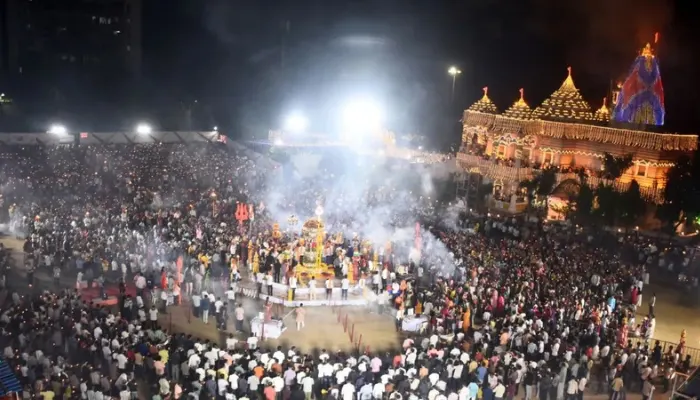
Case Summary
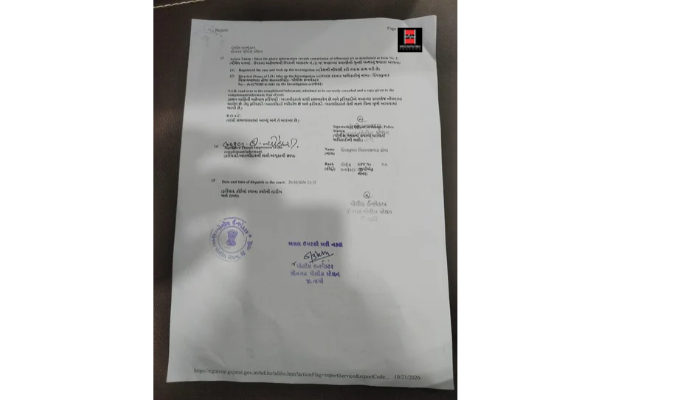
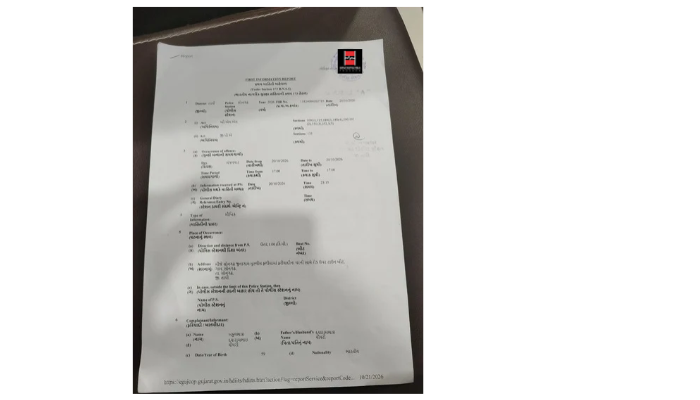
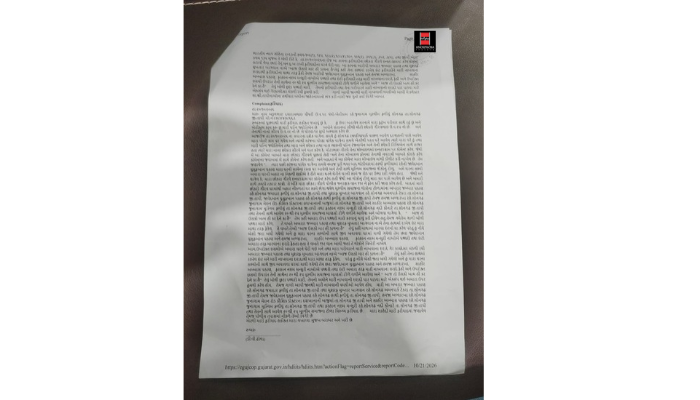
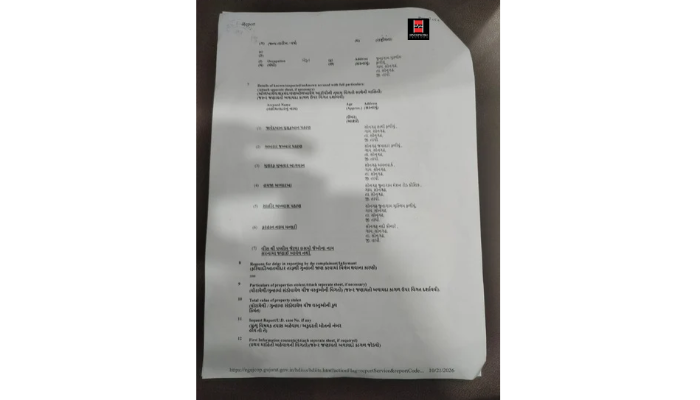
In Songadh, Tapi district, Gujarat, a Hindu youth named Gaurav Chaudhary was targeted for defending his faith. On 20 October 2026, a Muslim mob raised “Sar Tan Se Juda” slogans while attacking his house with stones and bricks. The assault was in retaliation for a post Gaurav Chaudhary posted on Instagram in which he merely responded to a Muslim man’s post mocking Navratri and Garba. The initial dispute was a verbal exchange that began after an Instagram page posted a video about a Muslim youth being caught at a Garba ground. A Muslim man left a mocking remark on the post, calling the Hindu religious event a “Garbhvati Pandal” (Garbhvati means pregnant in Hindi). Gaurav confronted the Muslim man over his denigrating remark by commenting about Halala, one of the tenets of Islam. After this, a verbal spat ensued between Gaurav and the Muslim man. In retaliation, Gaurav remarked about Mohammad and Aisha. Following the exchange, several Muslims approached Songadh Police Station and filed a complaint against Gaurav. Police subsequently visited his home and asked him to delete the comments, which he did. A Muslim man later visited Gaurav at his residence to discuss settling the dispute. However, on Tuesday (20 October) evening, after namaz, a crowd gathered from the mosque and proceeded toward the Hindu family’s home. According to reports, members of the crowd raised “Sar Tan Se Juda” slogans before attacking the house with stones and bricks. The mosque is approximately 50 metres from Gaurav’s residence. The surrounding area is Muslim-majority, with only five or six Hindu households, according to the account provided. As the crowd gathered and the attack began, Gaurav dialled 112. Police personnel arrived at the scene and took him to the police station. His father, 59-year-old Bakulbhai Dayarambhai Chaudhary, subsequently lodged a complaint, leading to the registration of an FIR at Songadh Police Station. In the FIR, the victim stated that at approximately 5:15 pm, a group of people gathered outside the family’s home in Junagam Muslim Faliyu. Bakulbhai, Javedkhan Yusufkhan Pathan, Abrar Jabbar Pathan, Mushraf Mukhtar Bagwan, Hamza Alwarkha, Sahir Abbas Pathan, and Farhan Naim Mansuri were among those involved, along with about 20–25 other individuals. The crowd shouted abuses and slogans like "sar tan se juda" and “aaj hi usko khatam hi kar dene ka hai” (Today we have to finish him off), before throwing stones and bricks at the house. The victim also stated that the attackers aimed at his head and intended to kill him and his family. He escaped injury by ducking, while his family rushed inside to protect themselves. The FIR registered on 20 October 2026 invoked Sections 109(1), 125, 189(2), 189(4), 190, 191(2), 351(3), 352 and 35(5) of the Bharatiya Nyaya Sanhita (BNS), along with Section 135 of the Gujarat Police Act. The investigation was assigned to Police Inspector Dipakkumar Visamabhai Dholara. The following day, police arrested nine adults and detained one minor in connection with the incident. Subsequent media reports identified the nine adults as Wasim Nasir Sheikh, Farhan Naim Mansuri, Shakir Abbas Pathan, Javed Khan Yusuf Khan Pathan, Musharraf Mukhtar Bagwan, Hamza Alla Rakha Sheikh, Farhan alias Adil Imtiyaz Mansuri, Tausif Yusuf Khatik and Altaf Qayum Mansuri. Police escorted the nine adults through the town with ropes tied around them and took them to the scene of the incident. Gaurav also identified a maulvi at the nearby mosque as the principal instigator of the attack. He stated that the maulvi had conducted a reconnaissance of the Hindu family’s residence before the incident. Police said they could add the maulvi’s name if the complainant filed a further complaint or if the investigation established his involvement. The incident prompted protests by Hindu organisations outside Songadh Police Station. Nilesh Chandrate, a representative of one such organisation, demanded the identification and arrest of everyone involved, including through an examination of video footage. Protesters also demanded action concerning illegal encroachments and businesses linked to the accused. Several organisations initially called for an indefinite shutdown of Songadh but withdrew the call after police assured them they would take action. Police deployed additional personnel in the town, and officers appealed to residents to maintain peace as the investigation continued.
Case Images
Why it is Hate Crime ?
The primary category selected for this case is: Hate speech against Hindus. The subcategory selected is: Anti-Hindu slurs, mocking faith. Anti-Hindu slurs and the deliberate mocking of the Hindu faith owing to religious animosity involve the use of derogatory terms, stereotypes, or offensive references to religious practices, symbols, or figures. One of the common anti-Hindu slurs used against Hindus is “cow-worshipper” and “cow piss drinker”. The intention of using this term is to demean and mock Hindus as a group and their religious beliefs, since Hindus consider the cow holy. Additionally, some symbols and the slurs attached to them have a historical context that exacerbates the insult, hate, stereotyping, dehumanisation and oppression against Hindus. Cow worship has been used for centuries to denigrate Hindus, insult their faith and oppress Hindus specifically as a religious group. There has been overwhelming documentation about how cow slaughter has been used to persecute Hindus, with cow meat being thrown in temples and places of worship. There has also been overwhelming documentation that cow meat (beef) has been force-fed to Hindus to either forcefully convert them to Islam or denigrate their faith. Apart from cow worship, the Swastika – which holds deep religious significance for the Hindus – has also been misinterpreted and distorted to be used as a slur against Hindus. Similarly, the worship of the Shivling has been used by supremacist ideologies and religions to denigrate Hindus owing to religious animosity. Such slurs and denigration stem from inherent animosity and hate towards Hindus and their faith; therefore, it is categorised as hate speech targeted at Hindus specifically owing to their religious identity. The other subcategory is: Violent threats. Violent threats, explicit, implicit or implied, is the most dangerous form of hate speech since it goes beyond discriminatory and prejudicial language to express the intent of causing harm to an individual or a group of people based on their religious identity and faith. There could be several different kinds of threats that are issued to Hindus based on religious animosity. An explicit threat would mean the direct threat of violence towards an individual Hindu, a group of Hindus or Hindus at large. Physical violence, death threats, threats of destruction of property belonging to Hindus and threats of genocide would mean explicit threats against Hindus for their religious identity. Implicit threats may not be a direct threat but implied through the use of symbols or actions – for example – in the Nupur Sharma case, other than explicit threats, there were also implicit threats when Islamists took to the streets to burn and beat her effigies. It implies that they want to do the same to Nupur Sharma; therefore, it is considered an implicit threat. Violent threats can be delivered in person, through letters, phone calls, graffiti, or increasingly through social media and other online platforms. It would be important to understand that a threat – explicit or implicit, online or offline – to an individual who happens to be a Hindu does not qualify as a religiously motivated threat. Such a threat, while vile and dangerous, could be owing to non-religious reasons and/or personal animosity. To qualify as a religiously motivated threat, it would need to exhibit an indication that the individual is being targeted for religious reasons and/or owing to his/her religious identity as a Hindu. The next primary category selected for this case is: Attack not resulting in death. The selected subcategory is: Attacked for opposing radicals or trying to save the victim. In several cases, Hindus are attacked for opposing religiously motivated crimes being committed against a fellow Hindu or simply for voicing an opinion opposing radical elements, who either have in the past or continue to persecute Hindus. In such cases, the initial attack against the victim, against which the Hindu was trying to defend the victim, would also need to be classified as a religiously motivated hate crime. Since the initial crime itself was religiously motivated and the subsequent crime of attempting to save the victim or speaking against the radical elements ends up inviting a violent attack, it would also be classified as a religiously motivated hate crime under this category. The other subcategory selected is: Attacked over 'Blasphemy'. Blasphemy essentially refers to the desecration of anything which is held sacred/holy to a group of people. However, for religious supremacist groups, the elements of ‘blasphemy’ are ever-changing, shifting and expanding – leading to infringement on the rights of other religious groups, freedom of speech and expression, threats and even physical violence. There are instances where blasphemy is also used as a dog whistle to target Hindus owing to intrinsic animosity towards Hinduism. There are several instances where stating truths as mentioned in the non-Hindu doctrine itself has led to unmitigated violence against Hindus. There have also been instances where non-Hindus have themselves created a ‘blasphemous’ situation, like placing a Quran in a temple, to use it as an excuse to attack Hindus. Essentially, Blasphemy charges are often made up and/or are used to shut down any form of criticism of non-Hindu faiths and as a tool to target Hindus. Any physical violence over Blasphemy charges against Hindus are foundationally based on animosity for Hindus and their faith owing to religious supremacist ideologies, therefore, such attacks would be documented as religious motivated hate crimes under this category. This case has been included in the Hinduphobia Tracker because a Hindu youth faced death threats and a violent attack on his family after defending his faith. It is important to establish that Gaurav Chaudhary did not initiate the verbal confrontation. His response came only after a Muslim social media user had published a post mocking his religious tradition. The dispute began when a Muslim man mocked Garba by referring to it as “Garbhvati Pandal”. Garba is a Hindu religious and cultural tradition associated with Navratri and devotion to the Goddess. Describing it as “Garbhvati Pandal” was a mockery of a Hindu religious observance. The Muslim man provoked Gaurav by denigrating a tradition integral to Hindu religious and cultural identity, and Gaurav’s subsequent response must be understood in this context. In retaliation, Gaurav raised the subject of halala, a practice rooted in Islamic scripture and jurisprudence concerning the rules governing remarriage after an irrevocable divorce, commonly associated with triple talaq. The Quran, in Surah Al-Baqarah (2:230), addresses the consequences of a third, irrevocable divorce. It states that a man cannot remarry a woman he has divorced for the third time unless she subsequently marries another man and that marriage is consummated before it ends. This provision forms the religious and legal basis of what is commonly known as nikah halala in Islamic jurisprudence. By invoking halala, Gaurav referred to a concept grounded in Islamic religious law; this is not equivalent to mocking a religion. As the dispute escalated, Gaurav also invoked Muhammad and Aisha. However, these remarks came only after he had been provoked by the Muslim man. His comments were made in retaliation and as a response to the denigration of his faith, rather than to incite violence or provoke a physical confrontation. When a person’s religious beliefs and traditions are ridiculed, a verbal response challenging the other person’s religious ideas is not equivalent to threatening that person’s life. The sequence of events is crucial: a Hindu religious tradition was mocked first, and Gaurav responded in kind. Whatever objections others may have had to his remarks, they did not confer any right to threaten his life or attack his family. Gaurav’s decision to delete his comments itself indicates that he had taken a step towards de-escalating the dispute. The Muslim social media user who had initiated the confrontation by mocking a Hindu religious tradition had not, according to this account, taken the same step. Despite Gaurav deleting the comments, a mob mobilised against him and his family. The subsequent escalation exposed the extreme hostility directed at Gaurav. Rather than allowing the disagreement to remain a verbal exchange, the group resorted to threats of lethal violence. The slogan “Sar Tan Se Juda”, which literally refers to separating the head from the body, constitutes a threat of beheading. It communicates that the targeted person should be killed by decapitation. Alongside the explicit threat, “Aaj hi usko khatam hi kar dene ka hai” (“Today we have to finish him off”), the slogan conveyed a direct threat to Gaurav’s life. The confrontation had by then moved far beyond a disagreement over religious beliefs or comments. The language invoked death as a response to the dispute, demonstrating the severity of the hostility directed at him. The group’s actions extended beyond verbal threats when its members gathered outside the family’s home and pelted the house with stones and bricks. Gaurav and his family were forced to take shelter inside as the attack unfolded. The resort to collective intimidation and physical violence reflected an alarming willingness to allow anger over religious remarks to override restraint and basic regard for human life. Instead of responding to a religious disagreement through counter-arguments or lawful means, the attackers brought the confrontation to a Hindu family’s doorstep and endangered its members. The death threats, beheading slogan and stone-pelting, taken together, demonstrate the gravity of the hostility directed at the family. Even if the men were offended by Gaurav’s remarks about Islam, that did not give them the right to threaten to kill him or attack his home. Hindus, too, have the right to speak up when their faith is mocked or insulted. If a comment about Islam can provoke such an extreme reaction, Hindus cannot be expected to remain silent when their own religious beliefs are ridiculed. The difference is that Gaurav responded with words; he did not threaten anyone’s life or mobilise a mob against those who had mocked his faith. Yet the response to his remarks escalated into death threats and a violent attack on his family. The right to respond to religious provocation cannot be reserved for one community while being denied to another, and taking offence at a religious comment can never justify threats of murder or physical violence. This incident also highlights how accusations of blasphemy can be weaponised to intimidate and persecute religious minorities, including Hindus. In Muslim-majority countries such as Pakistan and Bangladesh, blasphemy laws have been used against members of minority Hindu communities, exposing them to accusations, mob violence and social ostracism. A similar pattern of weaponising alleged religious offence to target Hindus is an alarming concern in India as well, where Islamist actors can invoke remarks about Islam to mobilise hostility and settle personal or ideological scores. The misuse of blasphemy allegations against Hindus can be driven by religious prejudice, with individuals being targeted on account of their religious identity. The present incident reflects this concern: a Hindu youth who responded after his faith was mocked became the target of death threats and a violent attack on his family. The Muslim mob disregarded the initial provocation and focused instead on Gaurav’s subsequent remarks. Those remarks were used as the basis for mobilising a group against him and launching a violent attack on his family. The sequence illustrates how a Hindu’s response to the denigration of his faith can be seized upon to justify intimidation and violence, while the original insult to the Hindu religious tradition is pushed aside. The case is therefore a clear example of anti-Hindu hostility, in which a Hindu youth’s response to the mockery of his faith was followed by threats to his life and violence against his family. The central issue is not merely the exchange of religious remarks, but the disproportionate and violent reaction directed at a Hindu family after a Hindu religious tradition had been ridiculed. The use of death threats, a beheading slogan and physical attacks to punish Gaurav for his response demonstrates the severity of the hostility and warrants the case’s inclusion in the Hinduphobia Tracker.
Victim Details
Total Victim
1
Deceased
0
Gender
- Male 1
- Female 0
- Third Gender 0
- Unknown 0
Caste
- SC/ST 0
- OBC 0
- General 0
- Unknown 1
Age Group
- Minor 0
- Adult 1
- Senior Citizen 0
- Unknown 0


Case Status
Case sub-judice


Perpetrators Details
Perpetrators
Muslim Extremists
Perpetrators Range
From 10 to 100
Perpetrators Gender
male
 Sources



