Durga idol immersion procession attacked with stones by Muslim mob in Washim, Maharashtra after accused get 'triggered' by throwing of gulal
 Washim, Maharashtra, India
 20 October, 2026
Case Summary
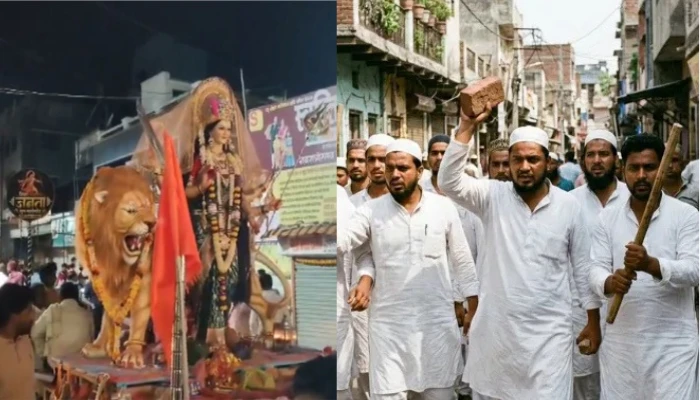
In Malegaon town of Washim district, Maharashtra, a Durga idol immersion procession was disrupted by stone pelting by Muslim men on 21 October 2026. The incident occurred near Tipu Sultan Chowk as Hindu devotees carried out the Durga Visarjan procession after the Navratri festival. The incident occurred between 8:30 and 10:00 PM as Hindu devotees passed through Tipu Sultan Chowk with the Durga idol. During the procession, the devotees threw gulal (coloured powder) as part of the celebrations, which accidentally fell on a few houses belonging to some Muslims near the procession route. Muslim individuals did not take this spiritedly and objected to the throwing of gulal. This led to a heated confrontation between members of the Hindu and Muslim communities. Subsequently, Muslim men hurled stones at the Hindu religious procession, disrupting the immersion celebrations. Thereafter, Hindus also retaliated, leading to a communal clash. Police personnel intervened promptly and brought the situation under control. A large crowd then gathered outside the Malegaon police station, demanding action against those responsible. The procession organisers initially insisted that the immersion rituals would not proceed until the accused were arrested. The police registered an FIR and began reviewing CCTV footage to identify those involved in the violence. To prevent further unrest, authorities deployed additional security forces, including the State Reserve Police Force (SRPF), Riot Control Police, and local police personnel, in the area. Following police intervention and security arrangements, the Durga idol immersion rituals were completed in the early hours of 22 October, between approximately 4:00 and 5:00 AM. Notably, the Hinduphobia Tracker has also recorded a similar case in which a Hindu man, Tarun, was brutally killed by Muslim men in Uttam Nagar, Delhi, after gulal was accidentally spilt on a Muslim woman during Holi celebrations. In what transpired, an 11-year-old girl from Tarun's family was playing Holi on the rooftop. During the festivities, she threw a water-filled balloon toward her father, who was standing below. However, the balloon fell on the road, and the water splashed onto a Muslim woman from a neighbouring family. The victim’s family said they apologised immediately, but she did not accept it. Instead, she called her relatives, after which the two sides began arguing. About an hour later, while Tarun was returning home on his motorcycle with a friend after playing Holi, a group of about 15 to 20 people stopped him on the road and brutally attacked him with iron rods, bricks, stones, and other objects. He was taken to the hospital after the assault, where he later died during treatment.
Why it is Hate Crime ?
The primary category selected in this case is- Attack not resulting in death. The subcategory selected is- Attack on Hindu religious procession. The outward celebration and display of religious symbols in an intrinsic part of Hinduism. Religious processions on various festivals are age-old traditions and a way to manifest faith and form a part of the religious practices of Hindus. On several occasions, such religious processions come under attack by non-Hindu mobs, in a manifestation of their animosity towards Hinduism and their practices. The reasons cited for such violent attacks are many and range from crossing a non-Hindu resident-dominated area to playing loud music, crossing from an area where there is a religious structure of another faith etc. The violent attacks are triggered by the outward display of religiosity by Hindus. The attacks are mainly a manifestation of religious supremacist doctrine which believes that idolatry, essentially the Hindu faith, is one that deserves to be annihilated since the very tenets of Hinduism, its practices and traditions are considered a sin in those doctrines. Since these attacks emanate from intrinsic and doctrinal animosity towards Hindus and Hinduism, it is considered a religiously motivated hate crime under this category. The other subcategory selected in this case is- Attack against Hindu devotees. Hindu devotees are a few of the easiest targets of religiously motivated hate crimes because during the festival/procession/puja etc, for non-Hindus it is easy to profile their victims on the basis of religion. Hindu devotees come under attack on several occasions by individual non-Hindus or mobs of non-Hindus owing to their animosity against Hinduism, its symbols and tradition/practices. There are several instances of Hindu devotees being attacked while they worship in temples or temporary religious structures, during religious processions, doing bhajan/kirtan/puja in their own homes, in the residential society etc. These attacks are perpetrated by non-Hindus primarily because of their animosity towards Hindus and their faith. In some cases, the trigger for the violence may be non-religious, however, there are two elements that make these hate crimes. First, the Hindus who come under attack are attacked violently while indulging in religious activity. Whether they are in a place of worship or not is immaterial to the crime. When individuals are attacked while indulging in religious practices, the attack in itself is a hindrance to their freedom to practice religion and therefore constitutes a hate crime. Secondly, religious supremacist doctrines and ideologies deem religious practices of Hindus to be offensive ab initio since they are considered “sinful” by these ideologies, worthy to be annihilated by force or coercion. Driven by these religious supremacist ideologies and doctrines, the attacks against Hindu devotees stem from intrinsic animosity towards Hinduism. In some cases, the trigger for the violence may be non-religious, however, it develops into a religiously motivated crime during the course of the violence. Since these attacks stem from animosity towards Hindus and Hinduism, they are considered religiously motivated hate crimes under this category. The other subcategory selected is- Attacked for crossing 'Muslim area'. One of the reasons that Hindus get attacked unprovoked specifically by Islamists is for crossing ‘Muslim areas’. Essentially, Muslim mobs often attack Hindus crossing or present in certain areas which have a majority Muslim population. It has often been cited as one of the reasons to blame Hindus for attacks against themselves, signalling that Hindus displaying religious symbols, taking our religious processions or crossing any area which is dominated by Muslim residents is a provocation in and of itself. These areas are mostly ghettoized areas where mobs mobilize quickly to attack Hindus for a variety of reasons like playing music during a religious procession, crossing a mosque, wearing a tilak or any other religious symbol in a Muslim-dominated area, praying at a local temple in that area etc. There have been cases where the few local Hindus of that area have been attacked on their way to the Temple for prayers as well, simply because the area is considered a Muslim-dominated area. Several times, it is entirely possible that the immediate trigger for the violence against Hindus was non-religious in nature, however, the violence became religiously motivated in nature because the area was Muslim dominated and the residents on the whole harboured animosity towards Hindus, evidenced from the actions of the mob, the slogans, and the nature of the attack. Such crimes are motivated by the religious identity of the victims and are therefore classified as hate crimes under this category. The other subcategory selected is- Communal Clash/Attack. Communal clash is a form of collective violence that involves clashes between groups belonging to different religious identities. For a communal clash between Hindus and non-Hindus to qualify as a religiously motivated hate crime, the trigger of the violence itself would have to be anti-Hindu in essence. For example, if there is a Hindu religious procession that comes under attack from a non-Hindu mob and after the initial attack, Hindus retaliate in self-defence, leading to a communal clash between the two religious communities. While at a later stage, both communities are involved in the clash/violence, the initial trigger of the violence was by the non-Hindu mob against the Hindus and therefore, it could safely be termed as an anti-Hindu violence. Further, the trigger would also have to be religiously motivated. In the cited example, the attack by the non-Hindu mob was against religious processions and therefore, can be concluded to be religiously motivated. In some cases, the trigger may be non-religious, however, it develops into religious violence against Hindus at a later stage. In such cases too, the foundational animosity towards Hindus becomes the motivating factor of the crime and therefore, it would be classified as a religiously motivated hate crime against Hindus under this category. This case was included in the Hinduphobia Tracker because Muslim men attacked a peaceful Hindu Durga Visarjan procession with stone-pelting, demonstrating hostility towards Hindu devotees publicly practising their faith. Durga Visarjan marks the culmination of Navratri, a sacred festival dedicated to Goddess Durga, who represents divine power, the victory of good over evil and the protection of Dharma. Carrying the Goddess’s idol for immersion is an act of devotion and an important part of Hindu religious tradition. Moreover, throwing gulal (coloured powder) is integral to Hindu religious processions, including Durga Visarjan. As devotees accompany Goddess Durga’s idol to the immersion site, they often celebrate with music, dancing, devotional chants and the throwing of gulal as an expression of joy, devotion and collective participation in the farewell to the Goddess. Therefore, throwing gulal is a form of religious and cultural celebration, not an act of provocation. Hindu devotees peacefully celebrated their faith, carrying out their procession without disrupting anyone. They had every right to observe their religious traditions and express their devotion in public. However, Muslim men turned an objection over gulal into violence against the procession. Instead of respecting the religious significance of the occasion and allowing the devotees to complete their observance, they resorted to stone-pelting. The deliberate disruption of a peaceful Hindu procession demonstrated hostility towards the public expression of Hindu faith. A Hindu religious celebration should not become a target for violence simply because it takes place in a public space or passes through an area dominated by another religious community. Moreover, the attack took place in a Muslim-dominated area, where Hindu devotees were carrying out their religious observance. Here, it is important to note that several Muslims consider an area that is predominantly occupied by them a "Muslim area". This reveals a disturbing sense of Islamic supremacy, where such people view the predominantly Muslim-occupied region as an exclusive zone where non-Muslims, particularly Hindus, were unwelcome. This sense of entitlement and superiority not only reflects deep-seated prejudice but also highlights an attempt to assert religious dominance over public spaces. The assault on the procession was motivated by this supremacist ideology, where Islamists in the area looked down upon Hindus, believing that they had the right to dictate who could move freely through their community. The trigger here might appear to be the throwing of the gulal, but the fact is that the Muslims' act of attacking the devotees and the procession also illustrates a dangerous mindset rooted in exclusion, intolerance and religious animosity. Targeting the procession with stones sent an intimidating message to the Hindu community that its religious practices were unwelcome in that area. Such violence served to instil fear among Hindu devotees, discourage them from expressing their faith openly and create an atmosphere in which they were made to feel vulnerable for practising their own religion. The attack also conveyed a message of intimidation, seeking to make Hindu devotees feel that their religious rights could be overridden through force. Another important aspect here is that the members of the Muslim community were the ones who initiated the attack by hurling stones at the Hindu devotees, who then attacked in self-defence and reprisal. Obviously, it was not the gulal thrown by the Hindu devotees that actually triggered the Islamists; in fact, that was only an excuse used by the perpetrators to target the procession because of the participants' religious identity. Such attacks are a form of symbolic aggression against the Hindu community that stems from an innate hatred for Hinduism. Given that the fundamental motivation behind these actions is contempt for Hindus and their religion, this instance has been added to the tracker under the following category.


Case Status
Complaint filed


Perpetrators Details
Perpetrators
Muslim Extremists
Perpetrators Range
From 10 to 100
Perpetrators Gender
male
 Sources



