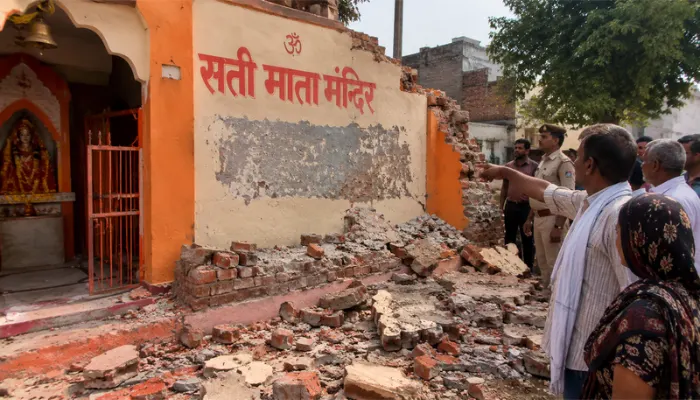
100-year-old Sati Mata temple wall demolished and temple name erased in Chhaprauli, Uttar Pradesh
 Baghpat, Uttar Pradesh, India
 20 October, 2026
Case Summary
In Chhaprauli, Baghpat, Uttar Pradesh, the wall of a 100-year-old Sati Mata temple belonging to the Kashyap community was demolished, and the temple's name written on the wall was erased. The incident triggered anger among residents, who gathered to protest and submitted a complaint at the police station, demanding action against those responsible for damaging the temple wall and erasing its name. Biram Singh, a resident, said repair and construction work was underway at the Kashyap community's Sati Mata temple when three people, including a woman living at the site, erased the temple's name from the wall and then demolished it. When Singh objected to the act, he was abused and threatened with being shot. The temple holds religious and ancestral significance for the local Kashyap community. Singh said it was more than 100 years old and housed the shrine of Mata Rani, along with sacred places associated with local families' ancestors. The demolition of the wall and erasure of the temple's name therefore angered residents, who demanded action against those involved. Following the complaint, investigating officer Inspector Prabhakar Kaintura said action would be taken based on the investigation.
Why it is Hate Crime ?
The primary category selected for this case is: Attack on Hindu religious representations. The subcategory selected is: Attack on Temples. In Hinduism, a temple is the abode of the Deity. The Deity in the Temple is consecrated, thereby making it a real, breathing entity. Hindus believe that not just the Deity but the temple premises themselves are sacred to Hindus, since Hindus hold the faith that the entire Temple space is an amalgamation of the divine energy of the deity. Given the central significance of Temples in Hindu Dharma, any attack against a Hindu Temple or its peripheral premises is an attack on the faith itself and is born out of animosity towards the faith, of which the Temple is a central tenet. Any manner of attack against a Temple and/or its premises would therefore be considered a religiously motivated hate crime. This incident exemplifies an attack on a Hindu religious representation, as the wall of the 100-year-old Sati Mata temple was demolished and the temple's name was erased. The destruction targeted part of a longstanding Hindu religious site associated with the worship of Sati Mata and the ancestral heritage of local Hindu families. The incident prompted anger among residents, who protested and approached the police demanding action against those responsible. In Hinduism, a temple is not merely a physical structure but a sacred abode of the deity and a focal point of religious devotion. The sanctity of a temple extends beyond the inner shrine to its surrounding premises, which devotees regard as part of the sacred religious space. The Sati Mata temple holds particular significance for the local Kashyap community, as the shrine is situated alongside sacred places associated with their ancestors. The demolition of its wall therefore affected a religious site connected to the community's worship, traditions and ancestral identity. Erasing the temple's name compounded the damage to the premises. A temple's name identifies its religious dedication and distinguishes the sacred site within the community's spiritual and cultural life. Removing that identification while demolishing part of the temple wall affected the physical premises and the visible identity of a century-old Hindu place of worship. Such damage to a Hindu temple cannot be treated merely as an alteration to an ordinary structure, given the religious significance the site holds for its devotees. Disclaimer: The Hinduphobia Tracker records the incident date. As the exact date of the incident is not known, 21st October, 2026, the date of the media report, has been taken as the indicative incident date for documentation purposes only. Disclaimer: For tracking purposes, the identities of the perpetrators have been kept unknown, as the available source does not provide their names or sufficient identifying details. The source identifies them only as three individuals, including a woman who resides at the temple site, whom resident Biram Singh held responsible for erasing the temple’s name from the wall and demolishing it. Because their names and other identifying details are unavailable, their identities have been recorded as unknown.


Case Status
Complaint filed


Perpetrators Details
Perpetrators
Unknown
Perpetrators Range
From 2 To 5
Perpetrators Gender
both
 Sources



