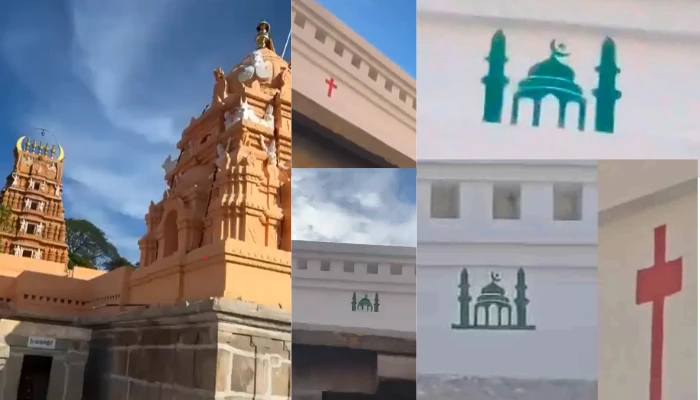
Historic Hindu Arkeshwara temple defiled; Christian crucifix and mosque symbol painted on temple wall in Mysuru, Karnataka
 Mysore, Karnataka, India
 18 October, 2026
Case Summary
In Mysuru, Karnataka, the historic Arkeshwara Temple was defiled with a red Christian crucifix (cross) and a green mosque symbol painted on the inner wall. The temple falls under the Hindu Religious Institutions and Charitable Endowments Department, run by the Congress Government of Karnataka. The paintings came to light after a social media post went viral. According to reports, renovation work at the temple was underway. A red cross and a green mosque image appeared on a wall within the temple compound. The paintings prompted objections from sections of the local Hindu community, with residents questioning the decision to depict symbols associated with other religions within a Hindu place of worship. The controversy gained momentum during the Mysuru Dussehra period, attracting wider attention and public debate. Members of local Hindu groups objected and sought an explanation for the religious symbols on the temple wall. Following the objections, K.R. Nagar Tahsildar Surendra Murthy visited the temple and inspected the site. He said police personnel were present during the inspection. “Upon learning of the matter, we visited the spot along with police officials and conducted a panchanama. Both the images were immediately erased to restore the temple’s wall,” Surendramurthy said. Subsequently, a police complaint was lodged against Arati, the temple parupattedar (administrator), and Vinay, the artist who painted the symbols. Based on the complaint, K.R. Nagar police registered a First Information Report (FIR) against the two accused. The police began an investigation.
Why it is Hate Crime ?
The primary category selected in this case is- Attack on Hindu religious representations. The sub-category this case falls under is- Desecration of Hindu religious symbols. Icons and symbols or a religious representation of a spiritual ideal are widely revered in Hinduism. Iconography is of vital significance in the Hindu milieu. It helps connect people’s spiritual beliefs with the real world. Iconography within the Hindu faith takes several shapes and forms. Murtis are of most significance to Hindus, to which daily rituals, prayers and offerings are done. Besides the murtis, there are several other symbols which have deep significance in the Hindu faith – the Om and Swastika for example. Since these Hindu religious symbols hold paramount importance in Hinduism, any desecration of symbols, icons, murtis, religious representations and manifestations, is driven by animosity towards the faith itself which manifests itself through these murtis, icons and symbols. Therefore, any desecration of these Hindu religious symbols and representations is considered religiously motivated hate crimes under this category. The other sub-category selected here is - Attack on temples. In Hinduism, a temple is the abode of the Deity. The Deity in the Temple is consecrated, thereby, making it a real, breathing entity. Hindus believe that not just the Deity but the temple premises itself are sacred to Hindus since Hindus hold the faith that the entire Temple space is an amalgamation of the divine energy of the deity. Given the central significance of Temples in Hindu Dharma, any attack against a Hindu Temple or its peripheral premises is an attack on the faith itself and is born out of animosity towards the faith, of which, the Temple is a central tenet. Any manner of attack against a Temple and/or its premises would therefore be considered a religiously motivated hate crime. The other subcategory selected is- Defiling religious customs. Sanatan Dharma is not a religion of one book, which is to say that while it has religious scriptures that form the central tenets of the faith, there are several traditions followed through thousands of years, mostly passed from generation to generation orally. There are several such customs and traditions that are followed by various Hindus and Hindu sects. Defiling of these traditions and customs is a breach of an individual or group’s religious practices. Such practices can range from dietary restrictions like not eating non-vegetarian food for a certain period of the year, not eating non-vegetarian food at all, not eating beef since the cow is considered holy in Hinduism, the sanctity of religious customs followed in the house (like many ISCKON devotees), etc. Any malicious action leading to the breach of such traditions or defilement of these traditions owing to animosity towards the faith or for the sake of activism stems not only from the lack of faith in the religion itself but also from disregard for the faith of the devotees who follow the customs/traditions and implicit bias against the faith, the tradition itself. Since these specific traditions are central to the faith of the devotees of that specific sect of Hindus, any non-compliance with these traditional rules would be considered a religiously motivated hate crime. This case was included in the Hinduphobia Tracker because the historic Hindu Arkeshwara Temple, also known as the Sri Meenakshi Sametha Arkeshwara Temple, was defiled with symbols of a Christian cross and a mosque painted on its wall. It violated the sanctity and established religious character of a sacred Hindu place of worship. The Arkeshwara Temple holds historical and religious significance for Hindus. In Hinduism, a temple is a consecrated abode of the Deity, where devotees offer prayers and perform religious rituals. Its sanctity extends beyond the presiding Deity to the temple premises, which form an integral part of the sacred space. Painting symbols associated with Christianity and Islam within this historic Hindu temple was a blatant violation of its religious character and the customs governing its use as a place of Hindu worship. The temple was not an ordinary wall or public space where religious imagery could be added without regard for its purpose; it was a sacred space dedicated to Hindu religious practice. Furthermore, introducing images of a Christian cross and a mosque into the temple premises disregarded the religious identity of the site and the sentiments of Hindu devotees. The issue was not simply the presence of symbols belonging to other religions, but their placement within a consecrated Hindu temple, where the surroundings were expected to remain consistent with its sacred purpose. Tampering with the temple wall in this manner violated the sanctity that Hindus attached to the temple and interfered with the religious environment in which they practised their faith. Religious symbols carry deep spiritual and emotional significance for the communities that revere them. For Hindus, the Swastika is an auspicious and sacred symbol associated with prosperity and well-being. Placing it inside a church or a mosque would, therefore, be unwelcome by Christians and Muslims, as for them, it would interfere with their faith. Similarly, a Christian cross and a mosque are not random images but representations of distinct religious faiths. Their placement within a consecrated Hindu temple disregarded the temple’s religious identity and desecrated the sanctity and sentimental value Hindus attached to their place of worship. Every religious symbol carries beliefs, traditions and emotions, and introducing symbols associated with other faiths into a Hindu temple without regard for its sacred character amounted to a blatant disregard for Hindu religious sentiments. Disclaimer: The Hinduphobia Tracker records the incident date based on when the victim’s ordeal began rather than when the media reported the incident. The available sources do not specify the exact date the incident began. Therefore, 19 October 2026, when it was reported in the media, has been selected as the indicative incident date for documentation purposes only.


Case Status
Complaint filed


Perpetrators Details
Perpetrators
Others
Perpetrators Range
From 2 To 5
Perpetrators Gender
both
 Sources



