Hindu diety Maa Durga's idol immersion procession obstructed and devotees assaulted by Muslims in Kandivali East, Mumbai
 Mumbai, Maharashtra, India
 20 October, 2026
Case Summary
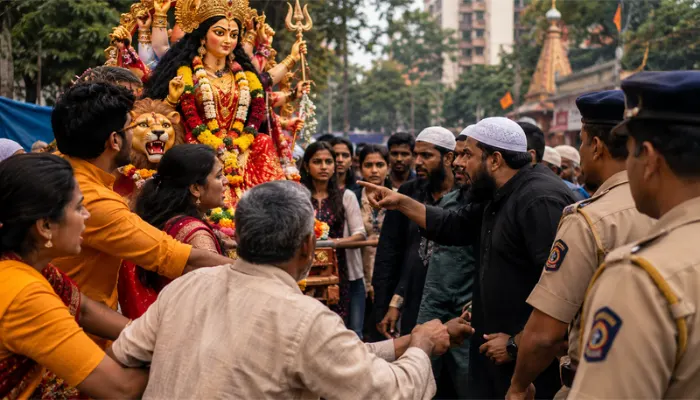
In Kandivali East, Mumbai, Hindu devotees carrying an idol of Maa Durga for immersion were stopped and assaulted near Vishwakarma Temple on Vadar Pada Road No. 1. The incident took place as the devotees were proceeding towards Dahanukarwadi, Kandivali, to immerse the idol. According to the social media account Treeni, Mohammad Irfan and three to four other Muslim men obstructed the procession. When Hindu men tried to speak to the group and asked them not to stop the immersion procession, the men refused to let it proceed. They brought several girls and positioned them at the front of the procession to block the devotees from moving forward. The men abused the Hindu devotees and made objectionable remarks insulting Maa Durga. They also assaulted Hindu women and attacked an elderly Hindu man. Kandivali Police present there remained mere onlookers during the confrontation, instead of intervening to stop the obstruction and assaults. Following the incident, members of the Hindu group approached the police to lodge a complaint. Hinduphobia Tracker contacted Treeni, who confirmed that the police refused to accept a written complaint and did not register an FIR.
Why it is Hate Crime ?
The primary category selected for this case is: Attack not resulting in death. The subcategory selected is: Attack on religious procession. The outward celebration and display of religious symbols in an intrinsic part of Hinduism. Religious processions on various festivals are age-old traditions and a way to manifest faith and form a part of the religious practices of Hindus. On several occasions, such religious processions come under attack by non-Hindu mobs, in a manifestation of their animosity towards Hinduism and their practices. The reasons cited for such violent attacks are many and range from crossing a non-Hindu resident-dominated area to playing loud music, crossing from an area where there is a religious structure of another faith etc. The violent attacks are triggered by the outward display of religiosity by Hindus. The attacks are mainly a manifestation of religious supremacist doctrine which believes that idolatry, essentially the Hindu faith, is one that deserves to be annihilated since the very tenets of Hinduism, its practices and traditions are considered a sin in those doctrines. Since these attacks emanate from intrinsic and doctrinal animosity towards Hindus and Hinduism, it is considered a religiously motivated hate crime under this category. The next subcategory selected is: Attack against Hindu devotees. Hindu devotees are a few of the easiest targets of religiously motivated hate crimes because during the festival/procession/puja etc, for non-Hindus it is easy to profile their victims on the basis of religion. Hindu devotees come under attack on several occasions by individual non-Hindus or mobs of non-Hindus owing to their animosity against Hinduism, its symbols and tradition/practices. There are several instances of Hindu devotees being attacked while they worship in temples or temporary religious structures, during religious processions, doing bhajan/kirtan/puja in their own homes, in the residential society etc. These attacks are perpetrated by non-Hindus primarily because of their animosity towards Hindus and their faith. In some cases, the trigger for the violence may be non-religious, however, there are two elements that make these hate crimes. First, the Hindus who come under attack are attacked violently while indulging in religious activity. Whether they are in a place of worship or not is immaterial to the crime. When individuals are attacked while indulging in religious practices, the attack in itself is a hindrance to their freedom to practice religion and therefore constitutes a hate crime. Secondly, religious supremacist doctrines and ideologies deem religious practices of Hindus to be offensive ab initio since they are considered “sinful” by these ideologies, worthy to be annihilated by force or coercion. Driven by these religious supremacist ideologies and doctrines, the attacks against Hindu devotees stem from intrinsic animosity towards Hinduism. In some cases, the trigger for the violence may be non-religious, however, it develops into a religiously motivated crime during the course of the violence. Since these attacks stem from animosity towards Hindus and Hinduism, they are considered religiously motivated hate crimes under this category. The next primary category selected for this case is: Hate speech against Hindus. The subcategory selected is: Anti-Hindu slurs, mocking faith. Anti-Hindu slurs and the deliberate mocking of the Hindu faith owing to religious animosity involve the usage of derogatory terms, stereotypes, or offensive references to religious practices, symbols, or figures. One of the common anti-Hindu slurs used against Hindus is “cow-worshipper” and “cow piss drinker”. The intention of using this term is to demean and mock Hindus as a group and their religious beliefs, since Hindus consider the cow holy. Additionally, some symbols and the slurs attached to them have a historical context that exacerbates the insult, hate, stereotyping, dehumanisation and oppression against Hindus. Cow worship has been used for centuries to denigrate Hindus, insult their faith and oppress Hindus specifically as a religious group. There has been overwhelming documentation about how cow slaughter has been used to persecute Hindus, with cow meat being thrown in temples and places of worship. There has also been overwhelming documentation that cow meat (beef) has been force-fed to Hindus to either forcefully convert them to Islam or denigrate their faith. Apart from cow worship, the Swastika – which holds deep religious significance for the Hindus – has also been misinterpreted and distorted to be used as a slur against Hindus. Similarly, the worship of the Shivling has been used by supremacist ideologies and religions to denigrate Hindus owing to religious animosity. Such slurs and denigration stem from inherent animosity and hate towards Hindus and their faith; therefore, it is categorised as hate speech targeted at Hindus specifically owing to their religious identity. This case has been included in the Hinduphobia Tracker because Hindu devotees carrying an idol of Maa Durga for immersion were obstructed, subjected to abuse and physically assaulted, while insults were also directed at the Hindu Goddess. Maa Durga occupies an exalted position in Hinduism as the embodiment of Shakti, divine power, courage, protection and the triumph of good over evil. Devotees worship her sacred form with deep devotion, particularly during Navratri and Durga Puja, when they offer prayers, celebrate her divine power, and participate in religious processions. The idol the devotees carried was therefore not an ordinary object being transported through a public street, but a sacred representation of the goddess. Obstructing her immersion procession and insulting Maa Durga showed contempt for the religious significance of her form and the beliefs of the devotees who worship her. Disrespect toward a revered deity strikes at the heart of Hindu religious reverence because the sacred representation embodies the faith, devotion, and spiritual connection of worshippers. Second, immersing Maa Durga’s idol is an integral part of the Durga Puja tradition. It marks the conclusion of the worship and is accompanied by established religious practices through which devotees express their devotion and bid farewell to the goddess. Such customs carry spiritual and cultural significance and are preserved through generations of Hindu religious life. Deliberately obstructing devotees as they carry out this observance interferes with their ability to practise their faith and imposes an unwarranted barrier upon a religious tradition. Hindu religious customs do not lose their sanctity simply because they take place in public spaces. The freedom to practise Hinduism includes the right to participate in religious processions and complete customary rituals without intimidation, abuse, or forcible prevention. Moreover, the insulting remarks directed at Maa Durga gave the incident a further dimension of hostility towards Hindu religious beliefs. A deity revered by millions of Hindus is not merely a subject of personal opinion; she holds profound spiritual significance for an entire religious community. Using insulting language against such a figure demeans what Hindu devotees consider sacred and turns their religious identity into a target of contempt. Disagreement with Hindu beliefs does not justify mocking a Hindu deity or humiliating those who worship her. When religious figures are deliberately insulted in a confrontation involving Hindu devotees, the conduct goes beyond an ordinary disagreement and becomes an attack on the dignity of the faith and its followers. The incident's significance also lies in its combined treatment of Hindu worship, religious custom, and sacred belief. The obstruction of the procession interfered with a religious observance, while the insults directed at Maa Durga demeaned the deity at the centre of that observance. The physical assault on Hindu devotees further intensified the intimidation faced by those participating in the procession. These acts must be understood in the context of the religious practice and beliefs being targeted, rather than dismissed as a routine public altercation. The devotees’ subsequent attempt to secure formal police action, as described in Treeni’s account, also left their complaint without the formal response they sought. The incident therefore raises concerns not only about hostility towards Hindu religious expression, but also about the protection available to devotees when they seek a solution after such an incident. Disclaimer: The Hinduphobia Tracker records incidents based on when an event occurred or when the victim’s ordeal began. None of the media sources covering this case has specified the exact date of the incident. Therefore, for documentation purposes, we have used 21 October 2026 as the indicative incident date. Disclaimer: Perpetrator count is set at 4 for tracking purposes, as the Twitter source Treeni identified Mohammad Irfan and 3–4 other men, leaving the exact number of perpetrators unclear.


Case Status
Complaint not filed


Perpetrators Details
Perpetrators
Muslim Extremists
Perpetrators Range
From 2 To 5
Perpetrators Gender
male
 Sources



